
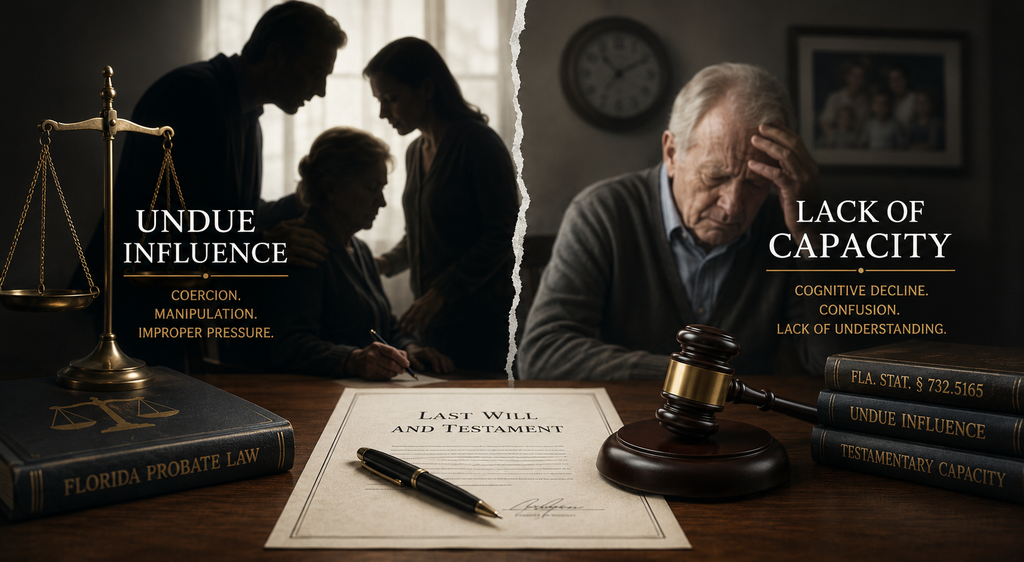
Under Florida probate law, contesting a will means filing a formal legal petition in court to declare a deceased person’s last will and testament void. Under Fla. Stat. § 732.5165, a court can invalidate an entire will,or specific clauses within it,if the document does not represent the free and uncoerced intent of a mentally sound person.
To understand how Florida probate courts evaluate these challenges, it helps to define key legal concepts:
- Testator: The individual who created and signed the will.
- Probate: The court-monitored legal process used to settle debts and distribute a deceased person’s property.
- Interested Person: An individual with a financial or legal stake in the estate (such as an heir, disinherited child, or surviving spouse) who holds the legal right to challenge the document.
The two most frequent legal grounds for challenging a Florida will are undue influence and lack of testamentary capacity.
- Undue Influence applies when the testator had mental capacity, but a third party used pressure, manipulation, or coercion to replace the testator’s true wishes with their own.
- Lack of Capacity applies when the testator suffered from cognitive decline (such as advanced dementia or severe intoxication) and lacked the mental sharpness required to understand what they were signing.
Key Differences: Undue Influence vs. Lack of Capacity in Florida Probate
| Legal Element | Undue Influence | Lack of Testamentary Capacity |
| Primary Statutory Basis | Fla. Stat. § 732.5165 (Void if execution is procured by undue influence) | Fla. Stat. § 732.502 (Execution standards requiring sound mind) |
| Core Legal Focus | Did a third party manipulate or coerce the testator’s decision-making? | Did the testator lack the basic mental understanding to execute a legal document? |
| Key Controlling Case | In re Estate of Carpenter, 253 So. 2d 697 (Fla. 1971) | In re Estate of Dunson, 141 So. 2d 601 (Fla. 2d DCA 1962) |
| Burden of Proof Shift | Presumption arises if the influencer held a confidential relationship, gained a substantial benefit, and actively procured the will (Fla. Stat. § 733.107(2)) | The law presumes sanity; the burden remains on the contestant throughout the case. |
| Relevant Timeline | Court examines the period of coercion leading up to and during execution. | Court examines mental state strictly at the exact moment of execution. |
| Effect of “Lucid Intervals” | Irrelevant if the influencer controlled or coerced the testator’s mind. | A will signed during a temporary window of clarity is valid, even with a dementia diagnosis. |
Proving Undue Influence in a Florida Will Contest (The Carpenter Rule)
Undue influence occurs when a third party exercises persuasion that overpowers the testator’s free agency, effectively forcing them to sign an estate document they otherwise would not have created.
Burden Shifting Under Fla. Stat. § 733.107(2): When a contestant proves that a primary beneficiary shared a confidential relationship with the testator and actively procured the contested will, a legal presumption of undue influence applies. The burden of proof then shifts to the beneficiary to prove the will was not the result of undue influence.
In In re Estate of Carpenter, the Florida Supreme Court established seven non-exclusive criteria to determine if a beneficiary “actively procured” a will:
- Presence at Execution: The beneficiary was in the room when the will was signed.
- Presence During Expressions of Intent: The beneficiary was present when the testator voiced desires to make or change a will.
- Attorney Recommendation: The beneficiary selected, hired, or recommended the lawyer who drafted the document.
- Prior Knowledge of Terms: The beneficiary knew the specific terms of the will before execution.
- Directing Draft Instructions: The beneficiary gave specific drafting instructions to the estate planning attorney.
- Procuring Witnesses: The beneficiary chose or brought in the attesting witnesses.
- Holding Document Custody: The beneficiary kept possession of the signed original document after execution.
Subsequent Florida decisions also recognize isolation of the testator from family members, mental inequality between parties, and sudden, unexpected changes to long-standing estate plans as supporting indicators of active procurement.
Proving Lack of Testamentary Capacity in Florida Probate Courts
Testamentary capacity requires that a testator possess a “sound mind” at the specific moment of executing a will. Under Florida case law (Skelton v. Davis, 133 So. 2d 432), courts evaluate three distinct requirements to determine if capacity existed:
- Understanding Property Extent: The testator generally understood the nature and approximate value of their assets.
- Recognizing Natural Heirs: The testator understood their family structure and recognized individuals who naturally expect to inherit (Hendershaw v. Estate of Hendershaw, 763 So. 2d 482).
- Understanding the Act’s Practical Effect: The testator understood that signing the document would permanently transfer property upon death.
The legal bar for testamentary capacity in Florida is relatively low. Medical records showing diagnoses of vascular dementia, Alzheimer’s, or memory loss do not automatically prove lack of capacity. If the testator signed the will during a temporary period of mental clarity—known legally as a “lucid interval”—the document remains valid (Scott v. Young, 2024 WL 4395136).
Florida Will Contest Deadlines and Circuit Court Jurisdiction
Will contests are litigated within the Probate Division of the Florida Circuit Court holding local jurisdiction, such as the 11th Judicial Circuit (Miami-Dade County), the 15th Judicial Circuit (Palm Beach County), or the 17th Judicial Circuit (Broward County).
Florida probate rules enforce strict, short deadlines for filing a challenge:
- 3-Month Notice of Administration Deadline: Under Fla. Stat. § 733.212(3), once a Personal Representative serves an interested person with a formal Notice of Administration, any claim contesting the validity of the will must be filed within 3 months. Failure to file within this window permanently waives the right to contest.
- 20-Day Formal Notice Deadline: If a petition for administration is served via Formal Notice under Fla. Prob. R. 5.040 prior to the will being admitted to probate, the recipient has only 20 days from the date of receipt to file formal objections.
What Happens When a Florida Will is Invalidated?
When a circuit court judge rules that a will is void due to undue influence or lack of testamentary capacity under Fla. Stat. § 732.5165, Florida law dictates specific outcomes for property distribution:
- Reinstatement of a Prior Valid Will: If the decedent executed an earlier, legally valid will before the contested document was signed, the court may reinstate the prior document under the doctrine of Dependent Relative Revocation (In re Estate of Pratt, 88 So. 2d 499).
- Distribution Under Florida Intestacy Laws: If no prior valid will exists, the decedent’s estate is administered under Florida intestacy statutes (Fla. Stat. § 732.101). Assets pass to statutory heirs according to family hierarchy, starting with surviving spouses and lineal descendants.
- Partial Invalidation: Under Fla. Stat. § 732.5165, if undue influence affected only a specific clause or devise within the will (such as an isolated bequest to an influencer), the court can invalidate that specific section while upholding the remainder of the document.
- Award of Attorney Fees and Costs: Under Fla. Stat. § 733.106(3), an attorney who renders legal services that result in a tangible benefit to an estate—including successfully contesting an invalid will to restore legal distribution—may petition the court to receive reasonable attorney fees and court costs paid directly from estate assets.
Retaining South Florida Probate Litigation Counsel
Initiating or defending a will contest requires immediate action to secure medical evidence, subpoena financial records, collect witness depositions, and meet strict filing deadlines enforced by local probate courts. Reinfeld Cabrera Tison represents beneficiaries, disinherited heirs, and fiduciaries in estate litigation across South Florida.
- Office Address: 9625 W Sample Rd, Coral Springs, FL 33065
- Contact Phone: (954) 866-4878 or 954-866-HURT
- Circuit Court Venues Served: 17th Judicial Circuit Court (Broward County Courthouse, Fort Lauderdale), 11th Judicial Circuit (Miami-Dade County), 15th Judicial Circuit (Palm Beach County), and 16th Judicial Circuit (Monroe County).