
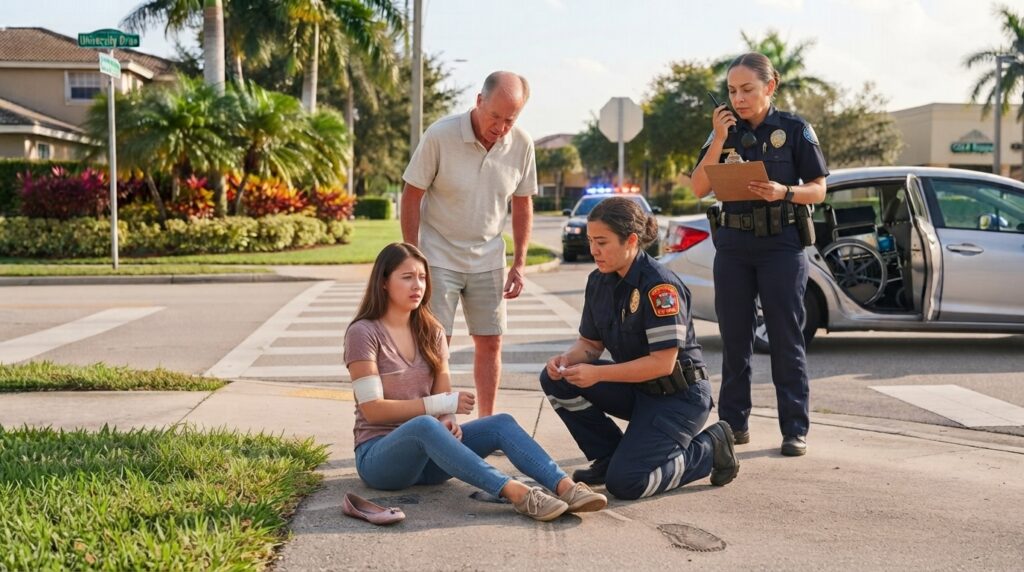
Helping Injured Pedestrians in South Florida Protect Their Rights
Being hit by a car, truck, bus, or other motor vehicle can cause devastating injuries. Unlike vehicle occupants, pedestrians have little physical protection from the force of a collision.
A crash that lasts only seconds can result in traumatic brain injuries, spinal injuries, fractures, internal injuries, permanent disability, or death.
At Reinfeld Cabrera Tison, our personal injury attorneys represent pedestrians injured in motor vehicle crashes throughout Coral Springs, Fort Lauderdale, Broward County, and surrounding South Florida communities. We investigate how the collision happened, identify the parties who may be responsible, and pursue compensation for the losses supported by the facts and applicable Florida law.
Florida Pedestrian Accident Statistics
Pedestrians remain among the most vulnerable people using Florida’s roads. According to the Florida Department of Transportation, 678 pedestrians were killed and 1,343 sustained serious injuries in crashes in 2024.
FDOT reported that pedestrian and bicyclist deaths together represented 28% of Florida traffic fatalities between 2019 and 2023.
These numbers are a reminder of how serious a pedestrian collision can be. For an injured person and their family, the consequences may continue long after the crash itself.
Quick Answers About Florida Pedestrian Accident Claims
What happens if I am hit by a car while walking in Florida?
A pedestrian injured by a motor vehicle may have claims for medical expenses, lost income, pain and suffering, and other damages depending on the circumstances. Florida law also provides certain personal injury protection benefits to people who are struck by a motor vehicle while not occupants of a self-propelled vehicle, subject to the requirements and limitations of the PIP statute.
Do pedestrians always have the right of way in Florida?
No. Florida law gives pedestrians the right of way in certain crosswalk and traffic-signal situations, but it also imposes duties on pedestrians. For example, a pedestrian crossing outside a marked or unmarked crosswalk at an intersection generally must yield to vehicles. At the same time, Florida law separately requires drivers to exercise due care to avoid colliding with pedestrians.
Can I recover compensation if I was partly responsible for the accident?
Possibly. Florida’s comparative fault statute generally reduces damages according to the claimant’s percentage of fault. In a negligence action, however, a party found to be more than 50% at fault for their own harm may not recover damages.
How long do I have to file a pedestrian accident lawsuit in Florida?
A standard negligence action generally must be commenced within two years under Florida Statute §95.11. Different deadlines can apply to certain claims, including claims involving governmental entities, so the specific facts of the accident matter.
Florida Pedestrian Accident Laws
Determining who is legally responsible after a pedestrian collision requires more than asking whether the pedestrian was in a crosswalk. Florida law establishes responsibilities for both drivers and pedestrians, and the facts surrounding the collision determine how those rules apply.
When Does a Pedestrian Have the Right of Way?
Florida Statute §316.130 establishes several situations in which drivers must yield to pedestrians.
At a signalized intersection, a driver must stop and remain stopped to allow a pedestrian with a permitted signal to cross in the circumstances described by the statute. At crosswalks where the applicable conditions are met, drivers must slow down or stop to yield to pedestrians crossing the roadway.
The law also establishes responsibilities for pedestrians. A pedestrian crossing outside a marked crosswalk or an unmarked crosswalk at an intersection generally must yield the right of way to vehicles. A pedestrian may also violate the statute by suddenly entering the path of a vehicle that is too close for the driver to yield safely.
The important point is that being outside a crosswalk does not automatically answer the question of legal responsibility. Investigators and insurers must consider what the pedestrian and driver were doing, the location and timing of the collision, traffic conditions, visibility, speed, and other evidence.
Florida Drivers Have a Duty to Exercise Due Care
Florida Statute §316.130(15) provides that every driver must exercise due care to avoid colliding with a pedestrian and must give warning when necessary.
Florida appellate courts have recognized that this statutory duty can be relevant to determining negligence. In Goddard v. J.S.J. Unlimited, LLC, the Sixth District Court of Appeal held that evidence supporting a violation of §316.130(15) could support a jury instruction concerning the driver’s duty to use reasonable care to avoid colliding with a pedestrian.
That means the investigation should not stop at the question of whether the pedestrian technically followed every crossing rule. The driver’s conduct and the circumstances surrounding the collision also matter.
Can I Recover Compensation If I Was Not in a Crosswalk?
Yes, potentially.
Florida law does impose responsibilities on pedestrians who cross outside designated crosswalks. However, a pedestrian’s location at the time of the collision does not by itself establish that the pedestrian was entirely responsible for the crash.
Florida’s comparative fault statute provides that a claimant’s damages generally are reduced in proportion to the claimant’s percentage of fault. A person found to be more than 50% at fault for their own harm may not recover damages in a negligence action covered by the statute.
For that reason, a pedestrian should not assume that an insurance company’s allegation of “jaywalking” means the claim has no value. Fault must be evaluated using the evidence and the applicable law.
Does PIP Insurance Cover Pedestrians in Florida?
Florida’s no-fault insurance law can provide personal injury protection (PIP) benefits to certain people who are struck by a motor vehicle while not occupying a self-propelled vehicle. Under Florida Statute §627.736, qualifying PIP coverage provides up to $10,000 in medical and disability benefits and includes specified death benefits, subject to statutory requirements, exclusions, priority rules, and policy terms.
The statute also generally requires an injured person seeking PIP medical benefits to receive initial services and care within 14 days after the motor vehicle accident to qualify for those benefits under the statutory framework.
PIP is not necessarily the end of a pedestrian injury claim. Depending on the circumstances, an injured pedestrian may also have a claim against a negligent driver or another responsible party for damages not fully covered by available insurance.
Because insurance coverage, priority, and liability can become complicated quickly, it is important to evaluate the specific policies and circumstances involved.
What Causes Pedestrian Accidents in Florida?
Pedestrian collisions can happen in many different ways. Common contributing factors include:
Failure to Yield
Drivers may fail to yield to pedestrians in crosswalks, at intersections, or while making turns.
Distracted Driving
Looking at a phone, adjusting navigation, interacting with passengers, or other distractions can prevent a driver from seeing a pedestrian in time to react.
Speeding
Higher speeds reduce the time available to recognize a pedestrian and increase the severity of an impact when a collision occurs.
Impaired Driving
Alcohol, drugs, or other forms of impairment can affect perception, reaction time, judgment, and vehicle control.
Turning and Intersection Collisions
A pedestrian may be struck when a driver turns through an intersection without adequately checking the crosswalk or surrounding roadway.
Poor Visibility
Nighttime conditions, glare, weather, inadequate lighting, obstructions, and other visibility problems can affect both drivers and pedestrians.
Dangerous Roadway Conditions
In some cases, the facts may raise questions about roadway design, construction, signage, lighting, or other conditions that contributed to a collision.
What Injuries Can a Pedestrian Accident Cause?
A pedestrian struck by a motor vehicle can suffer injuries ranging from relatively minor trauma to permanent and life-altering conditions.
Common injuries include:
- Traumatic brain injuries and concussions
- Skull and facial fractures
- Spinal cord and back injuries
- Broken legs, arms, hips, and pelvis
- Internal bleeding and organ injuries
- Nerve and soft-tissue damage
- Severe lacerations and road rash
- Permanent disability
- Psychological trauma
Some injuries may not become fully apparent immediately after a crash. Medical evaluation and appropriate follow-up care are therefore important even when the initial symptoms appear manageable.
What Compensation Can a Pedestrian Accident Victim Recover?
Every case is different, and the damages available depend on the injuries, losses, liability, and other facts. A pedestrian accident claim may involve compensation for:
Medical Expenses
Emergency treatment, hospitalization, surgery, rehabilitation, medication, follow-up care, and other medically necessary treatment.
Lost Income
Income lost because injuries prevent the victim from working.
Reduced Earning Capacity
Where injuries affect a person’s ability to earn income in the future, the claim may involve future economic losses.
Pain and Suffering
Serious physical injuries can result in substantial pain, limitations, and emotional consequences.
Other Applicable Damages
Depending on the circumstances, a claim may also involve other economic or non-economic losses recognized under Florida law.
When a pedestrian dies because of a collision, the legal analysis changes and surviving family members may have rights under Florida’s wrongful death laws.
How Is Fault Proven in a Pedestrian Accident?
The initial police report is only one piece of evidence.
A thorough investigation may examine:
- Police and crash reports
- Photographs and video from the scene
- Nearby business or residential surveillance footage
- Traffic-camera footage when available
- Eyewitness accounts
- 911 recordings
- Traffic-signal timing
- Vehicle damage
- Skid marks and other physical evidence
- Lighting and visibility conditions
- Roadway design and conditions
- Driver statements
- Vehicle data or other electronic evidence when available
- Accident reconstruction and expert analysis when warranted
- Medical records and injury evidence
At Reinfeld Cabrera Tison, investigating a pedestrian accident means looking beyond an insurance company’s initial version of events. Evidence can disappear, surveillance systems can overwrite recordings, and witness memories can change. Prompt investigation can therefore be important.
What Should I Do After Being Hit by a Car in Florida?
If you are physically able to do so after a pedestrian collision:
1. Get Medical Attention
Seek emergency treatment when necessary and follow appropriate medical instructions. Some serious injuries are not immediately obvious.
2. Make Sure the Crash Is Reported
Call 911 or make sure the collision is properly reported to law enforcement.
3. Preserve Evidence
When it is safe and practical, photograph the scene, your injuries, vehicles, roadway conditions, signs, traffic signals, and anything else that may help document what happened.
4. Collect Witness Information
Obtain names and contact information for witnesses when possible.
5. Preserve Your Records
Keep medical records, bills, prescription information, employment records, photographs, correspondence with insurers, and other documents connected with the collision.
6. Be Careful With Insurance Statements
An insurance company may ask for a statement about the accident. Before making statements about fault or the full extent of your injuries, consider discussing the claim with a personal injury attorney.
7. Seek Legal Advice Promptly
Important evidence may become harder to obtain as time passes, and Florida’s statute of limitations can restrict the time available to bring a lawsuit.
Why Choose Reinfeld Cabrera Tison?
After a serious pedestrian accident, an injured person may be dealing with medical treatment, lost income, insurance calls, and uncertainty about what happens next.
At Reinfeld Cabrera Tison, our personal injury attorneys focus on investigating the facts and pursuing compensation for clients injured because of another party’s conduct.
Our Approach Includes:
Prompt Investigation
We work to identify relevant evidence such as surveillance footage, witness information, crash reports, traffic-signal records, and other evidence that may help establish what happened.
Insurance Claim Representation
We handle communications and negotiations with insurers while building the claim around the available evidence and applicable Florida law.
Evidence-Based Liability Analysis
We examine driver conduct, pedestrian conduct, roadway conditions, visibility, traffic controls, and other relevant circumstances when determining how responsibility may be allocated.
Personal Attention
Our firm has offices in Coral Springs and Fort Lauderdale and represents clients throughout Broward County and South Florida.
Bilingual Representation
Our team provides bilingual assistance to help clients communicate about their cases and understand the legal process.
Contingency-Fee Representation
Personal injury representation is handled on a contingency-fee basis, subject to the terms of the representation agreement. You do not pay attorney fees unless we recover compensation for you.

Frequently Asked Questions About Florida Pedestrian Accidents
Do pedestrians always have the right of way in Florida?
No. Florida law gives pedestrians the right of way in specific circumstances, including certain crosswalk and traffic-signal situations, while also imposing duties on pedestrians. Drivers nevertheless have an independent statutory duty to exercise due care to avoid colliding with pedestrians.
Can I sue if I was hit outside a crosswalk?
Potentially. Florida law can assign responsibility to a pedestrian who crosses outside a designated crosswalk, but the location of the pedestrian does not automatically determine the entire fault analysis. Comparative fault may affect the amount of damages that can be recovered.
What if the driver says the pedestrian was at fault?
An insurance company’s position is not necessarily the final determination of legal fault. Evidence such as video, witnesses, traffic signals, vehicle damage, roadway conditions, and accident reconstruction may help establish what actually happened.
How long do I have to file a pedestrian accident lawsuit in Florida?
A general negligence action is subject to a two-year limitations period under Florida Statute §95.11. Certain claims can be subject to different rules, so the applicable deadline should be evaluated based on the parties and facts involved.
Does Florida PIP cover someone who was walking when they were hit?
Florida’s PIP statute provides coverage in specified circumstances to people struck by a motor vehicle while not occupying a self-propelled vehicle. Eligibility, priority, exclusions, and the available benefits depend on the applicable insurance coverage and statutory requirements.
What if the driver fled the scene?
A hit-and-run pedestrian accident can raise additional issues involving identification of the driver and available insurance coverage. The available options depend on the facts and evidence surrounding the collision.
Can I recover damages if I was partly responsible?
Possibly. Florida’s comparative fault law generally reduces damages according to the claimant’s percentage of fault. A claimant found more than 50% responsible for their own harm may not recover damages in a negligence action covered by the statute.
What evidence should I save after a pedestrian accident?
Keep photographs, medical records, bills, employment records, insurance correspondence, witness information, and other documentation connected with the crash. Surveillance and other electronic evidence may also be important, but it can disappear if it is not preserved promptly.
Should I hire a Florida pedestrian accident attorney?
A lawyer can help investigate the collision, evaluate liability and insurance coverage, communicate with insurers, document damages, and determine whether litigation may be necessary. The value and complexity of a claim depend on its individual circumstances.
Florida Pedestrian Accident Legal Resources
The following authorities are particularly relevant to pedestrian accident claims in Florida:
Florida Statute §316.130 — Pedestrians; Traffic Regulations
Addresses pedestrian responsibilities, crosswalk right-of-way rules, and the driver’s duty of care toward pedestrians.
Florida Statute §768.81 — Comparative Fault
Addresses allocation of fault and the effect of a claimant’s percentage of fault on recovery.
Florida Statute §95.11 — Limitations of Actions
Provides limitations periods for different types of civil claims, including actions founded on negligence.
Florida Statute §627.736 — Personal Injury Protection Benefits
Addresses PIP benefits, including coverage applicable to certain people struck by motor vehicles while not occupants of self-propelled vehicles.
Florida Department of Transportation — Transportation Fast Facts
Provides statewide crash, fatality, serious-injury, and transportation statistics.
Goddard v. J.S.J. Unlimited, LLC, 2023
A Florida appellate decision addressing a driver’s statutory duty to exercise due care toward pedestrians under §316.130(15).
Speak with a South Florida Pedestrian Accident Lawyer Today
If you or a loved one were struck by a vehicle in Coral Springs, Fort Lauderdale, or anywhere across South Florida, contact Reinfeld Cabrera Tison today.
- Firm: Reinfeld Cabrera Tison — Personal Injury Attorneys
- Offices: Coral Springs & Fort Lauderdale, FL (Serving Broward County)
- Phone: (954) 866-4878 | (954) 371-0499
- Consultation: Free, Confidential, 24/7 Available Evaluation