
By: Alan J Reinfeld
Reinfeld Cabrera Tison, Coral Springs, Florida. Last updated November 2026.
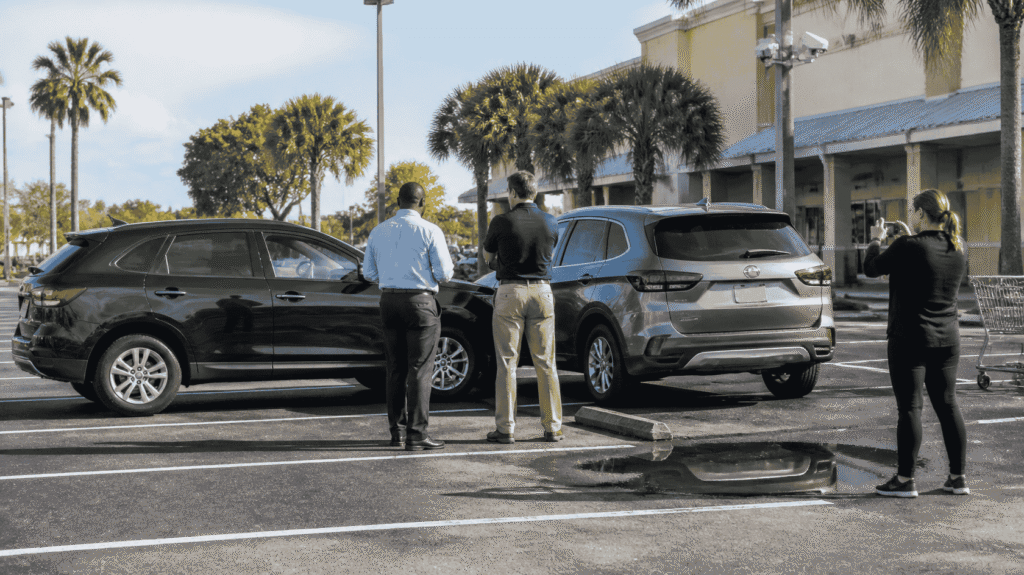
A parking lot is where two-ton vehicles, distracted shoppers, runaway carts, and one person who has definitely forgotten where they parked all share the same few hundred square feet. It feels low-stakes. Then someone backs into you, or you catch your toe on a chunk of broken asphalt, and suddenly you are asking a very grown-up question: who pays for this?
Here is the short answer. A Florida parking lot is not a law-free zone, and fault is not automatically 50/50. Who is responsible depends on what each person was doing right before impact, and sometimes on the property itself. That means the responsible party could be a driver, a property owner, a store, a property manager, a maintenance contractor, or more than one of them.
Do Florida Traffic Laws Apply in Private Parking Lots?
Often, yes. Florida’s traffic laws are not limited to public streets. Section 316.072(1) addresses where Chapter 316 applies, and in State v. Lopez (Fla. 5th DCA 1994), the court concluded that Chapter 316 applied to a privately owned commercial parking lot open to public vehicular use. A Florida Attorney General opinion reached a similar conclusion about privately owned areas open to the public.
There is a catch: the character of the property counts. A shopping-center lot open to every customer is different from a gated residential area or a restricted private facility, so not every traffic statute automatically governs every driveway and garage. But “it’s private property, so the rules don’t count” is a myth worth retiring.
Who Is at Fault in a Parking Lot Car Accident?
Fault turns on what each driver was doing immediately before impact. Florida has no rule that the person backing out is always to blame, and no rule that two reversing drivers must split fault evenly.
The Driver Backing Out of a Space
Section 316.1985 prohibits backing a vehicle unless the movement can be made safely and without interfering with other traffic. Translation: if you are reversing out of a space, the aisle is not yours until you have checked that it is clear.
That usually gives the driver traveling through the aisle the stronger argument, but “stronger” is not “bulletproof.” Speed, visibility, attention, and whether the aisle driver could have avoided the crash all come into play. Cruising through a parking lot like a getaway driver does not help anyone’s case.
When Both Vehicles Are Reversing
This is the classic parking-lot standoff: two drivers, two sets of reverse lights, one very unpleasant crunch. Insurers sometimes argue both drivers contributed. That is a possible factual conclusion, not a legal presumption.
The questions that actually matter include:
- Which vehicle started moving first?
- Did either driver stop before impact?
- Was one car already stationary?
- Could either driver see the other?
- Did anyone keep backing after a honk or other warning?
- Is there video or an independent witness who can establish the sequence?
A driver who stopped and was then struck is in a very different position from one who kept rolling. Drivers on public forums describe this exact fight, where without video the insurer shrugs and says “shared fault.” Those are anecdotes, not Florida law, but they show why proof of sequence is everything.
Drivers and Pedestrians
Section 316.130(15) requires drivers to exercise due care to avoid colliding with a pedestrian. In a parking lot, that means expecting people to appear from between vehicles, pushing carts and strollers. Nobody can assume everyone is politely staying on the sidewalk.
Pedestrians are not off the hook, though. Section 316.130(8) addresses a pedestrian who suddenly leaves a place of safety and enters a vehicle’s path so close that the driver cannot yield. A lot crash involving a walker is not automatically the driver’s fault.
Entering or Leaving the Lot
When a vehicle pulls out of a shopping-center driveway, § 316.125 comes into play. A driver entering or crossing a highway from a driveway or private road must stop before the sidewalk and yield to approaching traffic and pedestrians that pose an immediate hazard. That fits the plaza exit onto a public road, not every bump between two cars inside a parking aisle.
Can a Parking Lot Owner or Business Be Liable?
Yes, but an injury on business property does not automatically make the owner liable. A premises-liability claim generally requires a duty, a breach, and a breach that caused the injury. For a dangerous condition, two questions dominate: who was responsible for that area, and did they know about the problem?
Potentially responsible parties include:
- The property owner.
- A commercial tenant or store operator.
- A property-management company.
- A maintenance or paving contractor, depending on what work it undertook.
A lease or service contract can help identify who was supposed to inspect, repair, or maintain the lot, but it does not necessarily decide an injured person’s claim. In Burton v. MDC PGA Plaza Corp. (Fla. 4th DCA 2012), the Fourth District showed that lease language shifting maintenance duties does not automatically erase every duty of a commercial tenant. Actual control and the nature of the duty count, including the difference between maintaining premises and warning about a danger. The Fourth District covers Broward County, so that matters locally.
Injuries From Potholes, Wheel Stops, and Poor Lighting
Not every parking-lot injury involves a moving vehicle. Sometimes the villain is the pavement.
Potholes. In Trainor v. PNC Bank (Fla. 5th DCA 2017), a plaintiff was hurt by a pothole in a bank lot under construction, and the appeals court reversed summary judgment. Control of the area matters, and “the defect was obvious” does not automatically wipe out a premises duty.
Wheel stops. In Parker v. Shelmar Property Owner’s Association (Fla. 5th DCA 2019), a plaintiff tripped over a wheel stop near a building entrance, and the court reversed summary judgment because factual questions remained about whether the premises were reasonably safe. A wheel stop is not safe just because it is a standard parking-lot accessory.
Missing asphalt. The newest Fourth District example is PGA National Resort and Spa v. Ginsburg (Fla. 4th DCA Sept. 9, 2026). A guest tripped on a small patch of missing asphalt in a resort parking lot, in a spot with no sidewalks where shadows from lighting and palm trees hid the defect. The jury awarded $603,578.70, but the award did not stand. The court affirmed the denial of a directed verdict, yet reversed the final judgment and ordered a new trial because the trial court had taken judicial notice of a building-code provision that expired in 2005.
A note on spills. Section 768.0755 covers slip-and-fall claims involving a transitory foreign substance in a business establishment, such as a spilled drink, and requires proof the business knew or should have known about it. A pothole, missing asphalt, or a badly placed wheel stop is ordinarily analyzed under general premises-liability principles instead.
What If the Other Driver Leaves the Scene?
Florida treats a crash with an attended vehicle differently from damage to an unattended one.
- Sections 316.061 and 316.062 cover stopping, staying at the scene, and giving information or assistance after a crash involving injury or an attended vehicle or property.
- Section 316.063 covers hitting an unattended vehicle or property. The driver must stop and find the owner, or leave a conspicuous written note with identifying information, and notify law enforcement without unnecessary delay. A violation is a second-degree misdemeanor.
- Section 316.065 addresses when a crash must be reported. The threshold includes injury or death and apparent property damage of at least $2,000.
So the rule is not “every parking-lot accident must be reported.” It depends on the crash, any injury, and the damage. Under § 316.066, injury or reported pain can trigger a long-form report, while some property-damage-only incidents follow a written process. That framework is tied to public roadways, so private-lot incidents are not always handled exactly like street crashes.
What Evidence Proves a Parking Lot Accident Claim?
Parking lots create a special evidence problem: the best recording usually belongs to a business that may overwrite it faster than you can say “customer service.”
Surveillance video. Ask the property owner, store, or manager to preserve footage immediately, giving the exact location and a narrow time window. Cameras covering entrances or aisles may help even if they miss the specific space. A business may require a law-enforcement request or legal process before releasing it, which just means you should ask early.
Dashcams and witnesses. A dashcam may capture the crash or only the seconds before it. Get names and contact details from independent witnesses while they are still standing there. And a reality check: many backup cameras show a live picture but save nothing. A backup camera is not a dashcam.
Damage and photographs. Photograph both vehicles, the spaces, aisle markings, signs, lighting, and final positions. But the car with more damage is not necessarily the one at fault, since vehicle size, bumper height, and impact angle change what a dent looks like.
For premises claims. Photograph the defect with an object for scale and from several angles, and keep the shoes you wore in a fall. Maintenance logs, work orders, and prior complaints can show how long a hazard existed and who knew about it.
Reports and insurer verdicts. A police report does not conclusively decide civil liability, and an insurer’s initial “50/50” is not a court judgment. If you hear that number, ask what evidence supports it.
Can Both Sides Share Fault?
Yes. Section 768.81 sets up Florida’s modified comparative negligence rule. If you are found 50% or less at fault, your recoverable damages are reduced by your percentage of fault. If you are found more than 50% at fault, you generally cannot recover damages.
That matters in lot collisions where both drivers contributed, and in premises cases where the defense argues the injured person should have watched their step. Shared fault does not automatically mean 50/50, though. The percentage depends on the evidence.
What About Insurance and PIP?
Florida PIP coverage under § 627.736 may apply to qualifying injuries involving a motor vehicle, including certain pedestrians struck by one. It generally pays 80% of reasonable medical expenses within statutory limits, and the 14-day initial-treatment requirement is important. But a fall caused by a pothole or wheel stop is not automatically a PIP claim just because it happened in a parking lot.
Parking Lot Accidents in Coral Springs and Broward County
Picture the usual Coral Springs suspects: grocery-store lots, shopping centers, medical-office plazas, and apartment complexes, anywhere cars and people squeeze into limited space. The rules above apply to those very settings.
One honest limitation: there is no reliable public count of parking-lot crashes in Coral Springs. FDOT’s location-verified crash data excludes crashes on private roads, parking lots, and private property, so roadway totals do not measure private-lot incidents. You will not find an invented local statistic here, and you should be skeptical of anyone offering one. What local readers do have is real legal authority, since Fourth District cases such as Burton and Ginsburg apply in Broward County.
Contact Us
Coral Springs Office
9625 W. Sample Rd
Coral Springs, FL 33065
Tel: 954-866-HURT
(954-866-4878)
Fax: 954-334-1526
Frequently Asked Questions
Do Florida traffic laws apply in private parking lots?
Often. Courts have applied Chapter 316 to private lots open to public vehicular use, depending on the property and facts.
Who is at fault when two cars are backing out at the same time?
There is no automatic 50/50 rule. It depends on who moved first, whether either driver stopped, visibility, and video or witness evidence.
Is a driver always at fault for hitting a pedestrian in a parking lot?
No. Drivers must use due care, but a pedestrian who suddenly steps into a vehicle’s path can affect the analysis.
Can I sue a business if I tripped in its parking lot?
Possibly. It turns on who controlled the area and whether they knew about the hazard.
What should I do if the other driver leaves?
Document the scene, note plate and vehicle details, look for cameras and witnesses, and report the crash promptly.
How do I get parking lot video?
Ask the business to preserve it right away, naming the date, time, and location. They may require a police request, so do not wait.
This article provides general information, not legal advice. Every case is different; speak with a Florida attorney about your situation.