
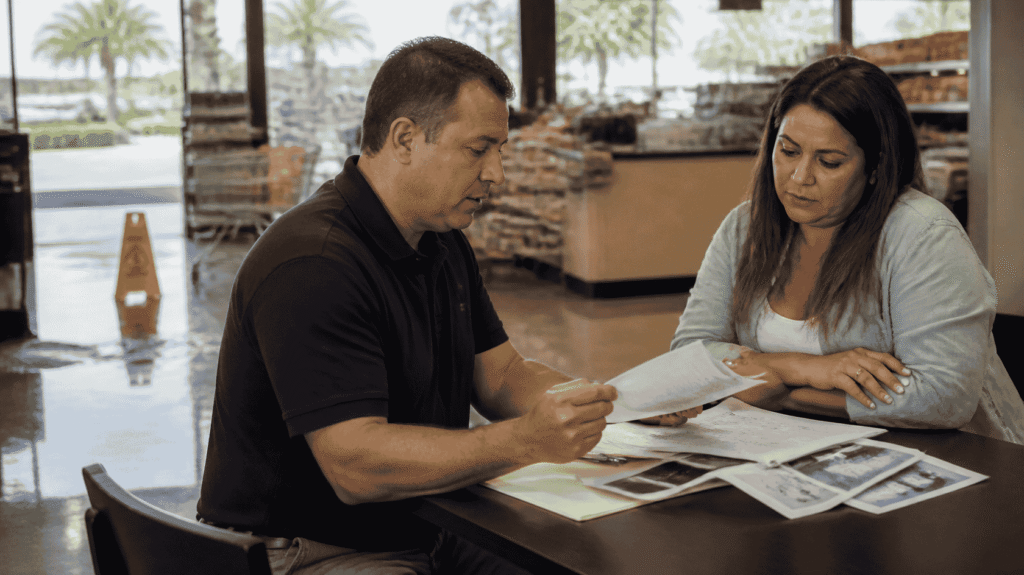
The numbers tell a more complicated story than a statewide average
So, how much is a slip-and-fall case worth in Florida? The tempting answer is to give you a neat number, perhaps $50,000 or $100,000, and move on. Unfortunately, the law does not work that way, and the available evidence does not support a reliable statewide average.
Florida does not publish a comprehensive database of private premises-liability settlements. That means we cannot simply add up every negotiated slip-and-fall claim across the state, divide by the number of cases and announce an average. Jury verdicts are easier to find, but they represent a very different group of cases: claims that went all the way to trial.
And even those figures need a closer look. A jury might award someone $500,000, only for an appellate court to reverse the judgment and order a new trial. Does that mean the person received half a million dollars? Not necessarily. A verdict is not a settlement, and an award that gets reversed is not a confirmed recovery.
With that in mind, the most useful way to examine Florida slip-and-fall case values is to look at actual outcomes, break down the amounts and understand what happened behind the courtroom doors. The cases below offer a much better picture than a generic settlement calculator ever could.
1. What have Florida juries actually awarded?
The following cases provide documented examples of Florida slip-and-fall verdicts. They also demonstrate why the headline figure is only the beginning of the story.
| Case | Reported amount | What happened afterward? |
|---|---|---|
| Marcano v. Publix (Osceola County, 2026) | $3,967,000 | Jury verdict; post-trial challenge reported, with no ruling located |
| Walgreens v. Chaux (Miami-Dade, 2026) | $5,547,733 | Reversed; new trial ordered |
| PGA National v. Ginsburg (Palm Beach County, 2026) | $603,578.70 | New trial ordered |
| Loren v. Once Upon a Time Group (Palm Beach County, 2025) | $437,186 | New trial ordered |
| Publix v. Safonte (Broward County, 2024) | $241,460 | Reversed; judgment ordered for Publix |
| Aponte v. Walmart (Indian River County, 2025) | $22,500 | Reversed; new trial ordered |
One important distinction before we get into the details: these are jury awards, not confirmed settlement amounts. They show what juries decided at trial, not necessarily what injured people ultimately collected. Still, the underlying facts are useful because they show how dramatically the numbers can change from one case to another.
The $3.967 million Publix verdict: when a recurring hazard meets serious spinal injuries
One of the most striking recent examples comes from Osceola County.
In February 2026, a jury awarded $3,967,000 to a 30-year-old woman who slipped on liquid in a supermarket beverage aisle. The accident happened in June 2023. Evidence presented at trial reportedly showed that employees had previously cleaned liquid in the same area.
Here is how the jury divided the award:
| Damage category | Amount |
|---|---|
| Past medical expenses | $411,000 |
| Future medical expenses | $556,000 |
| Past pain and suffering | $750,000 |
| Future pain and suffering | $2,250,000 |
| Total | $3,967,000 |
The woman underwent three spinal surgeries: one involving her neck and two involving her back. Publix disputed responsibility and challenged the extent and cause of her injuries, including by pointing to complaints associated with carrying her children before the accident. The jury ultimately assigned Publix 100% of the fault.
There is another figure worth paying attention to. The plaintiff’s lawyers reportedly said Publix’s final offer before trial was $600,000. The jury award was therefore approximately 6.6 times that amount.
That is a substantial difference. But before anyone starts treating it as a formula for calculating a future claim, there is a catch: the case did not simply end when the jury returned its verdict. In March 2026, Publix moved for a new trial and challenged the medical-expense evidence presented to the jury. The defense argued that the medical bills shown at trial exceeded the amounts admissible under Florida’s medical-damages statute. The available reporting did not establish a final ruling on that motion.
What makes this case interesting is the combination of evidence about the recurring condition and the seriousness of the injuries. It is one thing to show that a customer slipped on a spill. It is another to present evidence suggesting that the store had encountered the same problem before, followed by medical evidence involving multiple surgeries.
Those details help explain the verdict. They do not establish that another person who slips in a supermarket will receive anything close to $3.9 million.
Sources: Southeast Verdicts’ case summary and Rubenstein Law’s February 2026 announcement.
The $5.55 million Walgreens verdict: a traumatic brain injury and a dispute over surveillance footage
In Walgreens Co. v. Chaux, Nos. 3D24-0288 and 3D24-0761, decided January 14, 2026, a Miami-Dade County jury awarded $5,547,733 to a customer who fell in a Walgreens checkout lane.
This was not a minor fall followed by a few appointments with a physical therapist. A store employee found the customer unconscious on the floor. She suffered a brain injury and spent more than three months in the hospital.
The case also became a lesson in the importance of preserving evidence. Five days after the fall, the plaintiff’s lawyer sent a preservation request seeking surveillance footage from the store. Walgreens’ claims administrator reportedly responded that the area where the incident occurred was not captured on video. The litigation later involved disputes about surveillance evidence and the jury instructions concerning spoliation.
The Third District Court of Appeal reversed the judgment and ordered a new trial. It also reversed the attorney-fee and cost judgment.
So, what happened to the $5.55 million? The original jury award was no longer a valid final judgment after the appellate decision. It would be inaccurate to describe it as money the plaintiff definitively recovered.
The case nevertheless provides an important example of how a severe brain injury and prolonged hospitalization can affect a jury’s assessment of damages. It also shows that a large verdict can remain vulnerable to procedural errors. The amount on the verdict form is not necessarily the final chapter.
Source: Walgreens Co. v. Chaux, Third District Court of Appeal, January 14, 2026.
The $603,578.70 PGA National verdict: a fall in a parking lot
Not every serious premises-liability claim begins with a spill in a supermarket aisle. Sometimes the problem is under your feet before you even reach the front door.
In PGA National Resort and Spa v. Ginsburg, No. 4D2025-0428, decided September 9, 2026, a Palm Beach County jury awarded $603,578.70 after a woman tripped on missing asphalt in the resort’s guest parking lot.
The plaintiff fractured her wrist. The case involved questions about the missing section of asphalt and whether the defect was sufficiently visible under the conditions in the parking area.
The Fourth District affirmed the trial court’s denial of the resort’s motion for a directed verdict. That matters because the appellate court did not conclude that the evidence was legally insufficient to let the claim proceed.
However, the court reversed the final judgment and ordered a new trial. The reason was a trial error involving the court’s decision to take judicial notice of an outdated building-code provision that had expired in 2005.
The distinction is worth spelling out: the appellate court did not uphold the $603,578.70 award as a final recovery. It sent the case back for another trial because of the legal error.
For anyone researching Florida slip-and-fall claims, this case is useful because it takes us outside the familiar supermarket setting. Parking lots, walkways and other exterior surfaces can generate premises-liability disputes too. The legal analysis may differ depending on the type of defect, but the underlying question remains: who was responsible for keeping the area reasonably safe?
Source: PGA National Resort and Spa v. Ginsburg, Fourth District Court of Appeal, September 9, 2026.
The $437,186 restaurant verdict: medical bills were only a small part of the award
In Loren v. Once Upon a Time Group, Corp., No. 4D2023-3154, decided July 9, 2025, a Palm Beach County jury awarded $437,186 after a woman fell in a restaurant.
The breakdown is particularly revealing:
- $12,186 in past medical expenses.
- $425,000 in past and future pain and suffering.
Read that again. The jury awarded just over $12,000 for past medical expenses, yet the total verdict exceeded $437,000. The overwhelming majority came from noneconomic damages.
This is a useful example because it challenges a common assumption: that the value of an injury claim can be estimated simply by looking at the medical bills. A person’s pain and suffering, including the consequences expected to continue into the future, can represent a substantial portion of a jury award when the evidence supports it.
The jury found the plaintiff was not negligent. However, the trial court later set aside the verdict and alternatively ordered a new trial because of improper and prejudicial statements made by plaintiff’s counsel during closing argument.
The Fourth District reversed the ruling setting aside the verdict but upheld the order for a new trial. Once again, the original figure cannot be treated as a confirmed final recovery.
Source: Loren v. Once Upon a Time Group, Corp., Fourth District Court of Appeal, July 9, 2025.
The $241,460 Publix verdict: a Broward County case with a very different ending
For readers in Broward County, Publix Super Markets, Inc. v. Safonte, Nos. 4D2023-0216 and 4D2023-0815, decided June 20, 2024, deserves particular attention.
The plaintiff fell after encountering yogurt on the floor of a Publix store. The jury awarded $241,460, assigning 40% of the fault to Publix and 60% to the plaintiff.
That allocation would ordinarily have reduced the award to approximately $96,584, before any other applicable adjustments.
But the Fourth District reversed and directed that judgment be entered for Publix. The evidence indicated that the spill had been present for only about two minutes. The employee was working with her back turned, and the court concluded that the evidence did not establish actual or constructive knowledge of the spill. There was also insufficient evidence of a recurring condition.
This is a particularly useful case because it shows how quickly a claim can run into trouble when the evidence about the dangerous condition is weak.
Imagine two customers who suffer nearly identical injuries after slipping on yogurt in a supermarket. In one case, employees have repeatedly cleaned the same spill. In the other, the substance has been on the floor for only a couple of minutes and there is no evidence of a recurring problem. The injuries might look similar, but the liability evidence tells two very different stories.
For a Broward-focused article, Safonte is one of the strongest local examples. It comes from the Fourth District, which handles appeals from Broward County and surrounding jurisdictions.
Source: Publix Super Markets, Inc. v. Safonte, Fourth District Court of Appeal, June 20, 2024.
The $22,500 Walmart verdict: proving negligence is only half the battle
In Aponte v. Walmart Stores East, LP, No. 4D2023-2417, decided July 9, 2025, both sides agreed that Walmart’s failure to maintain its garden-center premises was at least partly responsible for the plaintiff’s fall on algae buildup.
The jury awarded $22,500, substantially below the damages the plaintiff sought.
The plaintiff claimed injuries involving her wrist, knee and lower back, along with future medical expenses and loss of earning capacity. The Fourth District concluded that the trial court had improperly restricted important medical evidence and argument. It reversed and remanded for a new trial.
The interesting part here is the gap between establishing responsibility for the fall and proving the full extent of the resulting damages.
Those are separate questions. A property owner might be responsible for a dangerous condition, but that does not automatically establish that every medical problem reported afterward was caused by the accident. The claimant still needs evidence connecting the incident to the injuries and supporting the damages being requested.
That is why the amount of a verdict can be surprisingly low even when negligence is not the central dispute.
Source: Aponte v. Walmart Stores East, LP, Fourth District Court of Appeal, July 9, 2025.
2. Why Florida law changes the numbers
The verdicts above make one thing clear: the injury is only part of the equation. Florida’s legal rules can determine whether a business is responsible in the first place and how much of the claimed damages can actually be recovered.
The notice requirement can make or break a supermarket claim
Under Florida Statutes §768.0755, a person who slips on a transitory foreign substance in a business establishment must prove that the business had actual or constructive knowledge of the dangerous condition and should have taken action to remedy it.
Constructive knowledge can be established through circumstantial evidence showing either that:
- The substance remained on the floor long enough that the business should have discovered it through ordinary care; or
- The condition occurred regularly and was therefore foreseeable.
This is where the contrast between Safonte and the 2026 Osceola County Publix verdict becomes especially interesting.
In Safonte, the approximately two-minute window and absence of evidence of a recurring condition undermined constructive notice. In the Osceola County case, evidence that employees had previously cleaned liquid in the same location supported the argument that the condition was recurring.
Same type of store. Same general type of hazard. Very different evidence.
A person who slips on a freshly spilled drink may have a serious injury but struggle to prove that the store knew about the hazard. Someone who falls in an area with repeated leaks, documented complaints or recurring spills may have a stronger argument.
One important qualification: §768.0755 concerns transitory foreign substances in business establishments. It should not be applied indiscriminately to every fall involving a broken stair, uneven pavement, missing asphalt or another structural defect. Those claims require analysis of the applicable premises-liability duties and evidence of control and maintenance responsibility.
Sources: Florida Statutes §768.0755, Safonte.
Medical bills are not a settlement calculator
For years, people have repeated simple formulas suggesting that an injury claim is worth two or three times the medical expenses. It sounds convenient. It is also a poor way to assess a Florida claim.
Florida Statutes §768.0427 governs the admissibility of evidence used to establish past and future medical expenses.
For medical expenses already paid, the statute generally limits evidence to the amount actually paid. For unpaid expenses, it identifies evidence that may be admitted depending on the claimant’s health coverage and treatment arrangements. It also addresses future medical expenses.
In practical terms, the number printed on a medical bill is not automatically the number a jury can consider as recoverable medical damages. This distinction becomes particularly important when a claim involves letters of protection or substantial billed charges.
The 2026 Osceola County Publix verdict illustrates the issue. The jury awarded $411,000 for past medical expenses and $556,000 for future medical expenses. Publix subsequently challenged the medical-expense evidence and argued that the award should be reduced.
The old habit of multiplying medical bills by two or three does not account for these evidentiary rules. Nor does it account for the fact that pain and suffering must be evaluated through the evidence rather than a fixed mathematical formula.
Sources: Florida Statutes §768.0427, Osceola County Publix verdict reporting.
Your own share of responsibility can reduce or eliminate recovery
Florida’s modified comparative-negligence rule appears in §768.81.
A claimant’s damages are reduced according to their percentage of fault. However, a party found to be more than 50% responsible for their own harm generally cannot recover damages in a negligence action covered by the statute.
The Safonte verdict makes this issue concrete. The jury attributed 60% of the fault to the customer and 40% to Publix. Under the current modified comparative-fault framework, a claimant found more than 50% responsible generally cannot recover.
The appellate court did not need to resolve the case on that basis, however. It concluded that the evidence did not establish the store’s constructive knowledge and directed judgment for Publix.
The broader point is that a settlement calculation must account for disputed liability. A claim with substantial medical damages can still have limited settlement value if the evidence suggests the injured person bears a significant share of responsibility.
Source: Florida Statutes §768.81.
3. What actually drives the value of a slip-and-fall claim?
Now that we have looked at the verdicts and the legal rules, some patterns become easier to spot.
The seriousness of the injury matters enormously. A fall resulting in temporary soreness is a very different claim from one involving spinal surgery or a traumatic brain injury. The Chaux verdict and the Osceola County Publix case illustrate how severe injuries can produce substantial damages awards.
Evidence that the business knew about the hazard can be decisive. The contrast between Safonte and the Osceola County Publix case is particularly revealing. Both involved supermarket falls, but the evidence concerning how the hazard came to exist and whether the store should have known about it differed substantially.
Future damages can account for a large share of an award. In the Osceola County case, future medical expenses and future pain and suffering represented $2.806 million of the total. In Loren, pain and suffering represented $425,000 of the $437,186 verdict. Looking only at medical bills already incurred would miss a substantial part of both awards.
A jury verdict is not necessarily the final result. The Chaux, Ginsburg, Loren and Aponte cases all involved appellate or post-trial developments that prevent the original jury figures from being treated as confirmed final recoveries.
There is another example worth considering. A 2025 defense verdict in a Miami-Dade Publix case was reported by defense firm Wicker Smith. The plaintiff reportedly presented more than $420,000 in medical bills and sought an award approaching $3 million. The jury returned a complete defense verdict after approximately 30 minutes of deliberation.
The defense account attributed the result partly to evidence that the plaintiff had undergone lumbar surgery before the fall and that later MRI studies showed no change in her condition. This is a defense firm’s account rather than an appellate opinion, so it should be treated as a reported trial result, not an independently reviewed judicial finding.
Still, it makes an important point: a large stack of medical bills does not automatically establish that a fall caused the underlying injuries. When pre-existing conditions are involved, the medical evidence connecting the accident to any new injury or aggravation can become central to the dispute.
Source: Wicker Smith’s case report.
4. What should someone preserve after a fall?
The cases also offer a practical lesson. Evidence can disappear, memories become less precise and surveillance systems do not necessarily keep footage indefinitely. Waiting too long can make an already difficult claim harder to prove.
Here is what deserves attention after a fall:
- Photographs of the hazard: Capture the substance or defect, along with the lighting and surrounding area. A close-up is useful, but so is a wider photograph showing where the hazard was located.
- Surveillance footage: Store footage may show how long a spill existed, whether employees passed it or whether the same area had been cleaned before. The Chaux litigation demonstrates why preservation requests should be made promptly.
- Incident and inspection records: Cleaning logs, inspection schedules and prior complaints can help establish actual or constructive knowledge.
- Witness accounts: Employees and customers may have seen the hazard before the fall or observed what happened immediately afterward.
- Medical records: Consistent treatment and medical opinions connecting the fall to the claimed injury are important, particularly when the claimant has a pre-existing condition.
- Evidence of future consequences: Medical recommendations, work restrictions and continuing limitations can support claims for future medical expenses and noneconomic damages.
The goal is not to collect every document imaginable. It is to establish a clear chain of evidence: what caused the fall, what the property owner knew or should have known, and what injuries the incident actually produced.
5. So, what is the average slip-and-fall settlement in Florida?
The honest answer is that no reliable official statewide average is available.
The documented Florida outcomes examined here range from a $22,500 jury award in a case involving disputed damages to multimillion-dollar awards involving serious injuries. Several prominent awards were later reversed or sent back for new trials. The $3.967 million Osceola County verdict is a notable 2026 example, but it remains subject to a reported post-trial challenge.
That range is striking, but it should not be mistaken for a statistical average. Jury verdicts are not private settlements, and the cases that reach trial are not necessarily representative of all claims.
For readers in Broward and South Florida, Safonte offers particularly useful local context. The Fourth District’s decisions in Loren, Aponte and Ginsburg add further examples of how liability and damages disputes affect the outcome.
The most important takeaway is that the value of a Florida slip-and-fall claim depends on two fundamental questions: can the property owner be held responsible, and what does the evidence establish about the claimant’s injuries?
A dramatic injury does not automatically prove negligence. A strong liability case does not automatically produce a large award. And a seven-figure jury verdict does not necessarily mean the claimant walks away with seven figures.
That is why a single average can be so misleading. The number matters, of course, but the story behind it matters considerably more.
Sources and research notes
The principal sources for this report are the Florida statutes and appellate decisions linked throughout the text. The 2026 Osceola County verdict figures come from verdict reporting and a plaintiff-law-firm announcement, not a published appellate opinion. The reported $600,000 final offer and the pending post-trial challenge should therefore remain attributed to those sources.
One additional research source, HOV Law’s September 2026 analysis of Florida slip-and-fall settlement averages, reaches the same basic conclusion about the absence of a published statewide average. Its useful contribution is the distinction between private settlements and publicly reported verdicts. It is a law-firm publication, not an official statistical source.
Recommended article: Average Slip and Fall Settlement in Florida: What Affects the Amount?