
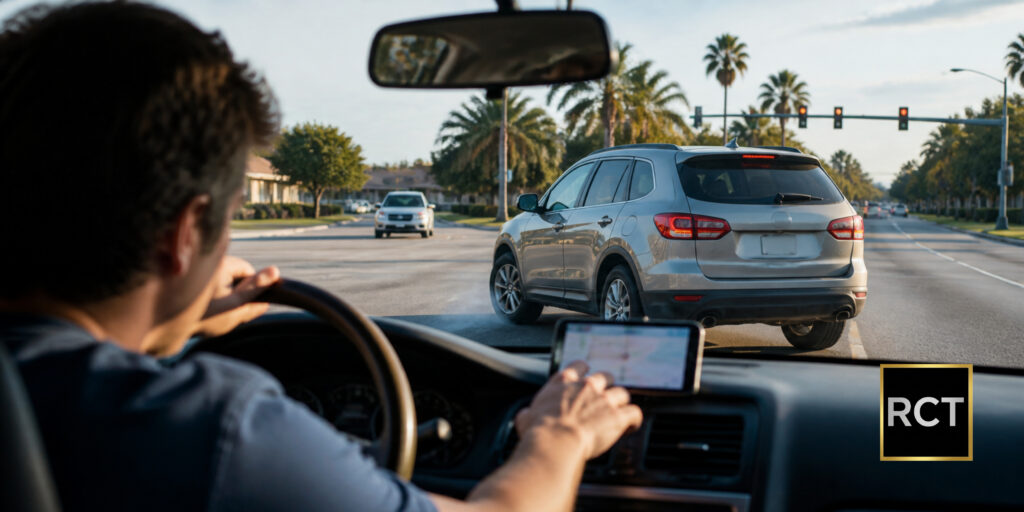
Yes. You can sue a driver who causes a car accident while using GPS in Florida if their distraction contributed to the collision. Using Google Maps or another navigation app is generally legal. That does not give a driver permission to stare at a screen, enter an address while moving, or miss a traffic signal because they are following directions.
The important distinction is between using GPS and driving carelessly because of it. Florida law recognizes navigation as a legitimate use of a phone, but drivers still have a duty to operate their vehicles safely. If someone looks down to change a route and rear-ends your car, misses a stop sign, or drifts into your lane, that conduct may support a negligence claim.
The difficult part is proving what the driver was doing immediately before the crash. A phone in someone’s hand does not automatically establish that GPS caused the accident. You need evidence connecting the driver’s actions to the collision.
Is It Illegal to Use GPS While Driving in Florida?
No. Florida law specifically recognizes navigation as an exception to its texting-while-driving restrictions.
Under Florida Statute §316.305, drivers generally cannot manually type or enter multiple characters into a wireless communications device, or read or send certain data, while operating a motor vehicle. However, the law includes an exception for using a device or system for navigation purposes.
That means a driver can generally follow directions through Google Maps, Apple Maps, or a vehicle’s built-in navigation system.
There is an important distinction, though. The navigation exception does not excuse dangerous driving. A motorist who repeatedly looks away from the road to adjust a route can still be responsible for a collision.
What About GPS Use in School Zones and Work Zones?
Florida has an additional restriction under §316.306. It prohibits certain handheld wireless-device use in designated school crossings, school zones, and qualifying work zones.
Hands-free navigation remains an exception. A driver may use a device or system for navigation without holding it, but that does not make every interaction with the screen safe or lawful.
For example, a motorist who mounts a phone on the dashboard and follows voice directions is in a different position from someone holding the phone while entering a new destination in a restricted zone.
Even when a particular GPS interaction does not violate a traffic statute, it can still be evidence of negligence.
Can You Sue a Driver for Causing an Accident While Following GPS?
Yes, if the driver’s conduct fell below the standard of reasonable care and caused your injuries.
Florida’s careless-driving law, §316.1925, requires motorists to drive in a careful and prudent manner. A driver who becomes so absorbed in navigation that they stop paying adequate attention to the road may violate that duty.
Consider a common situation. A driver approaches an unfamiliar intersection and realizes the GPS is giving confusing directions. Instead of continuing safely and checking the route after stopping, the driver looks down to adjust the destination. A pedestrian enters the crosswalk, or the vehicle ahead stops. The driver reacts too late and causes a collision.
The issue is not whether the driver was allowed to use GPS. It is whether the driver used it in a way that made the vehicle unsafe.
Does the Driver Have to Be Holding the Phone?
No. Distraction does not require a phone in the driver’s hand.
A driver can become distracted by a dashboard navigation screen, a built-in infotainment system, or voice-controlled directions. Looking away from the road to inspect a complicated map can interfere with driving even if the device is mounted securely.
The same applies when someone is trying to follow a route change. A driver may be legally using navigation but still fail to notice a red light or another vehicle slowing down.
The physical position of the device is only one part of the evidence. What matters is what the driver was doing and how that behavior affected their ability to drive safely.
How Do You Prove a Driver Was Distracted by GPS?
This is usually the most important part of a GPS-related car accident claim. You must establish a connection between the driver’s navigation activity and the collision.
A driver might admit they were using GPS, but that admission alone does not prove negligence. They could have been following voice directions without looking at the screen. The stronger case shows what happened immediately before impact and why the driver failed to respond.
Phone and Navigation App Records
A phone may contain information about navigation activity around the time of a collision. Depending on the device and application, relevant evidence may include navigation sessions, screen interactions, route changes, or location information.
These records have limitations. A location history may show where a phone traveled, but it does not necessarily establish that the driver was looking at the screen. Carrier records can identify certain calls or text activity, but they generally do not provide a complete history of every interaction with Google Maps or another navigation application.
The distinction matters. Evidence that a phone was moving along a route does not prove distraction. Evidence showing that the driver was actively changing directions seconds before a collision may be considerably more useful.
Dashcam Footage and Surveillance Video
Video can provide some of the clearest evidence in these cases.
A dashcam may show the driver’s vehicle drifting between lanes or braking too late. An interior camera could reveal whether the driver was looking down at a screen. Footage from a nearby business may capture the collision itself, although exterior cameras usually cannot show what was happening inside the vehicle.
The timing is particularly important. If video shows a driver looking down immediately before failing to stop, it may help connect the distraction to the crash.
Do not assume that useful footage will remain available indefinitely. Businesses and property owners may overwrite recordings as part of their normal systems. If you know a nearby camera may have captured the accident, preserving that footage should be an early priority.
Witness Statements and Driver Admissions
Passengers can sometimes provide details that an outside witness would never see. They may have watched the driver enter an address, repeatedly check the screen, or attempt to correct a route.
A statement such as “the driver was distracted” is less useful than a specific account of what happened. Did the driver look down before the intersection? Did they reach toward the dashboard? Did they say they had missed a turn?
The driver’s own statements may also matter. Someone who tells a passenger or responding officer that they were changing GPS directions could provide an important piece of evidence.
A witness does not have to understand the technical details of a navigation application. They need to describe what they actually observed.
Vehicle Data and Accident Reconstruction
Modern vehicles can record information about their operation. Depending on the vehicle and available equipment, an event data recorder may capture details such as speed, braking, and other vehicle behavior around a collision.
That information does not normally establish that a driver was using GPS. It can, however, help investigators determine whether the vehicle slowed down or reacted before impact.
An accident reconstruction specialist may compare that information with video footage, witness accounts, and available phone records. The goal is to establish a reliable timeline.
For example, a navigation record might show a route interaction shortly before impact. Vehicle data could show that the driver did not brake until the final moments. A nearby camera might show the vehicle
No single source necessarily proves the entire case. The strength comes from whether the evidence supports a consistent explanation of the collision.
What Florida Courts Say About Distracted Driving Evidence
Florida appellate decisions offer useful guidance on what evidence may be needed when a driver’s phone use is suspected.
One particularly relevant decision is Glade v. Govey, No. 4D2026-0218 (Fla. 4th DCA July 8, 2026). The case came from Broward County and involved a rear-end collision near an I-95 exit ramp.
A passenger testified that the driver had been using a phone with their fingers. However, the passenger could not establish what the driver was doing or how long the phone had been used.
The Fourth District reversed an order allowing a punitive damages claim to proceed. The court explained that the evidence did not establish the additional misconduct needed to support that type of claim. It pointed out that the plaintiff had not shown what the driver saw or failed to see.
The decision included an important observation: “All cell phone use is not equal.”
That distinction matters in GPS accident cases. A driver checking a mounted screen briefly is not necessarily engaging in the same conduct as someone repeatedly entering directions while traveling at highway speed.
The decision did not establish that phone use can never support an ordinary negligence claim. It addressed the higher evidentiary threshold for punitive damages. Those are different legal questions.
Can You Obtain the Other Driver’s Phone Records?
Potentially, yes. Florida courts have recognized that phone records may be relevant when investigating suspected distraction, although privacy protections limit how broadly those records can be obtained.
In Antico v. Sindt Trucking, Inc., 148 So. 3d 163 (Fla. 1st DCA 2014), a wrongful death case, the court considered a request to inspect a deceased driver’s iPhone. The defendants had evidence suggesting the driver may have been using the phone around the time of the collision.
The court allowed a controlled inspection. It described the request as something other than “an unanchored fishing expedition.”
The decision also recognized the importance of the opposing privacy interest. Phone contents can reveal personal information that has little or nothing to do with a crash.
A related decision, Morgan v. Wharran, No. 2D22-395 (Fla. 2d DCA Nov. 18, 2022), addressed a request for cell phone records after a rear-end collision. The court allowed discovery aimed at determining whether the driver had used the phone near the time of the accident. It rejected broader disclosure without adequate consideration of relevance and privacy.
Together, these decisions show why a request for phone data should have a specific purpose. A narrowly defined inquiry into activity around the collision is different from demanding access to someone’s entire digital life.
How Common Are GPS-Related Car Accidents in Florida?
Florida’s 2024 Traffic Crash Facts report recorded 2,499 people involved in crashes where an “Other Electronic Device” was identified as a distraction. The category includes navigation devices and DVD players.
Those crashes involved four fatalities. The report also recorded 21 incapacitating injuries and 225 non-incapacitating injuries in that category.
There is an important limitation: the figures do not isolate GPS use. They cannot tell us how many crashes involved Google Maps, a built-in navigation system, or another specific application. They also should not be presented as a count of crashes caused exclusively by GPS.
Still, the figures show that electronic-device distraction is a documented concern in Florida crash reporting. The Florida 2024 Traffic Crash Report provides the underlying data.
Research summarized by the National Highway Traffic Safety Administration also supports the broader concern. A study discussed in NHTSA’s distracted-driving research materials found that visual-manual cellphone tasks were associated with substantially higher crash odds. The reported odds ratio was 2.19 for visual-manual cellphone tasks overall.
That figure is not specific to GPS use. It does, however, help explain why looking away from the road to interact with a device can be dangerous.
What Should You Do After a GPS-Related Car Accident?
If you suspect the other driver was distracted by navigation, try to preserve evidence that could establish what happened before the collision.
- Record what the driver said. If they mention changing directions or checking the GPS, write down their exact words as soon as possible.
- Identify witnesses. Passengers and other motorists may have seen the driver looking down or interacting with a screen.
- Look for nearby cameras. Businesses, homes, and traffic systems may have footage that helps reconstruct the collision.
- Keep your own recordings. Preserve original dashcam footage rather than relying only on edited clips or social media uploads.
- Document the scene. Photographs of vehicle positions, road markings, traffic signals, and nearby signs may help explain what happened.
Avoid trying to access the other driver’s phone yourself. Digital evidence should be obtained through appropriate legal procedures.
You should also avoid assuming that the driver will admit to being distracted. Someone may tell the police they missed a turn, but later claim they were following directions normally. That is why independent evidence matters.
Can You Recover Compensation If GPS Distraction Caused Your Injuries?
If you can establish that another driver’s negligence caused the accident, you may seek compensation for losses recognized under Florida law.
Depending on the circumstances, a claim may include medical expenses, lost income, reduced future earning capacity, and pain and suffering. The available damages depend on the injuries and the evidence supporting the claim.
Florida follows a modified comparative negligence system under §768.81. If you are found partly responsible, your compensation may be reduced by your share of fault. If you are found more than 50% responsible, you generally cannot recover damages under the statute, subject to its exceptions.
The fact that a driver was using GPS does not automatically make them responsible for every injury resulting from the collision. The evidence must establish negligence and causation.
What If the Distracted Driver Was Working?
A separate question may arise when the driver was using GPS for a delivery, rideshare trip, or other work-related activity.
An employer may potentially share responsibility if the driver was acting within the scope of employment. The circumstances matter. An employer is not automatically liable simply because an employee was following a work-related route.
Commercial drivers may also face additional federal restrictions. For example, 49 C.F.R. §392.82 restricts handheld mobile telephone use by drivers of commercial motor vehicles. That federal rule is separate from Florida’s general navigation exception.
Contact Us
Coral Springs Office
9625 W. Sample Rd
Coral Springs, FL 33065
Tel: 954-866-HURT
(954-866-4878)
Fax: 954-334-1526
Frequently Asked Questions About GPS-Related Accidents in Florida
Can I sue if a driver rear-ended me while looking at Google Maps?
Yes, if the driver’s distraction contributed to the collision and caused your injuries. Evidence may include witness statements, video footage, phone records, or vehicle data showing that the driver failed to react in time.
Is using Google Maps while driving illegal in Florida?
Generally, no. Florida’s texting-while-driving statute includes an exception for navigation purposes. However, drivers must still operate their vehicles carefully, and separate restrictions apply to certain handheld device use in designated school and work zones.
Does a driver have to be texting for a distracted-driving claim?
No. A driver can be negligent while using GPS, adjusting an infotainment system, or interacting with another device. The central issue is whether the distraction caused the driver to operate the vehicle unsafely.
Can phone records prove someone was using GPS before an accident?
They may help, depending on the device and available records. Carrier records do not necessarily show every interaction with a navigation app. App data, device information, video, and other evidence may be needed to establish what the driver was doing.
Can I get punitive damages if the driver was using GPS?
Possibly, but the standard is considerably higher than ordinary negligence. Evidence of phone use alone is generally insufficient. Florida courts require additional evidence of conduct meeting the statutory threshold for punitive damages.