
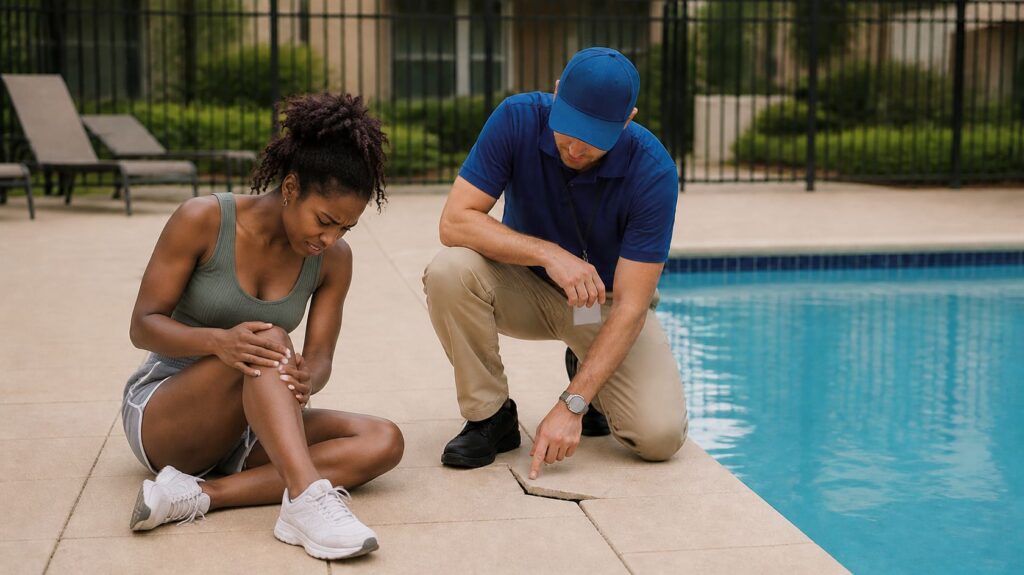
A swimming pool accident in Coral Springs or elsewhere in Broward County can leave you with a serious injury and a difficult question: who is responsible for what happened?
The answer depends on the circumstances. If you slip on a broken pool deck at an apartment complex, for example, the property manager may have some explaining to do. A child who gets through a defective backyard pool gate raises a different legal issue. And if a swimmer becomes trapped by a faulty drain, the investigation may focus on the equipment and the safety requirements that applied to that facility.
In Florida, property owners and pool operators can be held responsible when their failure to address a dangerous condition contributes to someone’s injury. However, an accident by itself does not establish liability. You must be able to connect the injury to a legal duty that someone failed to meet.
There is another detail worth understanding before looking at your options. Florida treats private residential pools differently from certain pools at apartment complexes and hotels. That distinction can affect which safety regulations apply to the property where you were injured.
When Is a Property Owner Liable for a Pool Accident in Coral Springs?
Most swimming pool injury claims involving unsafe property conditions fall under Florida premises liability law. The central issue is whether the person or business responsible for the property failed to meet a legal duty and whether that failure contributed to the accident.
Consider an apartment complex where residents have complained about a loose tile near the pool. Management knows about the problem but leaves it unrepaired. A resident later trips on that tile and suffers a serious injury. The maintenance history may help establish that the property operator knew about the hazard and had an opportunity to correct it.
The analysis changes when the danger was not reasonably foreseeable or when the property owner had no reasonable opportunity to discover it. A wet pool deck, for instance, does not automatically establish negligence. Water is an ordinary feature of swimming areas. The question is whether the condition became unreasonably dangerous and whether the responsible party should have taken steps to address it.
Swimming Pool Premises Liability in Broward County
Florida law generally requires property owners to use reasonable care toward lawful visitors. The specific duty depends on the visitor’s legal status and the circumstances surrounding the accident. For many apartment residents, hotel guests, and paying visitors, the relevant question is whether the property operator maintained reasonably safe premises and addressed dangers it knew about or should have discovered.
A claim may involve a property owner, apartment management company, hotel operator, maintenance contractor, or another party responsible for the pool area. Ownership alone does not settle the issue. Investigators must determine who controlled the area and who had responsibility for the condition that caused the injury.
That distinction matters when several companies are involved. An apartment owner may hire a management company to oversee daily operations and contract with a separate business for pool maintenance. Depending on the agreements and the actual responsibilities each party assumed, more than one entity may have potential liability.
What Pool Safety Laws Apply in Coral Springs and Broward County?
Florida has separate statutory frameworks for residential swimming pools and public swimming pools. The distinction is important because a private backyard pool does not necessarily face the same regulatory requirements as a pool at an apartment complex or hotel.
Chapter 515 of the Florida Statutes addresses residential swimming pool safety. Under Florida Statute §515.27, certain new residential pools must have at least one qualifying safety feature. These options include an approved barrier, a pool safety cover, an approved alarm, or another feature recognized by the statute.
The barrier requirements in Florida Statute §515.29 address matters such as enclosure height, access gates, and openings that could allow young children to enter the pool area. The statute is intended to reduce the risk of unsupervised access to residential pools.
However, these residential provisions should not be treated as a complete description of the rules governing every pool in Broward County. Some apartment and hotel pools fall under the separate public pool framework.
Florida Public Pool Laws and Apartment Pool Accidents
Chapter 514 regulates public swimming pools and bathing places. The definition in Florida Statute §514.011 includes certain pools associated with residential developments containing five or more living units. That means a pool does not necessarily escape public pool regulations simply because access is restricted to residents and their guests.
This distinction can surprise apartment residents. A swimming pool inside a gated community may look like a private amenity, but its legal classification can depend on the type of property and the statutory definition. The number of residential units is one factor that may matter.
Florida also imposes requirements intended to prevent injuries caused by suction entrapment. Under Florida Statute §514.0315, covered public pools and spas must comply with applicable anti-entrapment requirements. These protections address hazards associated with drains and circulation systems.
A violation of a pool safety statute may be important evidence in an injury claim. It does not automatically establish that the property owner is liable for every accident, though. The injured person must still connect the violation to the injury and establish the legal elements of the claim.
Who Inspects Public Swimming Pools in Broward County?
The Florida Department of Health in Broward County oversees public swimming pool permitting and inspections. Its responsibilities include reviewing covered facilities for compliance with applicable public health and safety requirements.
A public pool generally needs an operating permit before it opens. Newly constructed or modified pools must undergo the required approval process before being placed into service. The department also conducts inspections during the permit period.
According to the department’s pool program information, public pools are inspected at least twice during each permit year. Those inspections can provide useful information about the condition of a facility and whether inspectors identified violations.
Broward County Pool Inspection Records and Injury Claims
If an accident occurs at an apartment complex, hotel, or other regulated facility, inspection records may help establish what the operator knew about the pool’s condition. A prior inspection could reveal an unresolved safety concern. Maintenance documents may also show whether the operator addressed a problem after receiving notice.
An inspection report does not automatically prove negligence. A pool may pass an inspection and still contain a dangerous condition that develops later. Conversely, a violation does not necessarily mean that the violation caused the particular injury.
For an injured swimmer, the timing and subject of the inspection matter. A report identifying a defective drain cover shortly before an entrapment accident may be particularly relevant. A report concerning an unrelated administrative issue may have little bearing on the claim.
The Florida Department of Health in Broward County provides information about its Pools and Spas program. Its published contact number for this program is 954-412-7335. Records may also be available through the department’s Florida swimming pool inspection resources.
Does Coral Springs Have Local Swimming Pool Requirements?
Yes. Coral Springs has local provisions addressing swimming pool conditions and maintenance. Section 8-20.1 of the Coral Springs Code of Ordinances addresses stagnant water in certain pools, including pools under construction and pools that have been drained.
The provision establishes requirements for disinfection and addresses situations in which stagnant water remains on a property. It also gives the city authority to notify the responsible party and require corrective action.
These rules are relevant to property maintenance and public health. They should not be confused with a general rule that makes a property owner liable whenever someone is injured near a swimming pool.
Coral Springs Pool Permits and Safety Requirements
The city also publishes a pool and spa permit application checklist. This document provides information about the local permitting process for pool construction and related work.
Why might this matter after an accident? A dispute involving defective construction, an improperly installed feature, or an unauthorized modification may require a closer look at permit documents and approved plans.
Still, local permit compliance is only one part of the investigation. A pool can satisfy construction requirements and later become dangerous because of poor maintenance. Likewise, a permit issue may have no connection to the injury. The facts must establish that relationship.
Can You Sue an Apartment Complex in Broward County After a Pool Accident?
An apartment complex may face liability when an unsafe pool condition causes an injury and the responsible parties failed to take reasonable precautions. The claim may involve the pool itself or the surrounding area.
In Smith v. Jung, 241 So. 2d 874 (Fla. 3d DCA 1970), the court considered a drowning at an apartment swimming pool. The case addressed the precautions that could reasonably be expected of those responsible for operating the pool.
The decision is relevant because it recognizes that pool operators may have responsibilities concerning reasonable safety and rescue precautions. However, it should not be read as establishing a universal requirement that every apartment pool must have a lifeguard.
Apartment Pool Drowning Liability and Rescue Equipment
The distinction is important. A property operator’s responsibilities depend on the applicable law and the circumstances of the facility. The absence of a lifeguard does not automatically prove negligence. Other facts may be more significant, such as whether the operator provided required safety equipment or ignored a known hazard.
Suppose a resident becomes distressed in an apartment pool. If the facility lacked required rescue equipment, or if management had allowed a known safety problem to remain uncorrected, those facts could become relevant to a claim. The investigation would need to establish what precautions applied and whether the failure contributed to the harm.
Apartment pool cases can also involve defective gates, broken ladders, inadequate lighting, slippery walkways, or poorly maintained circulation equipment. The responsible party may be the property owner, management company, maintenance contractor, or another business with control over the hazard.
Can You Sue After Diving Into Shallow Water?
Yes, depending on the circumstances. A person who dives into a swimming pool and suffers a spinal injury is not automatically barred from bringing a claim. The investigation must consider the pool’s design and warnings, the visibility of the water, and whether the danger was reasonably apparent.
In Pozanco v. FJB 6501, Inc., No. 3D20-1734 (Fla. 3d DCA 2022), the plaintiff suffered a serious injury after diving into a pool. The case involved questions about the pool’s unusual design, lighting, and the absence of depth warnings.
The appellate court reversed summary judgment because factual disputes remained concerning whether the pool presented a hidden danger. The decision illustrates why the circumstances surrounding a diving injury matter. A swimmer’s decision to dive does not necessarily resolve every question about the property’s safety.
Shallow Water Diving Injuries and Florida Premises Liability
A pool owner may argue that the depth was visible or that the swimmer should have checked the water before diving. That argument may carry weight when the danger was obvious. It is less conclusive when the pool’s design or lighting concealed a hazard that a reasonable visitor would not have recognized.
Florida courts have also considered cases where a person dove into water without first checking its depth. In Ryan v. Unity, 55 So. 2d 117 (Fla. 1951), the Florida Supreme Court addressed a diving injury involving the plaintiff’s conduct. The case illustrates that a swimmer’s own actions can affect the outcome of a claim.
Pozanco came from Florida’s Third District Court of Appeal, which covers a different appellate district from Broward County. It is therefore persuasive authority rather than binding precedent in Broward. Even so, its analysis may be useful when a claim involves an unexpectedly shallow pool or a concealed design hazard.
What If You Slip and Fall Near a Pool in Broward County?
Pool decks and surrounding walkways can become dangerous when surfaces deteriorate or when changes in elevation are difficult to detect. A person may fall because of a loose tile, a damaged step, a poorly designed ramp, or a surface that becomes unusually slippery.
Florida law does not automatically excuse a property owner from responsibility simply because a dangerous condition was open and obvious. The visibility of a hazard may affect the owner’s duty and the injured person’s comparative fault, but it does not necessarily end the inquiry.
In Sutley v. The Ocean Trillium Suites, Inc., No. 5D2024-2346 (Fla. 5th DCA 2025), the case involved an elevation change between a sidewalk and a pool ramp. The appellate court addressed why an open-and-obvious condition does not automatically eliminate a property owner’s duty to maintain reasonably safe premises.
Pool Deck Slip and Fall Claims in Florida
An earlier Florida Supreme Court decision, Andrews v. Narber, 59 So. 2d 869 (Fla. 1952), involved a slippery walkway near a hotel swimming pool. It remains relevant to the broader question of a property’s responsibility for dangerous walking surfaces around recreational facilities.
These cases do not mean that every fall near a pool creates a valid lawsuit. A person may encounter an ordinary condition that the property owner had no reason to correct. The strength of a claim depends on the specific hazard and the evidence showing how long it existed.
If you fell at an apartment pool or hotel in Broward County, photographs of the surface can be useful. So can maintenance records showing whether the operator knew about the condition before the accident.
What Evidence Helps Prove a Swimming Pool Injury Claim?
The evidence available after a pool accident can determine whether it is possible to establish what happened and who was responsible. Some of the most useful records may disappear quickly, particularly surveillance footage that a property routinely overwrites.
Photographs and videos taken shortly after the accident can document the condition of the pool area. Witness statements may help establish whether the hazard was present before the injury or whether someone reported it to management.
Medical records are equally important. They document the injury and the treatment received. In serious cases, additional medical opinions may be necessary to explain the long-term consequences.
Evidence in a Broward County Swimming Pool Accident Lawsuit
Depending on the accident, relevant evidence may include:
- Surveillance footage from the pool and surrounding areas.
- Photographs of broken surfaces, defective gates, missing signs, or damaged equipment.
- Maintenance logs and repair invoices.
- Pool inspection reports and permit records.
- Incident reports prepared by management or facility employees.
- Statements from witnesses and people who reported earlier problems.
- Medical records, treatment bills, and expert evaluations.
It is important to preserve this evidence promptly. A written request asking the property operator to retain surveillance footage and relevant records may help prevent their routine deletion. The request should identify the accident date and location as clearly as possible.
Do not assume that the property will preserve everything automatically. If you were injured at an apartment complex, hotel, or public swimming facility, the operator may have records that are difficult to obtain later.
What Compensation Can You Recover After a Pool Accident?
A swimming pool injury claim may cover medical expenses, lost wages, future treatment, reduced earning capacity, and pain and suffering. The amount depends heavily on the injury. A fracture with a full recovery is a very different case from a near-drowning incident that causes permanent brain damage.
Florida case results illustrate the possible range. Published outcomes include a $320,000 recovery for a pool injury at a bar, a $1.25 million settlement involving a child who drowned at a hotel pool, and a $9 million settlement involving serious spinal injuries in a community swimming pool. These are actual reported results, not guaranteed settlement values. (Reported Florida case results)
Medical Expenses and Lost Wages After a Pool Accident
Even a temporary injury can create substantial financial losses. For example, someone earning $1,000 per week who misses eight weeks of work loses $8,000 in gross wages, before considering medical bills or other damages.
More serious injuries may require surgery, rehabilitation, long-term care, or home modifications. Those future expenses can become a significant part of the claim, particularly after a spinal cord injury or a near-drowning incident that causes neurological damage.
Wrongful Death Compensation After a Florida Pool Drowning
When a pool accident causes a death, eligible survivors may seek compensation under Florida’s wrongful death law. Depending on the circumstances, damages may include lost financial support, loss of companionship, and certain medical and funeral expenses.
A reported $1.55 million settlement in a Florida child drowning case involving inadequate pool fencing illustrates the potential value of these claims. However, every case depends on its evidence, the losses suffered, and the survivors legally entitled to recover damages. (Florida child drowning case results)
How Long Do You Have to File a Pool Accident Lawsuit in Florida?
Florida generally gives an injured person two years to file a negligence lawsuit. The current limitations period appears in Florida Statute §95.11(4)(a).
However, the deadline can depend on the type of claim and the parties involved. A case against a government entity may involve additional notice requirements and shorter procedural deadlines. A claim involving defective pool equipment may also raise different legal issues from an ordinary premises liability case.
Florida Swimming Pool Injury Lawsuit Deadlines
Waiting can also make it harder to preserve evidence. Surveillance recordings may be erased, witnesses may become difficult to locate, and maintenance records may no longer be readily available.
If you were injured at a pool in Coral Springs or elsewhere in Broward County, it is worth having the circumstances reviewed promptly. The applicable deadline should be confirmed based on the facts of the case rather than assumed from the general negligence rule.
Contact Us
Coral Springs Office
9625 W. Sample Rd
Coral Springs, FL 33065
Tel: 954-866-HURT
(954-866-4878)
Fax: 954-334-1526
Frequently Asked Questions About Swimming Pool Accidents in Florida
Can I sue an apartment complex if I drown or nearly drown in its pool?
Potentially, yes. The claim may depend on whether the apartment operator failed to meet a legal duty concerning the pool’s safety or failed to provide precautions required under the applicable law. The absence of a lifeguard alone does not establish liability.
Does Florida consider an apartment complex pool a public pool?
Some apartment complex pools fall within Florida’s statutory definition of a public pool. Section 514.011 includes certain residential developments with five or more living units. The classification depends on the statutory definition and the facility’s circumstances.
Are apartment complexes in Florida required to have lifeguards?
There is no universal rule requiring every apartment complex pool to have a lifeguard. Other safety requirements may apply, including rules concerning rescue equipment and pool operation. The applicable requirements depend on the facility and the governing regulations.
Can I sue a hotel after slipping near its swimming pool?
You may have a claim if a dangerous condition contributed to the fall and the hotel failed to meet its legal duty. A slippery surface, damaged walkway, or poorly maintained pool deck may be relevant, but the evidence must establish the circumstances of the accident.
Can a defective pool gate make a property owner liable?
It can. If a defective gate allows a child to enter a pool area and the failure to maintain a required safety barrier contributes to an injury, the condition may support a negligence claim. The applicable residential or public pool requirements will depend on the property’s classification.
Can I obtain pool inspection records after an accident in Broward County?
Inspection records may be available through the Florida Department of Health in Broward County. These documents can help establish whether inspectors identified problems before the accident. They do not automatically prove civil liability.
What if I was partly responsible for my swimming pool accident?
Your own conduct may affect the amount of compensation available. Florida’s comparative negligence law can reduce damages based on a claimant’s share of responsibility. In certain cases, a claimant found to be more than 50 percent at fault may be barred from recovering damages under the applicable statute.
What should I do after a swimming pool accident in Coral Springs?
Seek medical attention first. If possible, document the condition that caused the accident and obtain the names of witnesses. Keep copies of medical records and expenses, and consider requesting that the property operator preserve surveillance footage and maintenance records.