
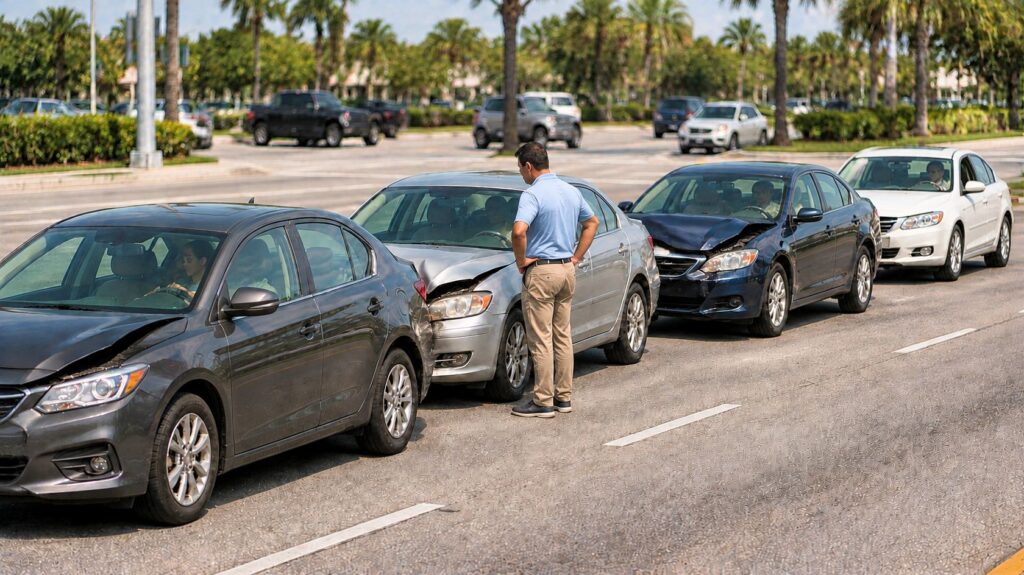
In Florida, liability in a multi-car accident is divided among every driver whose carelessness contributed to the crash, rather than falling automatically on the first or last driver. Under Florida Statutes §768.81, investigators examine each impact separately and assign each party a percentage of fault. Any person found more than 50% responsible cannot recover damages, while those 50% or less at fault have their compensation reduced by their share of blame.
Picture four cars lined up in Coral Springs traffic. Car A brakes hard. Car B taps Car A. Car C slams into Car B, and Car D finishes the chain. Who takes the blame? Most drivers point straight at the front car or the back car, yet Florida law looks closely at what every single person behind the wheel did in those few seconds.
Broward County recorded 38,338 crashes in 2024, compared with 381,423 across Florida. Broward’s crash rate reached 1,924.6 per 100,000 residents, well above the state rate of 1,654.2. Locally, Coral Springs reported a 4% drop in roadway crashes when comparing the same months from 2022 through 2024 across nearly 350 miles of roads. Even with lower local totals, multi-car crashes still happen at busy intersections, during lane merges, and in sudden traffic slowdowns.
Why Multi-Car Accidents Are Legally Different
Multi-car accidents differ legally from two-car crashes because a single pileup often involves several separate impacts caused by different careless acts. One driver may trigger the initial collision, while following drivers worsen the damage through tailgating or distraction. Investigators must link each driver’s conduct to specific impacts and injuries.
Think about what happens when four cars collide in a row. Car D hits last, so bystanders assume Car D caused the whole mess. What if Car B was tailgating from the start? What if Car C had plenty of room to stop but never looked up from a phone?
Four patterns show up often in multi-vehicle crashes:
- One driver causes the whole chain: A single driver fails to stop in time and pushes cars together. Nearby drivers act carefully and have no real chance to avoid the hits.
- Several drivers share the blame: One driver starts the pileup, and other drivers add to the damage through careless choices.
- Different impacts cause different harm: One crash happens at low speed, while a later hit causes severe injuries. Investigators often link specific injuries to specific impacts.
- An outside factor enters the picture: A bad brake part, a broken traffic light, or a road hazard may play a role when solid evidence backs it up.
How Does Florida Determine Who Caused the Crash?
Florida determines fault in a multi-car crash by evaluating whether each driver used reasonable care under the surrounding road, weather, and traffic conditions. Investigators review traffic citations, following distances, lane changes, and reaction times to decide whose negligence caused each collision.
Several traffic laws frequently come up in pileup investigations:
- Following too closely (Florida Statutes §316.0895): Drivers cannot follow another car closer than what is reasonable and prudent. Tailgating leaves zero cushion when traffic stops fast. Certain trucks and towing vehicles also face a 300-foot following rule outside business or residential districts.
- Careless driving (Florida Statutes §316.1925): Drivers must operate vehicles carefully with surrounding conditions in mind. Distraction, speeding in rain, or sudden braking can cross the line into careless driving.
- Lane changes and traffic signals: Rules like Florida Statutes §316.085 (lane changes and passing), §316.089 (laned roadways), §316.074 (traffic control devices), and §316.123 (stop and yield intersections) often apply when crashes start at intersections or during merges.
A traffic ticket helps tell the story, yet civil fault still requires proof of carelessness and causation.
Does the Last Driver Always Pay in a Rear-End Pileup?
No, the last driver in a Florida rear-end pileup does not automatically pay for every impact. While Florida law presumes a rear driver is negligent for hitting a car ahead, that presumption is rebuttable. Strong evidence of a lead driver’s sudden, careless maneuver can shift or split responsibility.
Three Florida cases show how courts view chain reactions:
- Pierce v. Progressive American Insurance Co. (1991): Four cars approached a traffic signal in crowded traffic. The lead car slowed to turn into a driveway, and a chain reaction followed. The last driver blamed earlier sudden stops, yet the court rejected that excuse because drivers in busy traffic should expect stops ahead.
- Clampitt v. D.J. Spencer Sales (2001): In a three-vehicle crash involving a semi-truck, the Florida Supreme Court explained why the rear-end presumption exists. People hit from behind rarely know why the rear driver failed to stop. Rebutting that presumption takes a strong, reasonable explanation, not a bare claim that traffic stopped fast.
- Birge v. Charron (2012): The Florida Supreme Court clarified that strong proof of a lead driver’s carelessness can rebut the presumption. Comparative fault still applies, and the presumption can also matter when an injured person was a passenger.
How Does Florida Split Fault Among Multiple Drivers?
Under Florida’s modified comparative negligence law (Florida Statutes §768.81), fault is divided by percentage among every person or entity that contributed to the crash. Each liable driver generally pays damages only in proportion to their own assigned share of fault, and anyone more than 50% responsible recovers nothing.
Suppose four drivers share responsibility for a pileup like this:
| Driver | Role in Collision | Sample Fault Share |
| Driver A | Unsafe lane change | 40% |
| Driver B | Following too closely | 30% |
| Driver C | Distracted driving | 20% |
| Driver D | Late braking | 10% |
Those numbers are just an example. In Florida, each liable party generally pays according to their own share of fault. If a driver has $100,000 in damages and one defendant has high coverage while another has almost none, the big policy does not automatically cover the entire bill.
What if a responsible driver is missing from the lawsuit or left the scene? Under §768.81 and the Florida Supreme Court’s decision in Fabre v. Marin (1993), a defendant can ask to allocate fault to a nonparty. The defendant must properly plead that nonparty’s fault, identify or describe them as specifically as possible, and prove their share by a preponderance of the evidence.
What If You Were Partly at Fault?
Under Florida Statutes §768.81(6), following tort reform law HB 837 (effective March 24, 2023), you cannot recover damages in a negligence claim if you are more than 50% at fault for your own harm. If your fault is 50% or less, your payout drops by your percentage. For example, $200,000 in damages with 20% fault leaves $160,000.
What If More Than One Driver Hurts You, or Someone Flees?
Yes, more than one driver can be held liable for your injuries if separate impacts contributed to your harm. When a driver flees the scene in a hit-and-run pileup, Uninsured Motorist (UM) coverage under Florida Statutes §627.727 may pay for your injuries if your policy applies.
In a multi-car crash, one car may push you into another car. A low-speed bump might happen first, followed by a hard hit from behind. Medical records, photos, and reconstruction help tie specific injuries to specific impacts. Defective seat belts, airbags, or seats can also worsen injuries and bring product-liability rules into play.
Hit-and-run drivers add another wrinkle. Simply spotting a car near the scene does not prove that driver caused your harm, so investigators look for physical contact or independent witness proof.
Which Insurance Policies Come Into Play?
Multiple insurance policies may apply after a Florida pileup, starting with your own Personal Injury Protection (PIP) coverage regardless of fault. Beyond PIP, injured people may file claims against each careless driver’s bodily injury liability policy or turn to their own Uninsured/Underinsured Motorist (UM/UIM) coverage.
Each insurer looks out for its own policyholder:
- Personal Injury Protection (PIP): Under Florida Statutes §627.736, PIP pays 80% of reasonable medical bills and 60% of lost wages up to $10,000, regardless of fault. You need initial medical care within 14 days, and a qualifying provider must diagnose an emergency medical condition for the full $10,000 medical cap (otherwise medical coverage caps at $2,500).
- Bodily injury liability: Florida generally does not require drivers to carry bodily injury coverage. When policies exist, multiple injured people may compete for limited policy dollars.
- UM/UIM coverage: Uninsured or underinsured motorist coverage can bridge gaps when an at-fault driver has no coverage or low limits. Having multiple policies does not let you collect the same damages twice.
How Do Investigators Piece Together a Pileup?
Investigators reconstruct a multi-car pileup by combining the official Florida crash report, vehicle dent patterns, scene photographs, camera footage, witness accounts, and electronic crash data. Comparing physical damage heights and impact angles helps reveal the exact order of collisions.
Here is how investigators build the timeline:
- The Florida crash report: Under Florida Statutes §316.066, officers file a long-form report within 10 days for crashes involving injury or complaints of pain. Statements in the report are generally inadmissible at trial, yet the report helps identify drivers, witnesses, and insurers.
- Vehicle damage and scene photos: Dent height, impact angles, and paint transfer show who hit whom and whether a car got pushed. Photos taken before tow trucks arrive are gold.
- Video footage: Dashcams, business cameras, and traffic cameras can show spacing, lane shifts, and brake lights. Video gets overwritten fast, so early checks matter.
- Witnesses and driver accounts: One witness may see the first hit while another sees the last. Investigators separate direct sight from guesswork.
- Accident reconstruction: When stories clash or injuries are severe, specialists analyze damage, road marks, and vehicle data to estimate speeds and impact order.
If you are involved in a multi-car crash, get medical care within 14 days, list every vehicle and driver (not just the first and last), photograph the scene, save video, and watch what you sign with insurers. Remember that the first insurer to call represents its own insured, not every driver in the pileup.
Common Misconceptions About Multi-Car Fault
| Common Myth | What Happens in Florida |
| The first driver is automatically liable for every car and injury. | Later drivers can share fault through tailgating, distraction, or unsafe moves. |
| The last driver in line always pays for the whole pileup. | The rear-end presumption is rebuttable, and each impact gets examined. |
| Every driver in a multi-car crash splits blame evenly. | Fault matches each person’s contribution to the crash and injuries. |
| One well-insured driver always covers the full judgment. | Liability is generally allocated by fault percentage, subject to policy limits. |
| A crash report proves legal fault in court. | It guides investigation, though statements in it are generally inadmissible at trial. |
How Long Do You Have to File a Claim in Florida?
Under Florida Statutes §95.11, you generally have two years from the date of a multi-car accident to file a personal injury lawsuit in Florida. Shorter deadlines apply to insurance benefits, including the 14-day window to seek initial medical care for PIP coverage and strict notice rules for government vehicle claims.
The 2023 tort reform law cut Florida’s general negligence deadline from four years to two years. Do not confuse the two-year court deadline with the shorter reporting requirements written into your auto insurance policy or Florida Statutes §768.28 for government agencies.
Contact Us
Coral Springs Office
9625 W. Sample Rd
Coral Springs, FL 33065
Tel: 954-866-HURT
(954-866-4878)
Fax: 954-334-1526
Frequently Asked Questions
If three cars crash and I was in the middle, am I automatically partly at fault?
No. Being stuck in the middle of a three-car crash does not automatically make you partly at fault. If you stopped safely with proper distance ahead and were pushed forward by a rear impact, fault generally rests with the driver behind you.
What if one driver in the chain has no bodily injury insurance?
If one at-fault driver in a multi-car crash lacks bodily injury insurance, you can still pursue claims against any other careless drivers who carry coverage. Your own Uninsured/Underinsured Motorist (UM/UIM) policy may also cover the gap if your policy includes it.
Can a passenger sue multiple drivers after a Florida pileup?
Yes. An injured passenger can file bodily injury claims against every driver whose negligence contributed to the pileup, including the driver of the car they rode in. Because passengers rarely cause collisions, their recovery is seldom reduced by comparative fault.
Talk With a Coral Springs Car Accident Team
Sorting out fault across several vehicles takes careful review of impact order, insurance policies, and medical records. At Reinfeld Cabrera Tison, we help injured drivers and passengers in Coral Springs, Fort Lauderdale, and across Broward County understand their options.
We work on a contingency fee basis, so you pay no attorney fees unless we recover compensation for you. Call (954) 866-4878 or reach out online for a free consultation.