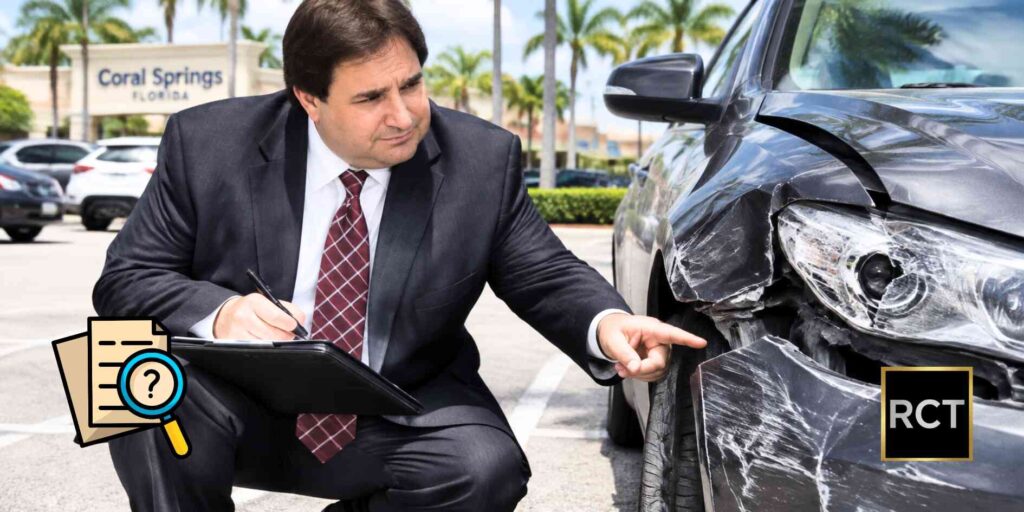
After a minor crash in Broward County, a car accident lawyer can inspect vehicle damage, preserve time-sensitive evidence, uncover insurance policy limits, and negotiate medical balances.
Broward County Attorney Tasks After a Crash Accident
After a crash in Broward County, a car accident lawyer may locate witnesses, obtain insurance information, investigate disputed facts, review medical charges, negotiate outstanding balances, and prepare a lawsuit if the insurer refuses to make a reasonable offer.
Some of that work runs on a clock. Nearby businesses may routinely overwrite security footage. Witnesses move or become hard to reach. A repaired car can no longer show what the crash did to it.
The same tasks apply after a relatively minor collision. A damaged bumper is easy to price. The insurance coverage behind the crash, the medical expenses that follow, and the amount you can realistically recover are harder to figure out.
Here are seven tasks a lawyer handles after a Broward County crash, and why each can affect what you end up with.
What Does a Car Accident Lawyer Do During an Investigation?
A crash report is a useful starting point. It is not a complete investigation.
An officer may document the drivers, vehicles, apparent damage, statements, and other information available at the scene. But the report may not identify every witness. It may not include footage from a nearby business. It certainly cannot establish every detail about how a collision happened.
How a lawyer finds witnesses and evidence after a car accident
An attorney can investigate beyond that initial record. Depending on the case, that may mean locating witnesses, requesting available video, reviewing photographs, examining vehicle damage, or hiring an investigator.
In an episode of the After the Crash podcast, former FBI agent Doug Kouns described how investigators search public information and social media for people who witnessed an accident. He recalled one case in which that work uncovered roughly half a dozen witnesses the legal team had not previously identified. Kouns also described investigators canvassing neighborhoods to ask residents whether their Ring doorbells had captured relevant footage.
His warning was simple: “People’s memories start to fade, witnesses move, and then they become hard to find.”
That is why an investigation may need to begin before a seemingly small detail disappears. A lawyer can also send preservation requests when relevant video or electronic records may be at risk of being overwritten.
How Does a Car Accident Lawyer Handle Insurance Claims?
A settlement discussion means little until someone understands the insurance policies that may pay the claim.
Finding out how much car insurance coverage is available
Florida Statute § 627.4137 gives a claimant a way to request information about known liability insurance policies. Following a proper written request, an insurer generally has 30 days to provide information including the insurer’s identity, the insured parties, coverage limits, available policy defenses, and a copy of the policy. The disclosure requirement also covers known excess or umbrella policies.
An attorney can make that request and examine the response. The lawyer may also review the injured person’s own policy to identify potentially relevant coverage, including uninsured or underinsured motorist protection.
This is not paperwork for its own sake. It helps establish the financial boundaries of a claim. A person may have substantial medical expenses but discover that the responsible driver has limited insurance. A lawsuit against that driver may be possible, but collecting a judgment can be a different problem if the driver has few assets.
A recent discussion in r/Car_Insurance_Help illustrates the confusion. A Fort Lauderdale poster said an insurance offer would not cover even half of the medical bills and asked whether negotiating alone made sense. One commenter urged the poster to find out the policy limits, explaining that a $10,000 limit would restrict what that policy could pay regardless of the size of the bills. Another commenter, who identified themselves as working in plaintiffs’ personal injury law, raised the possibility of other coverage and health insurance reimbursement.
The replies were not legal advice, and some of the insurance explanations were oversimplified. But the discussion points to a practical question a lawyer should answer early: What coverage is available, and what other sources of recovery may exist?
Can a lawyer deal with insurance adjusters and recorded statements?
After a collision, an adjuster may contact an injured person for a recorded statement, documents, medical information, or clarification about the accident. The requests can sound routine. The answers may later become part of the claim file.
A lawyer can review what the insurer is asking for, determine whether the client has a contractual obligation to respond, and handle communications where appropriate.
The distinction between insurers matters. An injured person generally does not have the same contractual duties to the other driver’s insurer that they may have to their own insurance company. A policyholder may have cooperation obligations under their own policy. Florida PIP coverage also has requirements that can include an examination under oath under § 627.736(6)(g).
Florida attorney Jeffrey D. Soud explains this distinction in his guide to recorded statements. The important point is that there is no single answer to every request for a statement. The identity of the insurer and the terms of the relevant policy matter.
When representing a client, an attorney can help prevent an informal conversation from becoming an avoidable problem. The lawyer can also organize the records the insurer needs instead of leaving the client to manage every request while dealing with treatment and recovery.
How Does a Lawyer Calculate and Negotiate a Car Accident Settlement?
A settlement figure is not the same as the amount the injured person receives.
Medical providers may still be owed money. Health insurers may assert reimbursement rights. Medicare or Medicaid may have interests in a recovery. A provider may have a lien or a letter of protection arrangement. The lawyer needs to identify these obligations before the client can make an informed decision about a proposed settlement.
Reviewing medical bills and negotiating outstanding balances
Florida Bar guidance on medical lien resolution explains that a lawyer handling a personal injury case has an ordinary responsibility to make reasonable efforts to identify medical liens and subrogation claims, advise the client about them, negotiate claims that can be negotiated, and distribute agreed payments appropriately. More complicated lien disputes may require separate arrangements, so clients should understand what their fee agreement includes.
There is another reason the medical records and bills deserve careful attention. Florida Statute § 768.0427 governs evidence of medical expenses in personal injury cases. The amount billed by a provider is not automatically the amount that can be presented as recoverable medical damages. The statute sets different evidentiary rules depending on whether charges have been paid, remain unpaid, or involve health coverage.
An attorney can review the billing records, identify outstanding balances, and assess how the applicable rules affect the damages calculation. The lawyer can also negotiate eligible balances when the representation agreement covers that work.
A discussion in r/Insurance shows why this part of a claim can surprise people. A poster described a $42,500 settlement in Texas but expected to receive only a small amount after attorney fees, medical balances, and other deductions. The post was not about Florida law, and its figures should not be treated as a guide to a Broward County case. It does illustrate why the gross settlement number tells only part of the story.
A good settlement review should explain the deductions before the client agrees to resolve the claim.
Preparing a car accident settlement demand
When the available evidence and medical information are sufficiently developed, the attorney may prepare a settlement demand.
That document should do more than list bills and request payment. It can explain how the collision occurred, why the available evidence supports the client’s account, what the medical records show, and how the injuries affected the person’s life. It should also address weaknesses the insurer may raise.
The supporting material may include medical records, billing statements, wage documentation, photographs, witness information, and other relevant evidence. The lawyer can organize those records into a coherent presentation and respond to an insurer’s questions about missing information or disputed charges.
The purpose is to give the adjuster a supported basis for evaluating the claim. It does not guarantee a particular offer. An insurer may still dispute responsibility, question the connection between the crash and an injury, or argue that the available coverage limits what it will pay.
If the offer does not account for the evidence, the attorney can explain why and negotiate further. The client, however, retains the decision whether to accept a settlement.
What Happens If a Car Accident Claim Goes to Court?
Some claims cannot be resolved through negotiations. If a lawsuit becomes necessary, the attorney’s work changes considerably.
The lawyer prepares and files the complaint, serves the appropriate defendants, responds to legal defenses, and manages the litigation schedule. The case may then involve discovery, the formal process through which parties obtain information and evidence from one another.
How a lawyer gathers evidence during a car accident lawsuit
Under Florida Rule of Civil Procedure 1.280, initial discovery disclosures generally include information about people with relevant knowledge, documents and electronically stored information, damage calculations, and applicable insurance agreements. The rule generally requires these disclosures within 60 days after service of the complaint or joinder unless the court sets a different time.
A lawyer may also seek records from people or organizations that are not parties to the lawsuit. Rule 1.351 provides a procedure for obtaining documents from nonparties by subpoena without deposing the person who holds them. Depending on the facts, that may help obtain relevant records from a business or another outside source.
The attorney may take depositions, question witnesses under oath, challenge evidence, and prepare the case for mediation or trial. Not every claim reaches that stage. The point is that filing suit gives the parties formal tools to investigate and present their positions when informal negotiations have reached a dead end.
How Much Does a Car Accident Lawyer Cost?
Many Florida car accident cases are handled through contingency fee agreements. The attorney’s fee depends on a recovery rather than an hourly bill, but the agreement should explain the percentage and how case expenses are handled.
Understanding contingency fees and case expenses
The Florida Bar’s consumer guidance describes the usual maximum contingency fee percentages for many personal injury cases. Before an answer is filed, the standard limit is generally 33⅓% of the first $1 million recovered. After an answer is filed, or the deadline to file one expires, the standard limit generally rises to 40% of the first $1 million. Different limits apply in certain circumstances, including when all defendants admit liability and the case proceeds only on damages. The written agreement should also explain litigation costs and whether they are deducted before or after the fee is calculated.
It is also worth remembering that a lawyer’s fee does not automatically mean a larger net recovery. In a discussion on r/Insurance, a poster described a previous claim in which the settlement amount after legal fees and medical bills seemed no better than the insurer’s earlier offer. Commenters disagreed about whether people with minor claims should handle them independently. Some argued that legal fees can outweigh the benefit in a straightforward case. Others pointed to policy limits and the difficulty of evaluating a claim without understanding the available coverage.
That disagreement is worth taking seriously. Legal representation has a cost. The relevant question is whether the investigation, insurance analysis, negotiation, and litigation work can provide enough value in the particular case to justify it.
How Do You Choose a Car Accident Lawyer in Broward County?
A law firm should be able to explain who will work on the claim and what the client can expect.
Questions to ask before hiring a car accident attorney
Will the attorney personally review the case? Who will communicate with the insurance adjuster? Who will explain settlement offers? How often will the client receive updates?
A Fort Lauderdale discussion in r/fortlauderdale raised similar concerns. The original poster described repeated back-and-forth with an insurer after being rear-ended and wondered whether speaking with a lawyer was premature. One commenter, who identified themselves as an insurance defense attorney, said representation may make sense when there is an actual injury requiring treatment or substantial vehicle damage.
The commenter also cautioned against assuming that every low-speed collision justifies a legal claim. Other replies offered personal experiences, including one person’s claim that hiring a lawyer increased their eventual settlement. Those anecdotes cannot establish what will happen in another case.
The useful lesson is that a consultation should involve more than a sales pitch. Ask what work the firm believes your case needs, who will perform it, and how the firm will keep you informed.
Speak With a Broward County Car Accident Lawyer
A lawyer cannot create insurance coverage that does not exist, guarantee a settlement, or promise that every claim will be worth pursuing. What an attorney can do is investigate the facts, identify available coverage, organize the evidence, address medical balances, and take the claim through litigation when necessary.
The information on this website is for general information purposes only. Nothing on this site should be taken as legal advice for any individual case or situation. This information is not intended to create, and receipt or viewing does not constitute, an attorney-client relationship.