
Written by Devin P Tison. Florida Bar Registered Attorney: Member Number: 95225
Reviewed by Alan J Reinfeld.
Last updated – November 2026
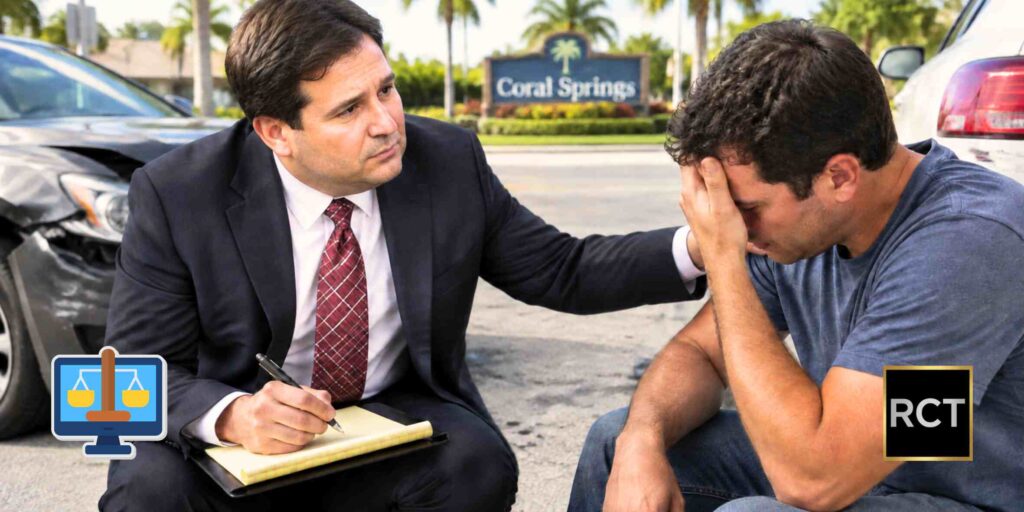
Short answer: a lot more than send a demand letter. Depending on your case, a car accident lawyer may investigate the crash, track down every insurance policy that could pay, collect your medical evidence, deal with insurers, negotiate medical liens, and prepare for litigation if negotiations fail.
You probably picture a lawyer’s job as writing a letter and haggling over a number. The reality is broader. An attorney may investigate how the collision happened, identify available insurance coverage, gather medical evidence, handle communications with insurers, negotiate outstanding medical bills, and prepare the case for litigation if negotiations fail.
That work can matter even after a crash that initially looks minor. A damaged bumper is easy to assess. The medical consequences, insurance arrangements, and financial impact of an injury can be considerably harder to establish.
So what does a car accident lawyer actually do once you hire one in Broward County? Below is what the work can involve, and why much of it happens long before anyone talks about a settlement.
In this guide you will find this relevant information about what an attorney in Broward County can do for you after a Car Crash:
- Investigating the accident beyond the police report
- Finding out which insurance policies may cover the claim
- Handling insurance company communications
- Building the medical evidence behind an injury claim
- Reviewing the settlement offer and calculating what you may actually receive
- Negotiating medical liens and reimbursement claims
- Preparing the case for litigation when negotiations fail
1. Investigating the accident beyond the police report
Think of the police report as the first page of the story, not the whole book. It is an important starting point. It is not necessarily the complete account of what happened.
An attorney may obtain the crash report, interview witnesses, collect photographs, review available surveillance footage, and investigate whether road conditions, vehicle defects, or other circumstances contributed to the collision.
Why speed matters. Time works against you here:
- Nearby businesses may routinely overwrite security footage.
- Witnesses move or become difficult to contact.
- Vehicles get repaired or sold, potentially eliminating physical evidence.
What investigators look for. In an episode of the After the Crash podcast, former FBI investigator Doug Kouns explained how investigators look for businesses with security cameras and people who may have recorded an incident on their phones. He described cases in which investigators located witnesses who had not initially been identified. His point was simple: useful evidence can exist well beyond the official I accident report. Listen to the interview with Doug Kouns.
Data from the vehicle itself. A lawyer may also arrange for a more technical investigation when the circumstances justify it. The National Highway Traffic Safety Administration’s explanation of Event Data Recorders describes how certain vehicles record technical information about vehicle movement, driver inputs, and safety systems around a crash. The precise information available depends on the vehicle and its equipment. Preserving and obtaining that information may require prompt action.
Not every minor collision needs a private investigator or accident reconstruction expert. The point is to identify what evidence could actually resolve a disputed issue before it disappears.
2. Finding out which insurance policies may cover the claim
Is the other driver’s policy the only place compensation can come from? People often assume so. That assumption can leave important questions unanswered.
An attorney can review the policies involved and investigate whether additional coverage may apply. Depending on the circumstances, this could include an employer’s commercial policy, coverage for a vehicle used for work, or the injured person’s own uninsured or underinsured motorist coverage.
Florida’s policy disclosure rule. Florida law also gives claimants a way to request information about known liability insurance policies. Under Florida Statutes § 627.4137, an insurer must generally provide specified information within 30 days of a written request. That information includes the insurer’s identity, the insured parties, policy limits, known coverage defenses, and a copy of the policy. The provision also covers known excess and umbrella policies.
Why does this matter? Because a claim cannot be evaluated properly without understanding the coverage potentially available to pay it.
A person may have a valid injury claim but discover that the at-fault driver’s policy has limited coverage. In that situation, identifying other applicable policies can become a central part of the case.
3. Handling insurance company communications
After a crash, insurance adjusters may request documents, ask questions about the collision, or seek a recorded statement. Some requests are routine. Others can affect how the insurer evaluates the claim.
A lawyer can handle communications with the opposing insurer, review requests, and help prevent incomplete or inaccurate information from becoming part of the claim file. The attorney can also distinguish between obligations under the injured person’s own insurance policy and requests made by another driver’s insurer.
Your insurer versus theirs. That distinction matters. Your own policy may contain cooperation requirements. You generally do not have the same contractual obligations to the other driver’s insurer simply because its adjuster asks for a statement.
Representation does not mean refusing every request or treating every adjuster as an adversary. It means understanding what is being requested, why it matters, and whether a response could create problems later.
4. Building the medical evidence behind an injury claim
A diagnosis alone does not necessarily explain the full impact of an accident. An injury claim may require:
- Medical records and treatment histories
- Imaging results
- Physician opinions
- Documentation of how symptoms affect everyday activities or the ability to work
A lawyer’s office may collect records from different providers, organize bills, follow up on missing documents, and prepare a medical chronology. When the connection between the collision and an injury is disputed, the attorney may also review whether additional medical evidence or expert testimony is appropriate.
Florida’s rules on medical expense evidence. These rules make this work particularly important. Florida Statutes § 768.0427 addresses how past and future medical expenses may be established in personal injury litigation. It includes provisions concerning health care coverage, letters of protection, and the evidence used to establish medical charges.
The practical issue is that a stack of invoices does not automatically establish what medical expenses are recoverable in a lawsuit. The source of payment, amounts actually paid, outstanding charges, and applicable statutory requirements can all matter.
Lost income. An attorney may also help organize evidence of lost income. Pay records, employer statements, work schedules, and documentation of missed opportunities can help explain financial losses that do not appear on a hospital bill.
5. Reviewing the settlement offer and calculating what you may actually receive
A settlement figure can sound impressive until the deductions are accounted for.
Attorney fees, case expenses, outstanding medical bills, and valid reimbursement claims may all affect the amount a client ultimately receives. That is why evaluating an offer involves more than comparing it with the total amount of medical invoices.
A real-world example of the confusion. A discussion in r/Insurance about a $100,000 settlement and 40% attorney fees illustrates the kind of confusion people experience. The original poster was concerned about how much would remain after fees and medical treatment. Across similar discussions, people debate whether an attorney’s contribution justified the percentage, whether medical providers’ bills could have been reduced, and whether the injured person would have received a comparable offer without representation.
The disagreement is worth paying attention to. Some commenters argue that legal fees can consume too much of a modest recovery. Others point out that negotiating medical balances and obtaining a stronger settlement can change the final calculation.
What your lawyer should show you. A lawyer should be able to explain the numbers rather than simply announce a gross settlement amount. That means identifying the fee, case expenses, outstanding balances, and expected net recovery before asking a client to approve a settlement.
6. Negotiating medical liens and reimbursement claims
Medical treatment can create financial obligations that remain after an insurance claim settles. Who might come asking for repayment?
- A health insurer may have a reimbursement or subrogation claim.
- A hospital or medical provider may assert a lien.
- Medicare or Medicaid may also have recovery rights in circumstances where those programs paid accident-related expenses.
An attorney can investigate whether these claims exist, determine whether they are valid, and make reasonable efforts to negotiate those that can be negotiated.
What the Florida Bar rule says. Florida Bar Rule 4-1.5 addresses attorney fees and costs, including contingency fee agreements. The Florida Supreme Court has also addressed the relationship between personal injury representation and medical lien resolution. This is an area where the exact scope of the lawyer’s work should be made clear in the fee agreement.
This work can directly affect the client’s final recovery. A settlement that looks adequate before outstanding medical obligations are addressed may leave considerably less money than expected.
7. Preparing the case for litigation when negotiations fail
Most clients hope to resolve an injury claim without going to trial. Still, a lawyer’s work should not stop at writing a demand letter and waiting for an insurance company to respond.
If negotiations do not produce an acceptable result, the attorney may:
- File a lawsuit
- Conduct discovery
- Obtain documents from other parties
- Question witnesses under oath
- Retain experts
- Prepare the case for trial
Initial disclosures. Florida’s civil procedure rules establish disclosure obligations once a covered lawsuit is underway. Under Rule 1.280, parties generally must provide initial disclosures within 60 days after service of the complaint or joinder, unless an exemption or court order applies. These disclosures can include people with relevant information, supporting documents, evidence concerning claimed damages, and applicable insurance policies.
That process can expose information that was not available during informal insurance negotiations. It can also require substantial preparation. Whether litigation makes financial sense depends on the strength of the claim, the available coverage, the likely recovery, and the costs involved.
What do people actually expect a car accident lawyer to do?
Online discussions about accident claims show that people do not always agree about the value of hiring an attorney. Some are frustrated by fees. Others are unsure what happens to their settlement after medical providers and insurers are paid. Two recent examples show the range of views.
“Was the lawyer worth it?” In a July 2026 r/Insurance discussion about handling a new accident without a lawyer, the original poster described a previous experience in which the insurer had made an offer before an attorney was hired. After attorney fees and medical bills, the poster felt the final amount was about the same. Several commenters agreed that handling a relatively small claim independently can make financial sense. Others argued that representation becomes more valuable when injuries are serious or coverage is complicated. One commenter questioned whether insurers have an incentive to offer the same amount to someone negotiating alone.
“Is this offer too early?” Another recurring concern is accepting an offer before the medical picture is clear. In an October 2026 discussion from someone injured in Fort Lauderdale, the poster said the insurer’s offer barely covered existing bills while treatment was still underway. One reply suggested asking the doctor about maximum medical improvement, while others emphasized that the final cost of treatment was not yet known. The exchange illustrates why reviewing medical progress and the terms of a proposed release can be part of an attorney’s work before a settlement is accepted.
These conversations also expose a point that is easy to overlook: a lawyer’s contribution is not measured only by the size of the check from the insurance company. The investigation, coverage review, medical documentation, and negotiation of outstanding obligations can all affect the final result.
Does every claim need an attorney? That does not mean every claim needs an attorney. For a straightforward property damage claim with no injury, legal representation may add little value. For an injury claim involving disputed medical evidence, limited coverage, or substantial outstanding bills, the work can be considerably more involved.
How much does a car accident lawyer cost in Florida?
Many personal injury lawyers handle car accident cases under contingency fee agreements. Instead of paying an hourly rate or a large retainer upfront, the client agrees that the lawyer will receive a percentage of the money recovered.
What percentage do Florida car accident lawyers charge?
A common reference point is 33⅓% of the recovery if the case settles before the defendant files an answer or the deadline to do so expires. If the case proceeds beyond that stage, the standard presumptive limit generally increases to 40% of the first $1 million recovered through judgment. Different percentages apply to amounts above $1 million. These are the limits set out in Florida’s contingency fee rules for typical personal injury cases, not mandatory rates. A lawyer can agree to charge less.
The Florida Bar’s consumer guide to attorney fees explains these percentages and how contingency arrangements work. The written agreement must also explain case expenses and whether they are deducted before or after the attorney’s percentage is calculated.
What about the initial consultation?
In a contingency fee arrangement, the attorney generally receives no attorney fee unless money is recovered. However, case expenses such as filing fees, records, expert witnesses, or investigation costs may be treated separately under the written agreement. Ask whether those expenses are advanced by the firm and whether you could be responsible for them if the case does not result in a recovery.
Before you sign, ask:
- Is the fee 33⅓% or 40%, and what event changes the percentage?
- Are expenses deducted before or after the attorney’s fee?
- What happens to case expenses if there is no recovery?
- What work involving medical liens is included?
You should understand the financial arrangement before the firm begins handling the claim.
Coral Springs Office
9625 W. Sample Rd
Coral Springs, FL 33065
Tel: 954-866-HURT
(954-866-4878)
Fax: 954-334-1526
What should you expect from your attorney?
A lawyer should be able to explain what is happening in your case without making you chase basic updates. You should know:
- What evidence is being collected
- Which insurance policies are being investigated
- What remains outstanding
- What decisions require your approval
The Florida Bar’s clients’ rights guide recognizes a client’s right to make the ultimate decisions about the objectives of the representation. Hiring an attorney does not mean handing over control of your claim.
If you are considering representation after a car accident in Coral Springs or elsewhere in Broward County, ask what the firm will actually do, who will handle the day-to-day work, and how often you can expect updates.
A good legal strategy should be built around the facts of your accident and the losses you can establish. It should also account for the cost of pursuing the claim. The objective is not to generate activity for its own sake. It is to understand the available recovery and take the steps that give the claim a sound basis.
Frequently asked questions
What does a car accident lawyer do after a minor crash?
Depending on the circumstances, an attorney may investigate how the collision happened, identify available insurance coverage, gather medical evidence, handle communications with insurers, negotiate outstanding medical bills, and prepare the case for litigation if negotiations fail.
Can a lawyer find insurance coverage beyond the other driver’s policy?
Potentially. An attorney can investigate additional coverage, such as an employer’s commercial policy, coverage for a vehicle used for work, or your own uninsured or underinsured motorist coverage. Under Florida Statutes § 627.4137, an insurer must generally provide specified policy information within 30 days of a written request.
Do I have to give the other driver’s insurer a recorded statement?
Your own policy may contain cooperation requirements. You generally do not have the same contractual obligations to the other driver’s insurer simply because its adjuster asks for a statement.
Who deals with medical liens after a settlement?
The lawyer’s responsibilities should be explained in the fee agreement. The Florida Bar’s Rules Regulating the Florida Bar address attorney fees and costs, including contingency fee arrangements and the scope of representation.
How much does a car accident lawyer cost in Florida?
Many personal injury lawyers work under contingency fee agreements. A common reference point is 33⅓% before the defendant files an answer or the deadline expires, and up to 40% after that stage through judgment. The exact fee and responsibility for case expenses should be explained in the written agreement.
Does RCT charge for an initial consultation?
No. RCT does not charge for the initial consultation. You can discuss your accident and ask about the potential claim and fee arrangement without paying a consultation fee.
Does every car accident claim need a lawyer?
No. For a straightforward property damage claim with no injury, legal representation may add little value. For an injury claim involving disputed medical evidence, limited coverage, or substantial outstanding bills, the work can be considerably more involved.