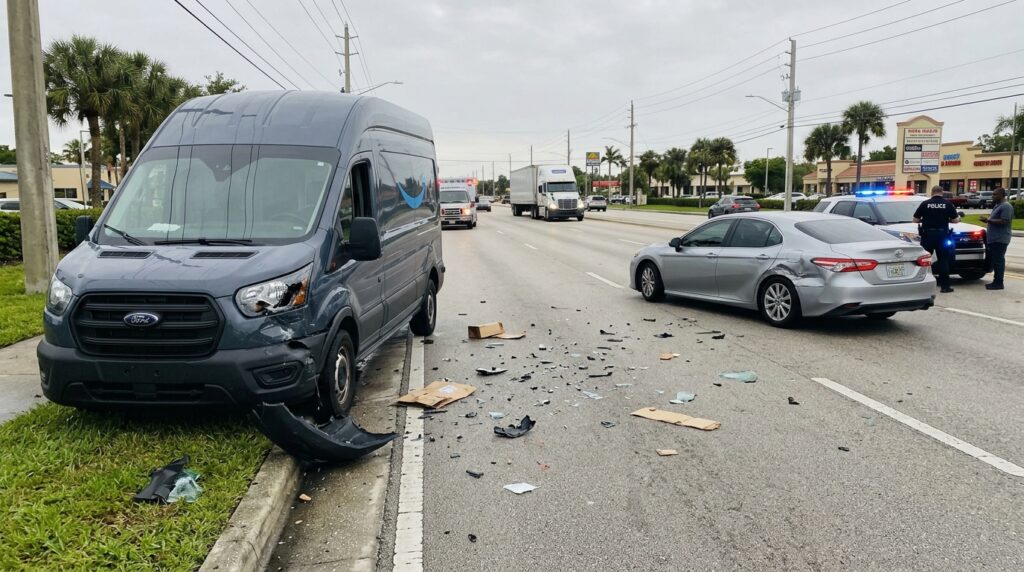
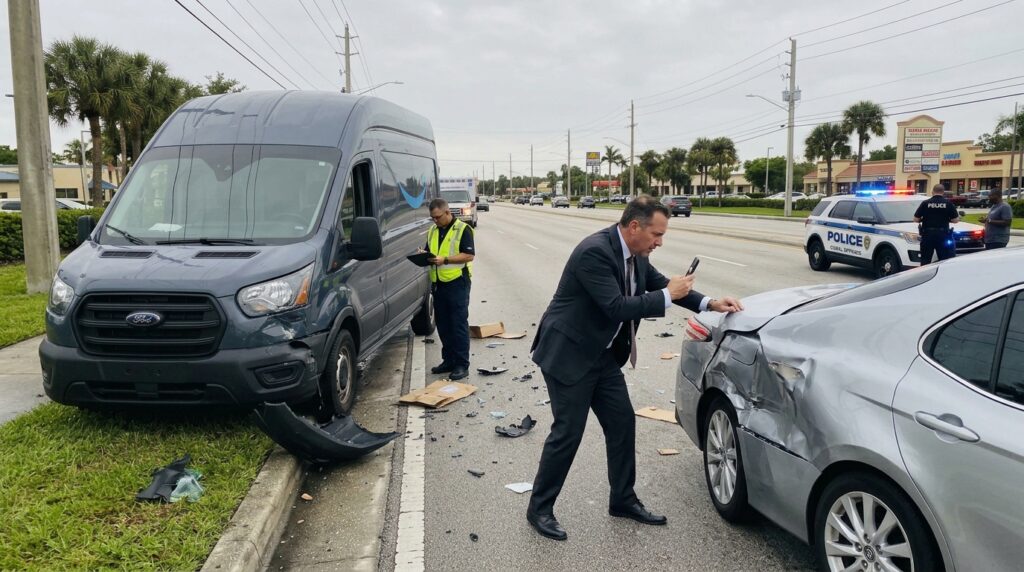
If you are hit by a commercial truck or delivery van in Florida, liability can extend beyond the driver to the trucking company, cargo loaders, and fleet maintenance contractors.
Under federal regulations (49 CFR § 387.9) and state guidelines, commercial motor vehicles must carry between $750,000 and $5,000,000+ in liability insurance. Always depending on vehicle weight and cargo classification. Victims can recover damages under Florida’s modified comparative negligence framework provided their fault does not exceed 50%.
Let’s be honest: sharing the Sawgrass Expressway or University Drive with an 80,000-pound tractor-trailer or a rushing 10-ton delivery box truck is enough to make anyone grip the steering wheel a little tighter.
We live in an era powered by instant shipping. This means South Florida roads are constantly packed with overworked drivers. Amazon Flex drivers, rushed FedEx couriers, and massive commercial freight rigs.
When one of these steel giants crushes a standard passenger vehicle, it isn’t just a basic fender-bender. You aren’t just exchanging insurance cards with a polite motorist. You are instantly up against a corporate legal engine whose sole job is to protect company assets. They will try to minimize your payout before your ambulance even reaches the hospital.
1. Understanding Commercial Fleet Liability: Who Is Actually Responsible?
In a standard car crash, you usually sue the driver who hit you. But when a commercial truck or delivery van smashes into your vehicle, the Web of Liability™ becomes significantly more complex. Under the legal doctrine of respondeat superior (employer liability) and federal motor carrier regulations, multiple corporate parties can be held accountable:
The Logistics / Trucking Company: For enforcing unrealistic delivery quotas that induce driver fatigue, committing negligent hiring practices, or failing to conduct mandatory drug screenings.
Freight Brokers and Freight Forwarders: Corporate intermediaries that contract unqualified, dangerous fleets simply to cut route costs.
Third-Party Cargo Loading Contractors: When improperly balanced or poorly secured cargo shifts mid-transit, causing catastrophic jackknives or rollover crashes.
Fleet Maintenance Providers: When brake failures, blown retread tires, or steering mechanical glitches trace back to skipped mandatory vehicle inspections.
The silver lining in a severe commercial vehicle collision? Unlike average Florida motorists who carry low personal liability coverage, commercial fleets are governed by strict federal and state coverage mandates.
Under 49 CFR § 387.9 and Federal Motor Carrier Safety Administration (FMCSA) standards, minimum mandatory policy limits include:
$1,000,000 minimum: For oil transport, hazardous material fleets, and large commercial operations.
$5,000,000 minimum: For heavy hazardous bulk cargo and bulk petroleum transports.
These high policy limits mean substantial financial assets exist to cover traumatic brain injuries (TBI), spinal cord damage, surgeries, and permanent disability—provided your legal team knows how to penetrate corporate insurance defenses.
3. Case Studies: How Commercial Trucking Claims Play Out in Court
Examining real-world precedents demonstrates how federal safety violations and corporate negligence impact commercial collision claims:
Case Study 1: Federal Hours-of-Service (HOS) & Unqualified Driver Negligence
The Scenario: A commercial semi-truck slammed into stopped traffic on a Florida highway at full speed.
The Legal Breakdown: Investigations revealed the truck driver was operating without a valid Commercial Driver’s License (CDL), actively using a mobile phone, and exceeding federal maximum Hours-of-Service (HOS) limits. Furthermore, the motor carrier failed to conduct basic background screening prior to dispatch.
Key Takeaway: Demonstrating gross corporate negligence in hiring and supervising drivers allows victims to pursue punitive damages well beyond standard compensatory insurance policies.
Case Study 2: Disputing Pre-Existing Conditions vs. New Spinal Trauma
The Scenario: A delivery van rear-ended a passenger sedan at moderate speeds. The commercial insurer offered a sub-par settlement, alleging the plaintiff’s severe back pain stemmed from a subsequent, unrelated incident.
The Legal Breakdown: Plaintiff’s counsel utilized radiofrequency ablation treatment logs and sequential medical imaging boards to prove the severe cervical and lumbar trauma directly originated from the delivery van impact.
Key Takeaway: Corporate insurers will frequently blame prior or subsequent events for your injuries. Detailed medical testimony and demonstrative timeline exhibits are vital to securing full multi-million-dollar recoveries.
4. How Florida’s Modified Comparative Fault Rule Applies to Truck Accidents
Corporate insurance defense attorneys love to point fingers at the occupant of the smaller car. Under Florida’s modified comparative negligence law, you can recover compensation as long as you are determined to be 50% or less at fault for the crash.
If an Amazon delivery van cuts across three lanes on Sample Road without signaling, but the corporate defense team claims you were driving 5 mph over the limit, they will attempt to assign you partial fault to slash your settlement. Our job is using scene telemetry and accident reconstruction to prove the commercial driver’s negligence was the primary cause of the wreck.
5. Critical Evidence Required to Win a Commercial Fleet Case
Commercial trucking firms employ rapid-response teams of adjusters sent directly to crash sites to preserve corporate interests. To fight back, we issue immediate legal Spoliation Letters to freeze and extract vital evidence before it disappears:
Electronic Logging Devices (ELD): Federal mandates (49 CFR Part 395) track hours behind the wheel to catch dangerous Hours of Service (HOS) violations.
Telematics & Dash-Cam Telemetry: Internal cab cameras and speed-tracking metrics showing sudden braking, rapid acceleration, or distracted driving.
Driver Qualification Files (DQF): Background check records, medical examiner certifications, and previous crash logs.
Maintenance & Inspection Records: Proof of whether brake pads, tires, and steering linkages were properly serviced prior to the crash.
Frequently Asked Questions About Commercial Truck Accidents in Florida
Q: Who do I sue if I am hit by an Amazon, UPS, or FedEx delivery van?
A: Liability depends on whether the driver is an employee or an independent contractor (such as an Amazon DSP owner or Flex driver). In most cases, claims are pursued directly against the delivery company’s primary commercial policy, which typically carries up to $1,000,000 in coverage.
Q: How long do I have to file a commercial truck accident lawsuit in Florida?
A: Under Florida’s updated personal injury statute of limitations, you generally have two (2) years from the date of the crash to file a personal injury lawsuit. However, key digital evidence like ELD logs can be legally overwritten in as little as 30 days, making immediate legal action critical.
Q: What if the truck driver claims they were forced to drive long hours by their employer?
A: Under FMCSA rules (49 CFR Part 395), employers cannot force or coerce drivers to exceed daily driving limits. If a fleet company coerced a driver to violate Hours of Service rules, the company faces severe statutory penalties and potential punitive damage exposure.
Q: Can I still recover damages if the trucking company declares bankruptcy after an accident?
A: Yes. Personal injury claims are paid out by the commercial liability insurance provider that insured the fleet at the time of the crash, not directly from the liquid operational assets of a bankrupt entity.
Q: What makes commercial vehicle collisions different from standard auto accidents?
A: Commercial collisions involve much higher insurance coverage limits, federal regulations (FMCSA rules), multi-party liability, and specialized electronic evidence like black boxes and ELD logs that require immediate legal preservation.
Injured in a Commercial Truck or Delivery Van Crash in South Florida?
Do not attempt to negotiate with corporate risk management teams on your own. At Reinfeld Cabrera Tison, we know how to audit driver logs, subpoena telematics data, and hold negligent fleet operators accountable.
Call Our Office Today: Speak directly with our team at 954-866-4878 for a free, no-nonsense case evaluation.
The information on this website is for general information purposes only. Nothing on this site should be taken as legal advice for any individual case or situation. This information is not intended to create, and receipt or viewing does not constitute, an attorney-client relationship.