
Quick Answer:
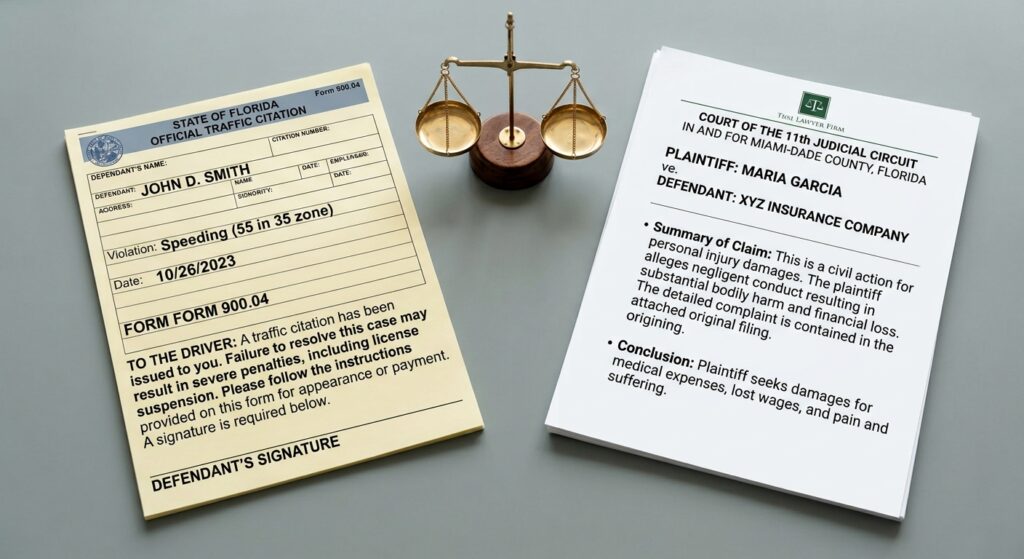
In Florida, receiving a traffic ticket after an accident is not automatic proof of civil liability, nor does paying a ticket constitute an admission of fault in a personal injury lawsuit. Under Fla. Stat. § 316.650, the citation itself is generally inadmissible in civil court to prove negligence. However, the investigating officer’s physical findings, traffic court dispositions (such as formal guilty pleas), and driver statements can heavily influence insurance negotiations and percentage of fault under Florida’s modified comparative fault rule (Fla. Stat. § 768.81).
Most drivers assume that a police officer’s traffic ticket settles the question of who pays for a crash. In reality, Florida traffic enforcement and civil personal injury law operate on two completely separate tracks.
A traffic citation is an administrative matter between a driver and the State of Florida. A personal injury claim is a civil dispute over financial losses between private parties. Because an investigating officer rarely witnesses a collision firsthand, their decision to issue a ticket carries far less weight in a civil injury claim than insurance adjusters want you to believe.
Understanding the boundary between traffic court and civil liability is essential for protecting your right to compensation after a collision in Broward County.
Traffic Court vs. Civil Injury Claims in Florida
To understand how a traffic ticket fits into your personal injury case, you must separate criminal/administrative traffic violations from civil personal injury claims.
┌────────────────────────────────────────────────────────┐
│                   THE TWO LEGAL TRACKS                 │
├───────────────────────────┬────────────────────────────┤
│       TRAFFIC COURT       │     CIVIL INJURY CLAIM     │
├───────────────────────────┼────────────────────────────┤
│ State / County vs. Driver │ Injured Plaintiff vs. At   │
│                           │ Fault Driver               │
├───────────────────────────┼────────────────────────────┤
│ Punishes traffic law      │ Recovers financial losses  │
│ violations                │ (Medical bills, lost pay)  │
├───────────────────────────┼────────────────────────────┤
│ Penalty: Fines, points,   │ Outcome: Money damages     │
│ license suspension        │ settlements / verdicts     │
└───────────────────────────┴────────────────────────────┘
When a Broward County Sheriff Deputy, Coral Springs Police Officer, or Fort Lauderdale Police Officer writes a traffic ticket at an accident scene, they are enforcing state traffic statutes. They are not awarding monetary damages to the injured parties.
Does Getting a Ticket Mean You Are Automatically at Fault?
In Florida personal injury litigation, a traffic citation is evidence of potential negligence, not definitive proof of civil liability.
Under Florida evidentiary rules (Fla. Stat. § 316.650), the mere fact that a police officer issued a citation is generally inadmissible in a civil trial to prove negligence.
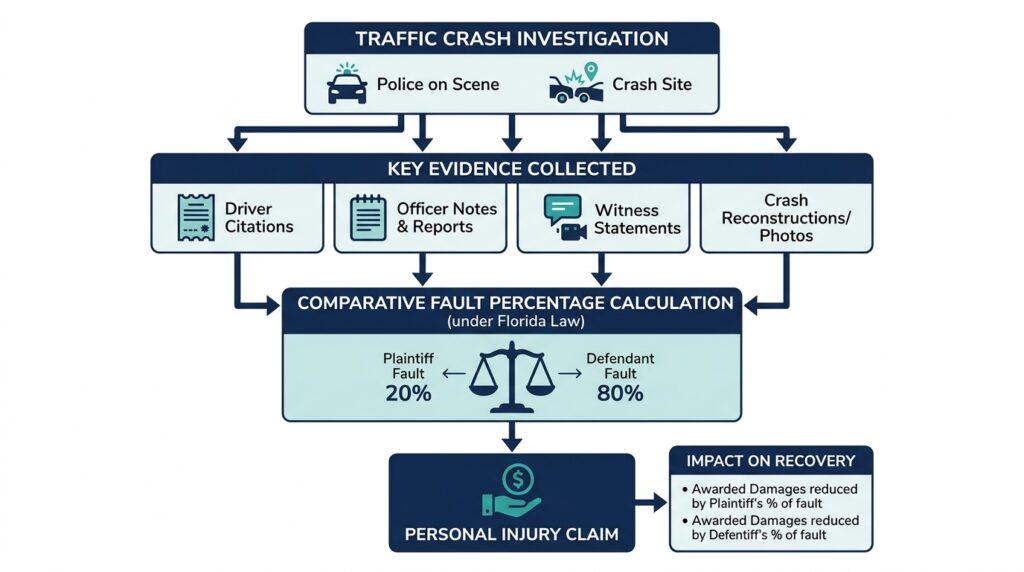
Why? Because the investigating officer rarely witnesses the crash firsthand. Their decision to issue a ticket is based on post collision observations, driver statements, and physical debris. A civil jury must evaluate the underlying facts themselves rather than relying on an officer’s opinion.
Exceptions Where Traffic Tickets Impact Your Civil Case
While the ticket itself might not be read aloud to a jury, the facts surrounding it heavily influence your claim:
- Plea of Guilty: If the cited driver pays the ticket or enters a formal plea of guilty in Broward County traffic court, that guilty plea can be introduced in your personal injury case as an admission against interest.
- Nolo Contendere (No Contest): If the driver elects to pay the fine, attend traffic school, or plead “no contest” without admitting guilt, Florida courts typically exclude that plea from the civil injury trial.
- Officer Testimony: The officer can testify about what they physically saw at the crash scene (skid marks, vehicle positioning, point of impact) even if their opinion on who was “at fault” is excluded.
How Comparative Fault Works After a Broward County Crash
Florida operates under a modified comparative fault rule (Fla. Stat. § 768.81). This means your financial recovery is reduced by your percentage of responsibility for the crash. Furthermore, if you are found to be more than 50% at fault, you are barred from recovering any compensation from the other driver.
Insurance adjusters love to use traffic tickets as leverage during settlement negotiations.
- Scenario A (The Other Driver Got a Ticket): If the other driver was cited for reckless driving, running a red light, or speeding, their insurance company knows a jury will likely view them unfavorably. This increases your settlement leverage.
- Scenario B (You Got a Ticket): If you received a ticket (e.g., for an expired tag or a minor lane change infraction), the insurance adjuster will try to claim you were primarily at fault. However, an experienced personal injury attorney can demonstrate that your minor traffic infraction did not cause the collision.
Key Takeaway: Receiving a ticket does not prevent you from filing an injury claim if the other driver’s reckless actions caused the crash.
Common Citations Issued After Broward County Car Accidents
Certain traffic violations carry heavy weight when establishing driver negligence in civil negotiations:
- Careless Driving (Fla. Stat. § 316.1925): The catch all citation given when a driver fails to operate their vehicle in a careful and prudent manner. Common in rear end collisions.
- Reckless Driving (Fla. Stat. § 316.192): Issued when a driver acts with willful or wanton disregard for the safety of people or property. Extremely useful for establishing gross negligence.
- Failure to Yield Right of Way (Fla. Stat. § 316.123): Common in intersection collisions along major corridors like University Drive, Sample Road, and Cypress Creek Road.
- Driving Under the Influence (Fla. Stat. § 316.193): DUI citations open the door for punitive damages in a civil lawsuit, going beyond standard medical reimbursement to punish the intoxicated driver.
What to Do If You Receive a Citation After an Accident
If you are involved in a collision in Coral Springs, Fort Lauderdale, or anywhere in Broward County and the police hand you a ticket, follow these steps to protect both your traffic record and your civil injury claim:
- Do Not Argue with the Officer: State your facts calmly. Arguing at the scene will not change the officer’s mind and can create hostile notes in the police report.
- Do Not Admit Fault: Avoid saying “I’m sorry,” “I didn’t see them,” or “I was distracted.” Stick strictly to the physical facts.
- Consult an Attorney Before Paying the Ticket: Simply paying the fine online seems convenient, but paying a ticket can be construed as an admission of responsibility. Speak with legal counsel before making a court election.
- Gather Independent Evidence: Take photographs of vehicle damage, road conditions, traffic signals, skid marks, and visible injuries. Collect contact information from independent eyewitnesses.
Frequently Asked Questions
Can I still file an injury claim if I received a ticket after the crash?
- Yes. Receiving a traffic ticket does not automatically disqualify you from recovering compensation. Under Florida’s modified comparative fault law, you can recover damages as long as you were not more than 50% responsible for the accident.
Will the police officer’s crash report prove who was at fault in court?
- No. Police crash reports are generally inadmissible in Florida civil trials under the accident report privilege (Fla. Stat. § 316.066). Statements made to the investigating officer cannot be used against you in court, though independent physical evidence collected by the officer can be presented.
What happens if the other driver pays their traffic ticket?
- If the other driver pays their fine without contesting it, or if they plead guilty in Broward County traffic court, that action can serve as valuable supporting evidence of negligence during insurance negotiations or civil court proceedings.
Should I go to traffic court for my citation after an accident?
- Yes, in most cases. Contesting the ticket or withholding adjudication in traffic court prevents a formal guilty conviction on your record, helping shield your civil personal injury claim from harmful admissions of fault.
Protecting Your Civil Claim After a Broward County Crash
A traffic ticket is just one piece of a complex legal puzzle after an automobile accident. Do not let an insurance adjuster use a citation to pressure you into accepting a lowball settlement or abandoning your claim altogether.
The personal injury attorneys at RCT Law protect crash victims across Coral Springs, Fort Lauderdale, and all of Broward County. We investigate the real causes of your collision, analyze police records, and fight to ensure you receive the full compensation you deserve.
Schedule a Free Case Evaluation
- Direct Telephone: (954) 866 4878 | Toll Free: (954) 866 HURT
- Coral Springs Office: 9625 W Sample Rd, Coral Springs, FL 33065
- Fort Lauderdale Office: 2933 W Cypress Creek Rd, Suite 201, Ft Lauderdale, FL 33309
- Website: lawrct.com
- Geographic Coverage: Coral Springs, Fort Lauderdale, Parkland, Tamarac, Margate, and all surrounding communities across Broward County.