Can You Sue Uber or Lyft After a Rideshare Accident in Florida?
Yes, but dealing with rideshare insurance feels like trying to crack a vault buried inside a maze. Florida law mandates heavy commercial coverage tiers under Florida Statute § 627.748. Yet corporate adjusters specialize in inventing reasons why your specific ride does not qualify.
Whether you were riding as a passenger staring at a shattered dashboard or getting clipped by a distracted driver at University Drive, the process is tedious. Getting paid requires proving which exact insurance tier applies during the exact second the metal crunched.
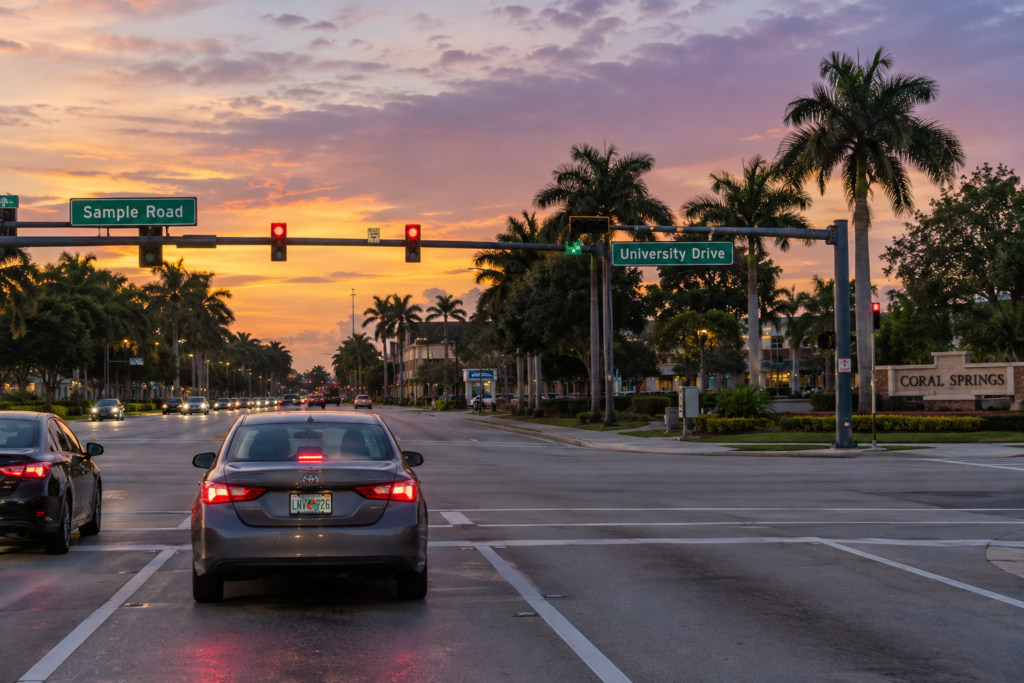
Getting into an Uber or Lyft around Coral Springs is supposed to be the easy part of going out. Instead, you end up trapped in the back seat while your driver steers with one knee. You see him type an address into a glowing dashboard screen. And then tries to merge across three lanes of traffic on Sample Road.
Rideshare corporations spend millions perfecting the art of corporate dodging. They call drivers independent contractors so they can shrug their shoulders whenever a bumper gets totaled.
Cutting through that thick layer of corporate nonsense requires experienced attorneys. Someone who knows how to strip away the excuses and track down the real policy limits.
1. What Are the Florida Insurance Coverage Tiers for Uber and Lyft Accidents?
Florida rideshare insurance is divided into statutory tiers based entirely on the status of the driver digital application at the exact moment of impact.
App Turned Off: When the driver is offline, they rely strictly on personal car insurance. Uber and Lyft wash their hands completely and offer zero financial protection.
App Waiting for a Request: When the driver is logged in and cruising around looking for a ping, a baseline commercial policy ($50k/$100k/$25k) activates under state law to cover initial damages.
En Route to Pickup Location: The instant a driver accepts a fare through the app, the higher $1 million commercial liability coverage immediately triggers even before the passenger steps inside.
App Active with a Passenger Aboard: During active transport, the one million dollar commercial policy remains fully active under Fla. Stat. § 627.748. This top tier covers passengers, pedestrians, and anyone else caught in the crossfire.
2. How Does the Florida First Dollar Rule Apply to Rideshare Injury Claims?
State law provides explicit statutory protections that prevent rideshare insurers from stalling claims by forcing personal auto insurance companies to issue formal denials first.
Eliminating Insurance Ping Pong: Because of Florida Statute § 627.748(7)(e), commercial rideshare coverage must respond immediately without waiting for a personal insurance carrier to review or deny the claim.
Mandatory App Log Disclosures: Under Florida Statute § 627.748(8)(d), transportation network companies are legally required to provide the exact digital timestamps showing when a driver logged on and off the app in the hours surrounding a crash.
First Dollar Primary Protection: With Florida Statute § 627.748(7)(d), if a driver’s personal policy lapses or excludes commercial activity, the TNC policy must pay claims starting from the very first dollar.
Locking Down the Evidence: Subpoenaing these exact digital server logs strips away corporate deniability and exposes whether a commercial policy must answer for your medical bills and lost wages.
3. What Are the Most Common Causes of Rideshare Crashes in Coral Springs?
High traffic South Florida corridors turn everyday digital multitasking into severe road hazards for local commuters and pedestrians.
The Dashboard Stare: Drivers treat GPS screens like sacred texts, missing red lights because they are hunting for a digital tip prompt or a new fare.
The Sudden Emergency Pullover: Spotting an apartment complex entrance causes drivers to jam on the brakes and swerve across bike lanes without a second thought.
Unfamiliarity with Local Roads: Out-of-town rideshare drivers frequently make dangerous, last-second lane chops along busy thoroughfares like University Drive and Sample Road.
The Exhaustion Factor: Working three different delivery and rideshare shifts back to back turns otherwise normal drivers into sleep deprived zombies piloting two tons of steel.
4. How Do Florida Courts and Case Precedents Handle Rideshare Liability?
Navigating rideshare litigation requires matching digital evidence trails against established transportation network statutes and local court interpretations.
Case Study 1: The Offline App Dispute on University Drive
The Incident: A rideshare driver slammed into a local pedestrian near Coral Square Mall. The corporate insurance carrier immediately denied liability, claiming the driver was completely logged off and driving for personal errands.
The Evidence: Our legal team subpoenaed cellular tower records and app ping logs under statutory disclosure rules. The data proved the driver accepted a trip request forty five seconds before impact.
The Outcome: Forcing the corporation to acknowledge the active status shifted the policy limit from a meager personal minimum up to the full one million dollar commercial tier.
Case Study 2: The Rear End Collision on Sample Road
The Incident: A rideshare passenger suffered severe cervical injuries when an in service Uber vehicle crashed into a stalled commercial truck. This happened near Sample Road and Coral Hills Drive. The corporate adjuster argued the passenger was partially at fault for distracting the driver with conversation.
The Evidence: Digital event data recorder extraction combined with phone usage logs proved the driver was lying. He was typing a customer support message inside the app interface at the exact moment of impact.
The Outcome: Establishing active electronic distraction completely neutralized the comparative fault defense. This leads to a substantial pre trial settlement covering all surgical and rehabilitation costs.
“Insurance companies love claiming an app was offline or blaming the passenger for a distraction,” says partner attorney Devin Tison.“When you subpoena the digital server logs and enforce statutory first dollar rules, their entire denial strategy falls apart instantly.”
Jurisprudential Context: Florida Transportation Network Company Framework
Florida courts evaluate rideshare liability strictly through the lens of state transportation statutes and traditional agency law principles. Under landmark Florida appellate interpretations governing commercial transport carriers and independent contractor classifications—such as the framework affirmed in Abner v. Lyft Fla., Inc. alongside principles affirmed across Broward County circuit rulings and Florida district courts of appeal regarding operational control—transport networks cannot simply hide behind contract labels.
These companies exercises continuous digital control over dispatching. They monitor route guidance, and fare collection through a proprietary software platform. Therefore courts closely scrutinize attempts to shirk vicarious liability. Establishing whether a driver was actively logged into the digital network at the exact moment of a collision is factually possible. This remains the definitive legal pivot point governing which insurance policy answers for the damages.
5. How Do Rideshare Insurance Companies Fight and Deny Injury Claims?
Multinational transportation networks deploy aggressive defense tactics designed to exhaust injured victims and minimize final payouts.
The Offline Pleading Game: Adjusters try to claim the driver accidentally logged off three seconds before the crash to drop your claim onto a cheap personal policy.
The Blame Shifting Routine: Corporate lawyers point fingers at every other car on the road to dilute fault and drag out your recovery.
Exploiting Personal Use Exclusions: Corporate insurers try to pass the bill to personal auto carriers, knowing standard personal policies explicitly exclude rideshare driving.
The Lowball Cash Grab: Insurance reps call you days after the accident offering quick cash. Don’t do anything before you realize your back pain requires actual medical treatment.
Frequently Asked Questions
Q: What is the very first thing I should do after a rideshare crash?
A: Call the police immediately. Report the incident right inside your Uber or Lyft app, screenshot your trip receipt details, and take photos of everything in sight.
Q: Can I sue Uber directly for a driver mistake?
A: Suing the corporation directly is nearly impossible. This is because of independent contractor rules. Your attorneys file claims against the commercial policy tied to the active app status instead.
Q: What if the driver was between fares when they hit me?
A: If the app was on but no passenger was loaded, you hit the murky middle insurance tier. This is where policy limits drop significantly ($50k/$100k/$25k).
Q: How long do I have to file a lawsuit in Florida?
A: Florida law gives you a two year window from the accident date to file a personal injury lawsuit before your rights expire permanently.
Q: Should I talk to the insurance adjuster who calls me?
A: Absolutely not. Adjusters record every word to twist your statements and shrink your payout. Let your lawyers handle all phone calls.
Injured in a Coral Springs Rideshare Collision?
If an Uber or Lyft driver turned your routine crosstown trip into an emergency room adventure, fight. Do not let corporate insurance agents brush you off. At Reinfeld Cabrera Tison, our attorneys punch through the insurance red tape and demand the full compensation you deserve.
Give Us a Call: Dial 954-866-4878 to talk through your case with our legal team.
The information on this website is for general information purposes only. Nothing on this site should be taken as legal advice for any individual case or situation. This information is not intended to create, and receipt or viewing does not constitute, an attorney-client relationship.