
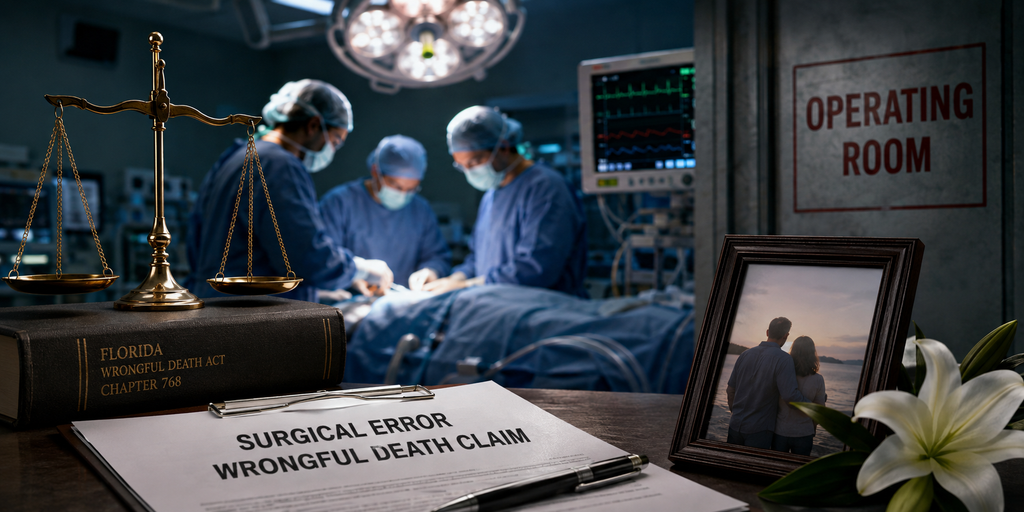
Losing a loved one during or immediately after a surgical procedure is tragic, and when that loss is caused by preventable medical negligence, it is devastating. Surgeons, anesthesiologists, nurses, and hospital surgical teams are therefore held to strict standards of care in the state of Florda.
When a surgical mistake results in death, Florida law allows surviving family members to seek financial compensation and justice through a medical malpractice wrongful death lawsuit.
Quick Answer: To sue for a fatal surgical error in Florida, the estate’s Personal Representative must initiate a medical malpractice claim under Fla. Stat. Chapter 766 and the Florida Wrongful Death Act (Fla. Stat. §§ 768.16–768.26).
Before a lawsuit can be filed in circuit court, Florida law mandates a strict 90-day presuit notice period, accompanied by a sworn affidavit from a board-certified medical expert in the same specialty confirming that the surgeon breached the standard of care.
Common Surgical Errors Resulting in Death
Surgical errors extend beyond simple complications or known medical risks. Medical malpractice occurs when a healthcare provider’s actions fall below the accepted professional standard of care, leading directly to a patient’s fatal injury.
| Surgical Error Category | How Malpractice Occurs | Fatal Medical Outcome |
| Inadvertent Organ/Vessel Puncture | Surgeon accidentally severs an artery, bowel, or vital organ during laparoscopic or open surgery. | Internal hemorrhaging, septic shock, peritonitis, or rapid organ failure. |
| Anesthesia Dosage & Monitoring Errors | Anesthesiologist administers excessive dosage, fails to monitor oxygen levels, or ignores intubation errors. | Anoxic brain injury, cardiac arrest, asphyxiation, or malignant hyperthermia. |
| Post-Operative Sepsis & Infection | Surgical team fails to recognize early signs of internal infection or fails to administer timely broad-spectrum antibiotics. | Septic shock, multi-organ collapse, and circulatory breakdown. |
| Retained Surgical Instruments | Surgical sponges, clamps, or scalpels are left inside the patient due to improper inventory counts. | Severe internal infection, tissue necrosis, severe hemorrhage, or systemic toxicity. |
| Wrong-Site or Wrong-Procedure Surgery | Surgical team operates on the wrong organ, limb, or site due to inadequate pre-op verification protocol. | Removal of healthy vital organs, failure to treat underlying condition, and fatal physiological distress. |
Florida Chapter 766 Mandatory Presuit Requirements
Unlike standard personal injury lawsuits, Florida enforces rigorous administrative hurdles before a medical malpractice lawsuit can ever reach a courtroom. Under Fla. Stat. § 766.203, every fatal surgical error claim must follow this statutory workflow:
- Medical Record Subpoena & Audit: Your legal team conducts an exhaustive review of all surgical logs, anesthesia records, post-op vitals, and pathology reports.
- Same-Specialty Expert Review (Fla. Stat. § 766.102): Florida law strictly requires a written opinion from a board-certified physician practicing in the exact same specialty as the defendant surgeon (e.g., a board-certified cardiothoracic surgeon must review a fatal cardiac surgery error).
- Corroborating Expert Affidavit: The expert physician must sign a sworn written affidavit stating that reasonable grounds exist to support a medical negligence claim.
- Notice of Intent to Initiate Litigation (NOI): Serving the formal NOI on all prospective defendants (surgeons, surgical groups, and hospitals) triggers the mandatory 90-day presuit investigation period.
- Presuit Negotiations or Lawsuit Filing: During these 90 days, the statute of limitations is tolled. The defense insurer may choose to settle, offer arbitration, or reject the claim—at which point a formal circuit court lawsuit is filed.
Who Has Standing to Sue for a Fatal Surgical Error in Florida?
Under the Florida Wrongful Death Act (Fla. Stat. § 768.20), individual family members do not file separate lawsuits. Instead, the court appoints a Personal Representative (usually named in a will or appointed by probate court) to bring one single lawsuit on behalf of the estate and all eligible survivors.
Eligible statutory survivors under Florida law include:
- The surviving spouse.
- Minor children (defined under Florida wrongful death law as children under age 25).
- Parents of a deceased minor child.
- Dependents who relied on the deceased for support or services.
Important Exception (Fla. Stat. § 768.21(8)): Florida’s medical malpractice statutes contain a unique rule—often called the “Free Kill” law—which bars adult children (age 25 or older) and parents of adult children from recovering non-economic damages (pain and suffering) in medical negligence deaths if the deceased was unmarried and had no minor children. Contact our attorneys to analyze how this standing rule applies to your family’s situation.
Medical Malpractice Exemption from HB 837 Comparative Fault
Under Florida’s 2023 tort reform laws (HB 837), standard negligence claims transitioned to a modified comparative fault system, where a plaintiff is completely barred from recovery if found more than 50% at fault. However, medical malpractice claims are explicitly exempt from this 51% bar under Fla. Stat. § 768.81(6). Medical negligence cases in Florida remain under a pure comparative fault standard, meaning recoverable damages are simply reduced by the plaintiff’s percentage of fault, if any.
Frequently Asked Questions (FAQs)
Can you sue a hospital or surgeon for a fatal surgical error in Florida?
Yes. Under Florida Statute Chapter 766 and the Florida Wrongful Death Act (Fla. Stat. §§ 768.16–768.26), the Personal Representative of the deceased’s estate can file a medical malpractice wrongful death lawsuit against negligent surgeons, anesthesiologists, surgical staff, and hospitals.
What is the statute of limitations for a surgical error death in Florida?
Under Fla. Stat. § 95.11(4)(b), the statute of limitations for medical malpractice wrongful death is two (2) years from the date the death occurred or from when the medical negligence was discovered (or should have been discovered with reasonable diligence). In no event can a claim be brought past Florida’s 4-year statute of repose.
What is required before filing a surgical malpractice lawsuit in Florida?
Before filing a lawsuit, Fla. Stat. § 766.203 mandates a formal 90-day presuit investigation. Claimants must obtain a written medical expert opinion from a board-certified physician in the same medical specialty verifying that surgical negligence occurred.
Statutory References & Legal Index
- Florida Statute Chapter 766: Medical Malpractice and Related Matters.
- Florida Statute § 766.102: Medical expert witness qualifications and standard of care requirements.
- Florida Statute § 766.203: Presuit investigation and expert medical affidavit mandates.
- Florida Statute §§ 768.16–768.26: The Florida Wrongful Death Act.
- Florida Statute § 768.21(8): Damages recoverable by statutory survivors in medical negligence claims.
- Florida Statute § 768.81(6): Statutory exemption of medical malpractice from 51% comparative fault bar.
Why Choose Reinfeld Cabrera Tison for Fatal Surgical Error Claims
Surgical malpractice litigation is among the most complex and expensive legal fields in Florida. Hospital legal teams and malpractice insurance carriers aggressively defend surgical death claims, arguing that fatal complications were unavoidable or known surgical risks.
Reinfeld Cabrera Tison brings distinct advantages to your family’s fight for justice:
- Capital to Fund Board-Certified Medical Experts: Under Chapter 766, a case cannot move forward without expert medical testimony. RCT invests the substantial financial capital required to retain top-tier, board-certified surgeons and medical experts to review your loved one’s records and testify on your behalf.
- Meticulous Presuit Execution: We handle every phase of Florida’s complex 90-day presuit process, drafting precise Notices of Intent (NOI) that withstand defense attempts to dismiss claims on technical procedural grounds.
- No Upfront Costs or Fees: We prosecute fatal surgical malpractice cases on a contingency fee basis. You pay nothing out-of-pocket, and we recover zero attorney fees or legal costs unless we successfully secure a settlement or jury verdict for your family.
Contact Reinfeld Cabrera Tison Today
If you suspect that a surgical mistake or hospital negligence caused the death of a loved one in Florida, prompt legal action is critical due to strict 2-year statutory deadlines and pre-suit expert requirements.
Call Reinfeld Cabrera Tison today at (954) 866-8600 or complete our online contact form to schedule a free, zero-obligation consultation. Our fatal medical malpractice attorneys will review your medical records, explain your rights under Florida Chapter 766, and help your family hold negligent medical providers accountable.
Author Bio
Written by Alan J. Reinfeld, Esq.
Alan J. Reinfeld, Esq. is a founding partner at Reinfeld Cabrera Tison. He focuses his legal practice on Florida personal injury litigation, complex medical malpractice claims, and wrongful death cases, representing surviving families against negligent healthcare providers and hospital networks.