
Does Seeing Any Doctor Within Two Weeks Secure Your Full Injury PIP?
No. Many Florida accident victims mistakenly believe that going to any walk-in clinic or seeing a chiropractor within 14 days guarantees their full $10,000 Personal Injury Protection (PIP) payout under Florida Statute § 627.736.
The harsh reality is that unless a legally authorized medical provider formally diagnoses you with an Emergency Medical Condition (EMC), the state (or insurer) automatically caps your PIP coverage at a mere $2,500. At Reinfeld Cabrera Tison, our attorneys fight back against insurance adjusters who exploit this medical-legal loophole. We understand how they deny coverage for severe neck, back, and brain injuries.
Getting into an auto accident on University Drive or Sample Road in Coral Springs is traumatic enough without the immediate financial aftermath. You can do everything “by the book”. Exchanging info, calling the police, and seeing a doctor within the statutory fortnight. Yet you can still receive a denial letter or a capped bill.
Insurance carriers in Florida rely on victims not understanding the difference between standard medical treatment and the strict statutory definition of an EMC. Securing your full $10,000 medical coverage requires having a highly specific binding diagnosis on your record before the clock runs out. Fighting these corporate caps requires experienced attorneys who know how to enforce the rules and coordinate with local medical networks.
1. What Are the Four Medical Criteria Required to Secure the Full $10,000 PIP Limit in Florida?
To unlock the full statutory ten-thousand-dollar Personal Injury Protection benefit, your early medical records must satisfy strict statutory thresholds under Fla. Stat. § 627.736(1)(a)(3).
- Determining an Emergency Medical Condition (EMC): The diagnosing medical provider must explicitly declare that your crash injuries meet the legal definition of an EMC. This means they require immediate attention to prevent serious jeopardy to your health. Things as impairment to bodily functions, or dysfunction of any organ.
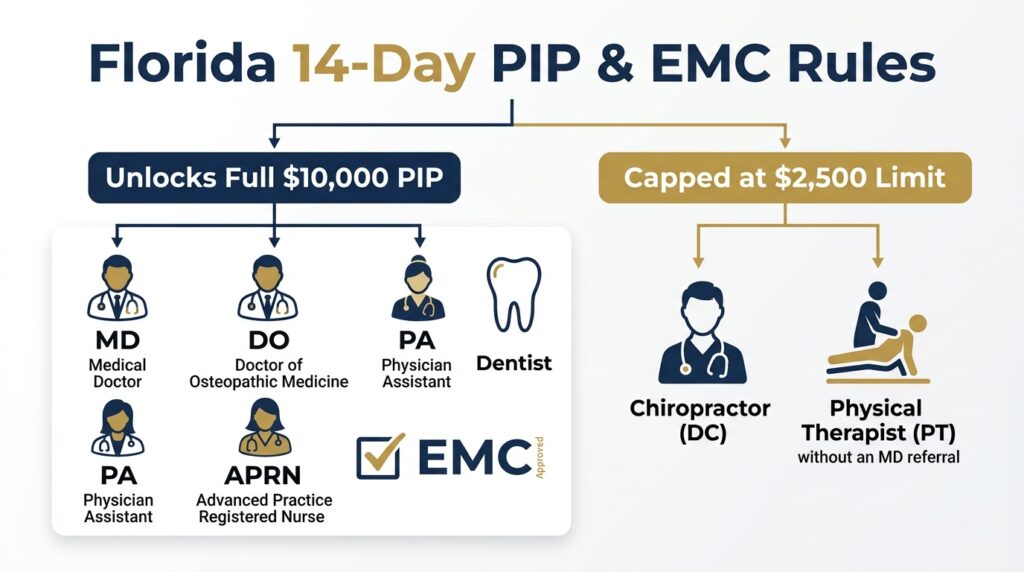
- Diagnosed by an Authorized Medical Professional: Under Florida law, only a licensed medical doctor (MD), doctor of osteopathic medicine (DO), dentist, physician assistant (PA), or advanced practice registered nurse (APRN) can declare an EMC. Chiropractors can treat you within the 14 days, but cannot establish the diagnosis to unlock the full $10,000.
- Obtaining Treatment Within the Strict 14-Day Window: Regardless of the severity of your injuries, your initial medical evaluation must happen within exactly 14 days. Missing this deadline by even one hour forfeits 100% of your PIP benefits.
- Corroborating Clinical Documentation: The medical provider’s chart notes must clearly link your acute symptoms: such as spinal trauma, head injuries, or internal pain – to the physical impact of the motor vehicle accident.
2. How Does Missing the 14-Day Rule Allow Auto Insurers to Deny Your Entire Claim?
Failing to complete your initial medical evaluation within 14 days triggers an automatic, un-appealable statutory forfeiture of all PIP benefits.
- The Mandatory Strict Forfeiture: Insurance carriers are legally allowed to deny your claim in its entirety under Florida Statute § 627.736(1)(a) if 14 days pass post-crash without an initial professional medical evaluation.
- Loss of No-Fault Insurance Protections: When your PIP is invalidated, you are stripped of the no-fault buffer that pays 80% of all necessary medical expenses and 60% of lost wages, transferring the entire early financial burden to you.
- No Alternative First-Party PIP Options: Your private health insurance or out-of-pocket funds cannot restore the forfeited state PIP, leaving you financially vulnerable before you can even establish third-party fault.
- Leverage for the Defense: If you seek treatment on day 15 or later, defense adjusters will argue that your injuries are not crash-related, using the delay to severely damage any future bodily injury lawsuit.
3. What Exact Healthcare Providers Are Legally Authorized to Determine an EMC in Broward County?
Knowing who can and cannot confirm an Emergency Medical Condition is vital to preserving your injury claim.
- Medical Doctors (MD) and Osteopathic Doctors (DO): Fully licensed physicians, such as those at Coral Springs ERs or urgent care clinics, hold primary authority to diagnose and register your EMC.
- Nurse Practitioners (APRN) and Physician Assistants (PA): Florida law authorizes certified APRNs and PAs working under a physician’s supervision to make an EMC determination.
- Chiropractors (DC) Excluded: While highly valuable for rehabilitation, a chiropractor cannot diagnose an EMC; seeing only a DC within 14 days limits your PIP payout to $2,500.
- Physical Therapists and Alternative Providers: Florida law explicitly prohibits physical therapists, acupuncturists, and massage therapists from issuing an EMC finding, meaning their care alone cannot trigger the higher coverage threshold.
4. How Do Coral Springs Auto Accident Attorneys Protect PIP Coverage From Insurer Delay Tactics?
When insurance adjusters try to delay your payments or dispute your EMC, our legal team takes aggressive action to secure your full benefits.
Case Study 1: The Disputed EMC at a Local Urgent Care
- The Incident: A rear-end collision on University Drive left a Coral Springs resident with herniated discs, leading them to seek ER treatment within four days. The insurer capped PIP at $2,500, claiming the medical record lacked the “magic words” designating an Emergency Medical Condition.
- The Evidence: Our attorneys subpoenaed the full admitting chart, proving the treating APRN recorded acute, severe spinal trauma and sensory loss. These acts meet the statutory requirements for an EMC.
- The Outcome: The policyholder forced the insurer to reverse the cap and pay the full $10,000 to cover the client’s medical and therapy bills.
Case Study 2: The Chiropractor Trap & Timely Medical Referrals
- The Incident: An accident victim near Sample Road went to a chiropractor on day 5. Unfortunately, the provider never referred him to a licensed MD or DO for an EMC evaluation before day 14.The insurance carrier capped benefits, leaving the client with $8,000 in unpaid medical debt.
- The Evidence: We proved the client sought chiropractic care promptly. Then we coordinated an urgent MD referral to verify the severe spinal issues.
- The Outcome: Although delayed, we established that the ER documented the underlying trauma within the 14-day window and successfully secured the EMC to unlock the full PIP policy.
“Insurance companies love using the strict EMC rules to cut payouts to $2,500,” says partner attorney Devin Tison. “When you know the statute and ensure the medical record legally proves the emergency, their delay tactics fall apart.”
Jurisprudential Context: The Battle Over F.S. § 627.736 and EMC Authority Florida courts evaluate PIP disputes strictly under the lens of the state’s No-Fault Statute.
In landmark appellate cases like State Farm v. Medical Plaza and various Broward County circuit rulings, courts have affirmed that the burden is not on the patient to use specific “magic words,” but on the medical record to reflect the objective severity of the injury.
Our attorneys hold insurers to these precedents, ensuring that insurers pay the full $10,000 if a licensed professional notes an emergency-level injury within 14 days
5. How Does Florida PIP Split Payments Between Medical Expenses and Lost Wages?
Understanding the statutory percentages under Florida Statute § 627.736(1) prevents unexpected out-of-pocket expenses for medical treatment and lost income.
- The 80 Percent Medical Reimbursement Cap: PIP does not pay 100 percent of your medical bills; it pays only 80 percent of reasonable, medically necessary care, leaving you responsible for the remaining 20 percent co-insurance.
- The 60 Percent Lost Wage Allocation: If your injuries prevent you from working, PIP reimburses 60 percent of your gross lost wages and earning capacity up to your aggregate policy limit.
- The $5,000 Death Benefit Provision: In the tragic event of a fatal collision, Florida law provides an additional $5,000 per individual for funeral and burial costs, separate from medical and disability limits.
- Exhaustion of the $10,000 Policy Limit: Because medical bills and wage claims draw from the same single bucket, heavy hospital bills can drain your $10,000 pool instantly, leaving zero funds for lost paychecks unless an attorney steps in to structure the claims.

Frequently Asked Questions
Do I have to go to an ER within 14 days?
Can a chiropractor determine an Emergency Medical Condition?
Does PIP pay for my lost paychecks if I cannot work after a crash?
- A: Yes. PIP pays 60 percent of your gross lost wages, but those payouts draw from the same $10,000 aggregate cap as your medical bills.
Who pays the remaining 20 percent of my medical bills that PIP does not cover?
- A: You are responsible for the 20 percent co-insurance, which our attorneys seek to recover directly from the at-fault driver’s bodily injury liability policy or your uninsured motorist (UM) coverage.
What if my symptoms take more than 14 days to appear?
- A: Even if you feel fine initially, you must see a medical provider within 14 days, or you forfeit your $10,000 in PIP benefits. Soft-tissue and spinal injuries often take days to show severe symptoms.
Have Your Florida PIP Benefits Been Wrongfully Capped or Denied?
If you or a loved one are struggling with insurance delays after a Coral Springs car accident, do not let insurers cap your medical coverage. At Reinfeld Cabrera Tison, our attorneys fight to ensure insurers fully pay your PIP and EMC benefits
- Give Us a Call: Dial 954-866-4878 to talk through your case with our legal team.
- Reach Out Online: Contact us through our website to set up a free case review.