
Written by Alan J Reinfeld, Florida Bar Associated Lawyer # 91602, 18 years of practice. Reviewed by Devin Townsend. Last updated November 2026
Short answer: not after every crash. But if you are hurt, still in treatment, or being told your injuries are not related to the collision, a consultation before you accept any offer can protect your options.
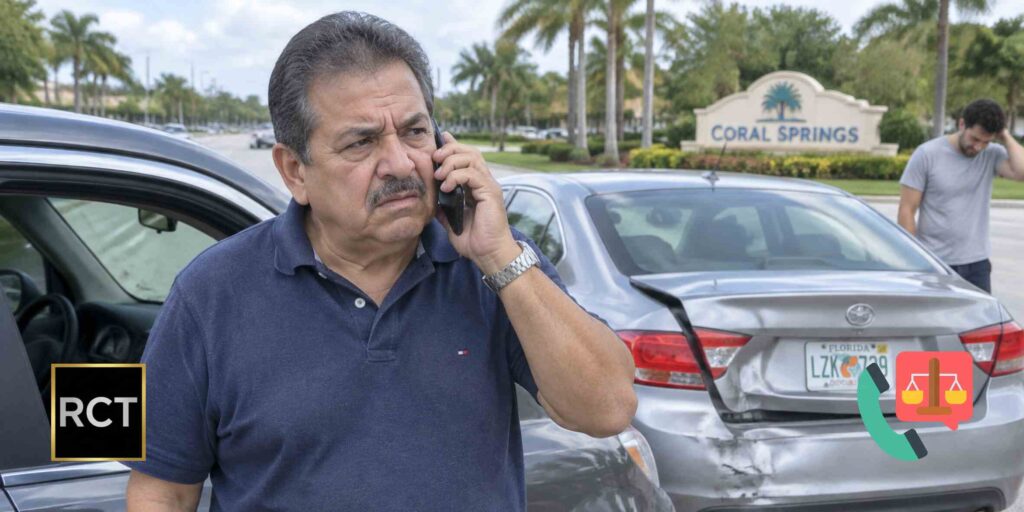
Picture this. A driver rear-ends you at a traffic light in Coral Springs. The police report backs up your account. The other driver admits fault. Their insurance company calls about the damage to your car.
It feels settled. Why would you need an attorney?
Then your neck pain does not go away. The insurer starts asking whether your treatment really has anything to do with the collision. An adjuster makes an offer while you are still seeing doctors.
The accident was the simple part. The injury claim is often where things get complicated.
In this guide, we walk through when you can reasonably handle a claim yourself, why an admission of fault does not end the discussion, which Florida rules shape what you can recover, and what to ask before you sign anything with a lawyer or an insurer.
How common are car accidents in Broward County?
More than most of us would guess. According to Florida Health Charts, maintained by the Florida Department of Health, Broward County recorded 38,338 motor vehicle traffic crashes in 2024, a rate of 1,924.6 crashes per 100,000 residents.
Zoom out to the whole state and the picture is just as sobering. The Florida Department of Transportation’s Target Zero initiative reports that, on average, eight people are killed and 49 are seriously injured on Florida roads every day. The agency identifies driver behavior as a contributing factor in most fatal and serious crashes.
None of this means every collision calls for a lawyer. It does show why it pays to take the risks seriously, especially when an injury does not show itself right away.
When can you handle a car accident claim yourself?
Sometimes, you can. Ask yourself whether all of these describe your situation:
- Nobody was injured.
- The damage is limited to your vehicle.
- Responsibility is clear.
- The insurance company is handling the property damage fairly.
If so, you may be able to resolve things without an attorney.
The same can be true when minor injuries clear up quickly, your medical expenses are straightforward, and the insurer does not dispute either the treatment or the amount you are claiming.
There is no reason to pay for representation just because two vehicles collided. A good lawyer should be willing to tell you honestly whether your circumstances justify getting involved.
The picture changes when the insurer disputes your injuries, questions the connection between the accident and your medical condition, or proposes a settlement before you understand the full extent of your losses. Is that where you are right now? Keep reading.
The other driver admitted fault. Why is the insurer questioning my injuries?
Because accepting responsibility for a collision and accepting responsibility for every injury claimed afterward are two different things.
Two recent decisions from Florida’s Fourth District Court of Appeal show how that distinction plays out.
Barrera v. Rodriguez-Orengo. In Barrera v. Rodriguez-Orengo, No. 4D2024-2661 (Fla. 4th DCA Apr. 8, 2026), the plaintiff was rear-ended while stopped at a red light in Pembroke Pines. The defendant’s responsibility for the collision was not disputed. The fight was over whether the crash caused the plaintiff’s more serious injuries, particularly given evidence of preexisting spinal conditions.
The jury found the defendant entirely at fault but awarded $20,000, even though the plaintiff had sought more than $1 million. The Fourth DCA ordered an increase to approximately $36,670, the amount the defense had conceded was reasonable during closing arguments.
Dolan v. Negron. Dolan v. Negron, No. 4D2024-1528 (Fla. 4th DCA Apr. 15, 2026), involved a similar disagreement over injuries and their permanence. The defendant admitted responsibility for the collision, but the plaintiff’s history of earlier spinal injuries complicated the damages evidence. The jury awarded $1 million but found that the plaintiff had not suffered a permanent injury. The appellate court ordered a new trial on permanency and all damages issues because the findings were interrelated.
What to take from these cases. The dollar amounts are not the point. The point is the gap between proving who caused the accident and establishing which injuries resulted from it.
Neither decision means insurers will challenge every injury claim. They do show why an admission of fault does not automatically resolve the entire case.
Florida law can affect what you can recover
Several Florida statutes can influence the value and outcome of a car accident injury claim. Here is the short version, followed by the details.
| Rule | What it means for your claim |
| Fla. Stat. §627.737 | Injury threshold for noneconomic damages such as pain and suffering |
| Fla. Stat. §768.81 | Modified comparative fault can reduce, or bar, recovery |
| Fla. Stat. §627.736 | PIP no-fault benefits, with a 14-day treatment requirement |
| Fla. Stat. §95.11(5)(a) | General two-year limitations period for negligence actions |
The injury threshold. Under Florida Statutes §627.737, an injured person generally must meet a statutory injury threshold to recover noneconomic damages such as pain and suffering. Qualifying conditions include a significant and permanent loss of an important bodily function, a permanent injury within a reasonable degree of medical probability, significant and permanent scarring or disfigurement, or death.
Why does this matter? Because you can have medical expenses and lost income after a crash without necessarily meeting the threshold for pain and suffering damages.
Modified comparative fault. Under §768.81, damages can be reduced according to the injured person’s share of responsibility. In most negligence actions covered by the statute, a claimant found more than 50% at fault cannot recover damages.
No-fault (PIP) insurance. Florida’s no-fault system adds another set of requirements. Under §627.736, PIP generally covers 80% of eligible medical expenses and 60% of qualifying disability benefits, subject to statutory limits and conditions. Initial qualifying medical care generally must occur within 14 days of the accident. These PIP benefits do not determine the total value of every possible injury claim. LawRCT explains the requirements in greater detail in its article about Florida’s 14-day PIP rule.
Time limits. Under §95.11(5)(a), the general limitations period for negligence actions against private parties is two years, subject to exceptions and different rules for particular claims. Waiting until a deadline approaches can create unnecessary problems.
Should you accept an insurance settlement while still receiving treatment?
This is the question we see come up again and again in online discussions. A few recent South Florida examples show how real people are asking it:
- In a November 2026 discussion on r/AskLawyers, a Fort Lauderdale driver described growing medical bills, slow insurance responses, and an offer well below their expenses. The question was whether hiring a lawyer made sense when the other driver was already considered responsible.
- A Fort Lauderdale driver on r/Car_Insurance_Help raised another concern: the insurance company’s offer would not cover half their medical bills. They wanted to know whether negotiating independently could improve the offer or whether legal representation was worth the expense.
- In a separate r/FloridaLawyersAdvice discussion, a South Florida driver said the other driver’s insurer had offered less than their physical therapy expenses while treatment was still ongoing. They were unsure whether to accept the offer or wait until they had a clearer picture of their recovery.
These are individual accounts, not legal authorities. But the concerns behind them deserve attention.
A settlement can be permanent. If you accept an offer and sign a release, you generally cannot return later to request additional compensation because your symptoms worsened or treatment became more expensive.
That does not make every early offer unfair. It means you should understand what the offer covers, which claims you are releasing, and whether you have enough information to evaluate your losses before signing.
Insurance limits are real. Insurance coverage also places practical limits on recovery. An insurer cannot necessarily pay beyond the applicable policy limits simply because your medical expenses are higher. The other driver’s available assets and your own uninsured or underinsured motorist coverage may also matter.
A quick gut check before you reply to an offer. Does it account for your medical expenses, your lost income, and your reasonably anticipated future treatment? If not, consider getting legal advice before responding.
How much does a car accident lawyer cost?
Many personal injury attorneys work on a contingency fee basis. Instead of charging an hourly rate, the attorney receives an agreed percentage of the recovery.
Attorney fees and case expenses, however, are separate matters.
The Florida Bar’s consumer guidance on attorney fees explains that contingency fee agreements must be in writing and signed. The agreement must identify the percentage the attorney may receive and explain how expenses will be deducted.
Court filing fees, expert witness expenses, and other case costs may be deducted from a recovery. Depending on the agreement, a client may still owe certain expenses even if the case does not succeed.
Questions to ask before you sign a representation agreement:
- What percentage of the recovery will the firm charge?
- Are case expenses deducted before or after the attorney’s fee?
- Will I owe expenses if there is no recovery?
- Who will actually handle my case?
- How often will I receive updates?
The fee arrangement should be clear before the attorney begins representing you. If you cannot explain how the agreement works after reading it, ask for clarification.
When should you call a car accident lawyer in Coral Springs?
If the accident caused no injuries and the insurer is handling a straightforward property damage claim, you may not need one.
A consultation is worth considering if any of these sound familiar:
- You are still receiving medical treatment or your symptoms have not resolved.
- The insurance company questions whether the accident caused your injuries.
- The insurer disputes responsibility or argues that you share fault.
- A settlement offer does not account for your medical expenses, lost income, or anticipated treatment.
- You have concerns about available insurance coverage or the time limits for bringing a claim.
You can also ask an attorney to explain what they would investigate, what obstacles they see in your claim, and whether formal representation makes financial sense. You do not have to hire the first lawyer you consult.
Frequently asked questions
Do I need a lawyer after every car accident?
No. You do not necessarily need a lawyer after every car accident. But when injuries, insurance disputes, or settlement negotiations become complicated, getting legal advice before accepting an offer can protect your options.
The other driver admitted fault. Can the insurer still dispute my injuries?
Yes. Accepting responsibility for a collision and accepting responsibility for every injury claimed afterward are two different things, as the Fourth DCA decisions in Barrera v. Rodriguez-Orengo and Dolan v. Negron illustrate.
Should I accept the insurance company’s first offer while I’m still in treatment?
Not before you understand what it covers. A settlement can permanently resolve an injury claim, and if you sign a release you generally cannot return later for more compensation.
How long do I have to file a car accident injury claim in Florida?
Under §95.11(5)(a), the general limitations period for negligence actions against private parties is two years, subject to exceptions and different rules for particular claims.
How much does a car accident lawyer cost?
Many personal injury attorneys work on a contingency fee basis, receiving an agreed percentage of the recovery. Fee agreements must be in writing and signed, and case expenses may be handled separately, so ask how they are deducted.
Talk to a Coral Springs car accident attorney
9625 W. Sample Rd
Coral Springs, FL 33065
Tel: 954-866-HURT
(954-866-4878)
Fax: 954-334-1526
You do not need a lawyer after every car accident. You should understand the potential consequences before deciding that you do not need one.