- Quick Answer: In South Florida, “account leasing”-where a driver uses another person’s verified Uber profile—is an escalating crisis. When an unauthorized driver crashes, Uber’s insurance carriers frequently issue blanket claim denials based on terms-of-service fraud.
- However, under the Florida Transportation Network Company (TNC) Act (Fla. Stat. § 627.748), the $1,000,000 commercial liability policy must provide first-dollar coverage for injured passengers regardless of driver identity fraud, provided the trip was executed through an active app session.
The Account-Sharing Crisis in South Florida Rideshares
When you request a ride through a TNC app, Florida law mandates that the app display the driver’s name, photo, and license plate number prior to entry (Fla. Stat. § 627.748(9)).
However, individuals who fail background checks or lack valid driving credentials frequently “rent” or purchase verified accounts from third parties.
- Unverified Driver: Operates under a leased or purchased profile to bypass background checks.
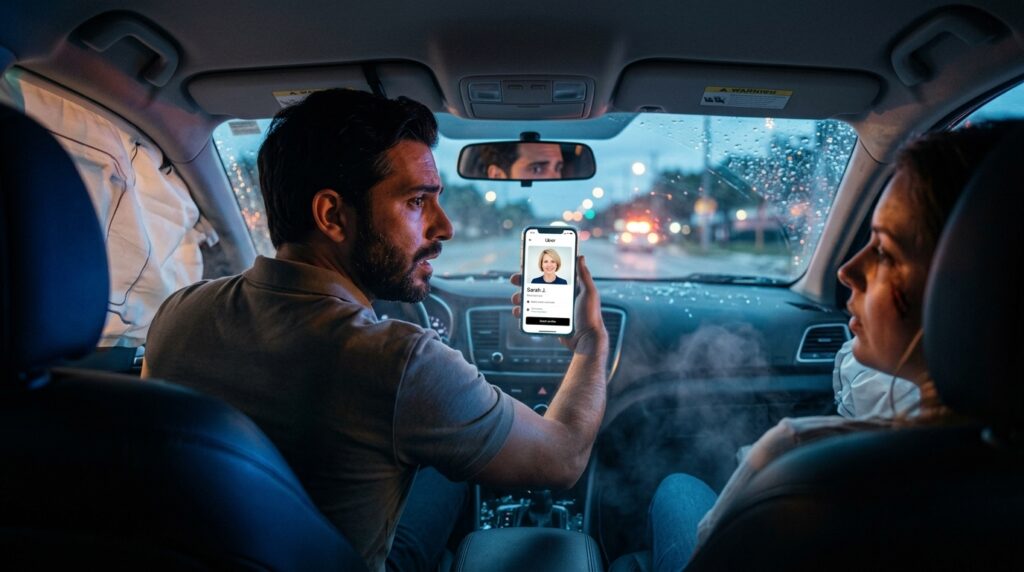
- Active Trip Executed: The passenger enters the vehicle believing the driver matches the digital receipt; a collision occurs.
- Insurer Reaction: The commercial insurance carrier denies the claim, citing terms-of-service misrepresentation and an unauthorized driver.
- Legal Protection: Fla. Stat. § 627.748 mandates first-dollar passenger protection for active app trips regardless of driver identity fraud.
When a collision occurs, injured passengers discover that the driver behind the wheel does not match the driver shown in their digital receipt. Insurance companies immediately attempt to leverage this discrepancy to deny all liability.
2. How Insurers Use Identity Fraud to Block $1,000,000 Claims
Following an accident with an unauthorized driver, insurance adjusters deploy two primary arguments to escape financial responsibility:
1. Uber’s Commercial Denial (Breach of Contract)
Uber’s third-party insurer argues that because the actual driver breached the platform’s Terms of Service by using fraudulent credentials, the $1,000,000 primary commercial coverage is void ab initio (invalid from the start).
2. The Personal Auto Policy Rejection
The unauthorized driver’s personal auto insurance carrier denies the claim under two separate exclusions:
- The Public/Livery Conveyance Exclusion: Commercial transportation activity is excluded.
- Unlisted Driver / Fraud Exclusion: Using false credentials or operating an unlisted vehicle forfeits coverage.
3. The Statutory Solution: Overcoming Denials Under Fla. Stat. § 627.748
Florida statutory law prevents insurance companies from leaving innocent passengers empty-handed due to corporate security failures.
| Defense Strategy | Legal Basis | Operational Mechanism |
| First-Dollar Primary Coverage | Fla. Stat. § 627.748(7)(d) | If the driver’s personal policy lapses or voids coverage, the TNC policy must cover the loss from dollar one. |
| Statutory Duty Non-Compliance | Fla. Stat. § 627.748(18) | Corporate immunity does not protect TNCs that fail statutory driver identity and background check protocols. |
| Digital Waybill Subpoena | Fla. Stat. § 627.748(10) | Proves the active digital trip session existed regardless of who operated the physical vehicle. |
Statutory Background Check Violations
Under recent appellate rulings (including Haddad v. Uber Technologies, Inc.), rideshare corporate immunity is stripped if the company failed to comply with statutory driver verification standards. If Uber’s security software failed to catch unauthorized profile sharing, direct legal claims can be brought for statutory non-compliance.
4. Real-World Execution Scenarios
Scenario A: The Airport Pick-Up Discrepancy (Fort Lauderdale / FLL)
- Profile: A business traveler at FLL enters an Uber. The profile shows a female driver, but a male driver operates the vehicle. A multi-vehicle crash occurs on I-95, causing severe spinal injuries.
- Insurer Strategy: Uber’s carrier denies coverage, citing an unauthorized driver operating outside contract terms.
- RCT Legal Fix: Our firm issues immediate spoliation demands for digital waybill telematics and invokes Fla. Stat. § 627.748(7)(d), forcing Uber’s $1,000,000 policy to step in as primary coverage for the innocent passenger.
Scenario B: The Shared Delivery & Rideshare Account Crash
- Profile: A driver operating under a friend’s account collides with a pedestrian in a Coral Springs crosswalk while transporting an active fare.
- Insurer Strategy: Both the driver’s personal insurer and the TNC carrier issue total coverage denials.
- RCT Legal Fix: We establish statutory non-compliance for background check failures under Fla. Stat. § 627.748(18) while pursuing Uninsured Motorist (UM) benefits as a secondary recovery stream.
Frequently Asked Questions
What should I do if my Uber driver’s face does not match the app profile?
Do not enter the vehicle. If an accident has already occurred, immediately take a screenshot of your active trip receipt (showing the assigned profile) and photograph the physical driver and their state driver’s license at the scene.
Can Uber deny my injury claim if the driver was using a stolen or rented account?
Insurers will initially attempt to deny the claim. However, under Florida law, the TNC commercial policy is mandated to cover passenger injuries on active trips even if the driver’s personal insurance voids coverage for fraud.
Who is liable if an unauthorized Uber driver strikes my personal vehicle?
If an unauthorized TNC driver hits your vehicle while transporting a passenger or en route to a fare, the TNC’s statutory $1,000,000 policy remains liable for third-party bodily injury and property damage under Florida law.
Protect Your Claim Against Corporate Coverage Denials
Navigating complex account-sharing fraud, statutory TNC laws, and insurance coverage disputes requires immediate trial attorney intervention.
- Schedule a Free Case Evaluation: Call Reinfeld Cabrera Tison at 954-866-HURT (954-866-4878) to speak directly with a South Florida rideshare accident attorney.
- Local Representation: Serving injury victims across Coral Springs, Fort Lauderdale, Broward County, and Miami-Dade.
- Learn More: Visit our South Florida Personal Injury Legal Hub for advanced analysis on insurance coverage disputes and complex motor vehicle litigation.
Author Bio
Written by Alan Reinfeld, Esq.
Alan Reinfeld, Esq. is a Founding Partner at Reinfeld Cabrera Tison. He specializes in complex motor vehicle accidents, rideshare litigation, and insurance coverage disputes across South Florida.