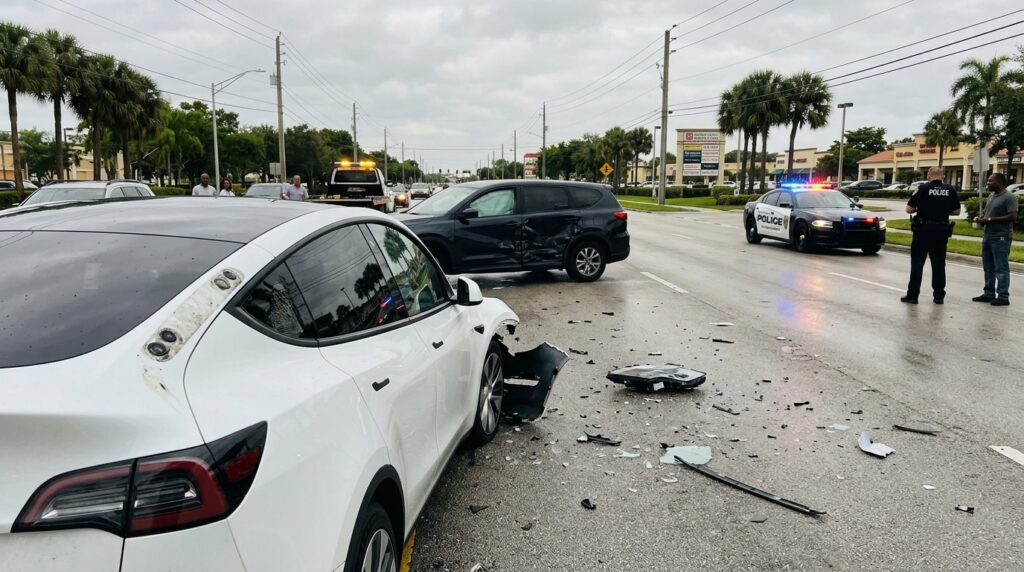
If you are hit by an autonomous vehicle (AV) or a Tesla operating on Autopilot/FSD in Florida, liability can be split between the human driver, the software developer, and the vehicle manufacturer. Under Florida Statute § 316.85, autonomous vehicles are legally permitted on public roads, but manufacturers must ensure system safety.
Victims can pursue compensation through commercial liability policies—which mandate a minimum of $1,000,000 in coverage for commercial autonomous fleets—or via product liability claims.
Remember when “driving yourself crazy” used to be just a figure of speech? Nowadays, you can just sit back, let a robotaxi or a car running on digital pilot-assist take the wheel, and let the software drive you literally and figuratively up the wall.
South Florida roads are increasingly filled with high-tech machines, Teslas on Autopilot, and automated delivery pods. It looks like something straight out of a sci-fi flick—until an algorithm glitches, a sensor gets blinded by a Florida downpour, and you find yourself in a collision. Suddenly, you’re left wondering: Who do I sue? The human behind the wheel who was busy catching up on TikTok, or a team of software engineers sitting in a Silicon Valley boardroom?
Let’s get one thing straight: Florida loves innovation. Under Florida Statute § 316.85, fully automated vehicles are explicitly allowed on our public roads. In the eyes of the law, when an Automated Driving System (ADS) is fully engaged, the system itself can be treated as the operator.
However, there is a massive catch. Most consumer vehicles on the road today (like Teslas using Autopilot or Full Self-Driving capabilities) operate at Level 2 or Level 3 automation. This means the car assists you, but you—the human—are legally required to stay alert and keep your hands ready to take over.
When a crash happens, insurance companies love to hide behind this distinction, blaming the driver for “not paying attention” while simultaneously selling cars marketed as practically driving themselves. You need an attorney who can see right through that double talk.
2. Landmark Case Study: When Tech Giants Face Florida Juries
If tech companies think they are completely immune because of a disclaimer in a user manual, Florida juries have news for them.
Take the landmark Florida federal court caseBenavides v. Tesla. A Miami federal jury handed down a staggering $243 million total verdict (including $200 million in punitive damages) after finding Tesla’s Autopilot software partially responsible for a tragic, high-speed crash.
A federal judge later rejected Tesla’s bid to overturn the verdict, ruling that the evidence at trial more than supported holding the automaker accountable. The court and jury made it clear: manufacturers cannot aggressively market “self-driving” features to consumers while dodging accountability when their perception software and algorithms fail on real-world streets.
The takeaway? Even if an insurance adjuster tries to convince you that it was purely “driver error,” courts are increasingly willing to hold manufacturers accountable when design flaws or misleading automation encourage dangerous over-reliance.
3. Who Can Actually Be Held Liable in a Tech-Assisted Crash?
When you are hit by a vehicle controlled partly or entirely by code, your potential list of defendants expands well beyond a standard fender-bender:
The Software Developer / Manufacturer: If a sensor misreads a stopped truck, or the software fails to process a pedestrian in a crosswalk due to a perception glitch.
The Human Operator: If they abused Level 2/3 systems by zoning out, playing video games, or falling asleep at the wheel.
Commercial Fleet Operators: Robotaxi and autonomous delivery services in Florida are required by law ($\text{Fla. Stat. § 627.749}$) to carry hefty commercial liability policies—often starting at $1,000,000+—meaning there are serious insurance assets available when things go wrong.
Third-Party Maintenance Providers: Companies responsible for servicing hardware, cleaning lidar sensors, or calibrating cameras.
4. How Florida’s Modified Comparative Negligence Law Affects Your Claim
Insurance adjusters love a good tech crash because they can muddy the waters. Under Florida’s modified comparative negligence rule things change. You can still recover damages as long as you are 50% or less at fault for the accident.
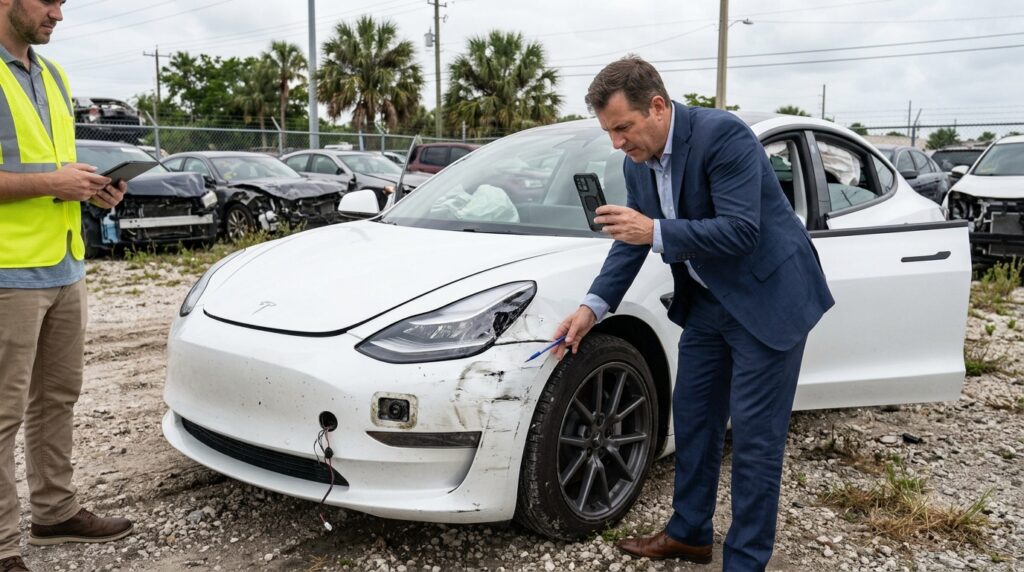
When autonomous systems are involved, insurance companies will try to pin 51% of the blame on you. They will argue you didn’t override the system fast enough or that you looked away for a split second. Overcoming this requires more than just a police report. it requires extracting black box data logs to prove what the car’s computer was “thinking” milliseconds before impact.
5. Critical Digital Evidence Needed in a Tech-Assisted Car Crash
Standard skid marks tell a story, but software crashes leave an entirely different trail of breadcrumbs. To win these cases, you need to lock down digital evidence before it gets wiped. Sometimes it can also be overwritten by an over-the-air (OTA) software update:
Event Data Recorders (EDR): The car’s physical black box recording speed, braking force, and steering inputs.
ADAS Telemetry Logs: Proves whether autonomous features were actively engaged, tracking lanes, or issuing warnings.
Over-the-Air Update History: Shows if a recent patch altered the vehicle’s braking or collision-avoidance behavior.
Driver Monitoring Footage: Interior camera data checking whether eye-tracking or steering-wheel sensors registered driver attentiveness.
Frequently Asked Questions About Autonomous Vehicle Accidents in Florida
Q: Who is legally considered the “driver” of an autonomous vehicle in Florida?
A:Under Florida Statute § 316.85, when a fully automated driving system (ADS) is engaged, the system itself is legally deemed the operator of the vehicle. However, for Level 2 and Level 3 systems like Tesla Autopilot, human supervision is still legally required, which is usually where complex liability battles begin.
Q: Can I sue Tesla or a car manufacturer if Autopilot fails?
A: Yes. Landmark Florida product liability verdicts—such as the federal court case Benavides v. Tesla—have proven that manufacturers can be held liable. This covers when software defects, sensor failures, or misleading marketing contribute to a crash.
Q: What insurance coverage applies to commercial autonomous fleets in Florida?
A: Under Florida Statute § 627.749, commercial autonomous vehicle networks must maintain a minimum of $1,000,000 in primary liability insurance, alongside mandatory Personal Injury Protection (PIP) and uninsured motorist coverages.
Q: What happens if an autonomous vehicle crashes while operating completely empty or as a robotaxi?
A: If an un-manned robotaxi or autonomous delivery pod causes a wreck, liability shifts entirely. The focus goes away from a human occupant and onto the fleet owner, software developer, or maintenance contractor. These commercial networks carry mandated million-dollar policies under Florida law. Because of that victims can file claims directly against corporate commercial policies. This is much better rather than relying solely on personal auto insurance.
Q: How do you prove that a self-driving system caused or failed to prevent an accident?
A: Proving software liability requires securing digital evidence immediately following the crash. This includes a list of steps. Downloading the vehicle’s Event Data Recorders (EDR), extracting Advanced Driver Assistance Systems (ADAS) telemetry logs, checking over-the-air (OTA) update history. We also pull interior monitoring camera footage before data can be overwritten or wiped.
Injured in an Autonomous or Tech-Assisted Vehicle Crash in South Florida?
Fighting major tech conglomerates and massive corporate insurance policies takes more than just standard legal paperwork. Your case requires deep technical investigation, data log analysis, and a team that isn’t intimidated by Silicon Valley defense lawyers.
Call Our Office Today: Speak directly with our team at 954-866-4878 for a free, no-nonsense case evaluation.
The information on this website is for general information purposes only. Nothing on this site should be taken as legal advice for any individual case or situation. This information is not intended to create, and receipt or viewing does not constitute, an attorney-client relationship.