
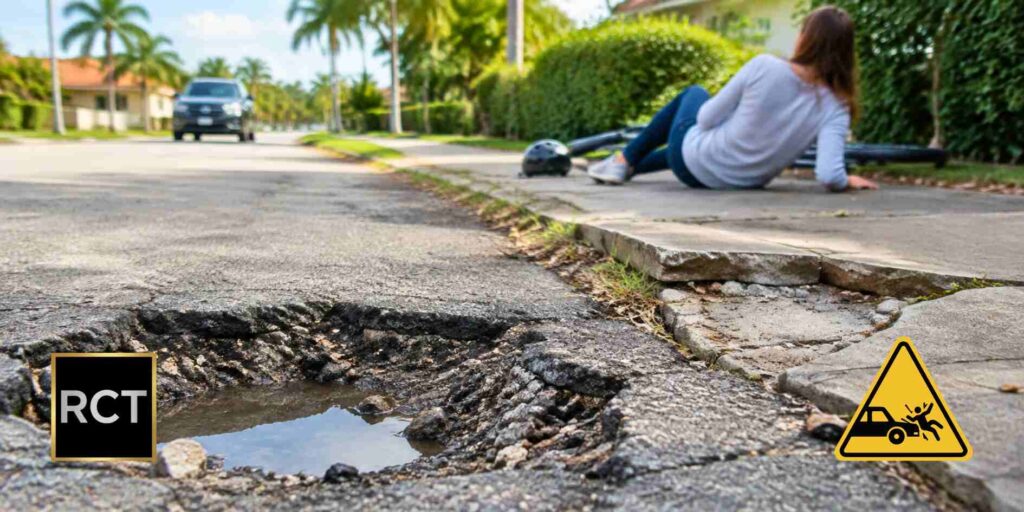
A pothole can ruin your afternoon. A badly maintained sidewalk can ruin considerably more. When a road defect causes a serious accident in Coral Springs, an injured person may have grounds for a claim against the government agency or private party responsible for the hazard.
But there is an important catch: the fact that an accident happened on a Coral Springs road does not automatically make the City of Coral Springs responsible. Some roads belong to Broward County or the Florida Department of Transportation (FDOT). Others may fall under private maintenance agreements. Even when the responsible party is a government agency, Florida law places limits on when it can be sued.
The difficult part often begins after the accident. Who maintained that stretch of pavement? Had anyone reported the problem? How long had it been there? And was the hazard something the responsible party should have repaired, or a consequence of a protected road design decision?
Those details can make a substantial difference to an injury claim.
Can You Sue a Government Entity for a Dangerous Road in Florida?
Yes. Florida law allows people to pursue certain negligence claims against government entities, including municipalities, counties, and state agencies. The main statute governing these claims is Florida Statute §768.28, which partially waives the state’s sovereign immunity.
In practical terms, a government agency may be liable when an employee negligently performs duties within the scope of employment and the circumstances would support a comparable claim against a private party. That can include certain failures to maintain public roads and sidewalks.
However, government agencies are not responsible for every accident that happens on public property. Florida courts distinguish between two kinds of government decisions.
Maintenance failures and protected design decisions
A failure to repair an existing pothole, address deteriorating pavement, or maintain a malfunctioning traffic signal may constitute operational negligence. These are problems involving the way existing infrastructure is maintained or operated.
By contrast, decisions about where to build a road, how many lanes it should have, or how an intersection should originally be designed generally fall under protected planning-level discretion.
The Florida Supreme Court explained this distinction in Department of Transportation v. Neilson, 419 So. 2d 1071 (Fla. 1982).
There is also a narrower exception involving government-created dangers that are known to the agency but not readily apparent to people who may be injured. In City of St. Petersburg v. Collom, 419 So. 2d 1082 (Fla. 1982), the Florida Supreme Court addressed this type of hidden danger.
That exception should not be confused with an ordinary maintenance claim. A poorly marked intersection is not automatically a legally recognized hidden trap. In Department of Transportation v. Konney, 587 So. 2d 1292 (Fla. 1991), the court explained that the exception has specific limits.
Who Is Responsible for Maintaining Roads and Sidewalks in Coral Springs?
This is where an otherwise straightforward accident can become a jurisdictional puzzle.
A road does not acquire city ownership simply because it runs through city limits. Coral Springs has municipal streets, but Broward County and FDOT also maintain roads within the area. Private communities and property owners may have responsibility for other locations.
The responsible party depends on the specific road segment and the infrastructure involved.
- City of Coral Springs: The city’s Public Works Department handles municipal street maintenance and other local infrastructure responsibilities.
- Broward County: The county maintains designated county roads and related infrastructure within municipal boundaries.
- FDOT: The state agency maintains designated state roads and certain intersections.
- Private entities: Property owners, homeowners’ associations, and contractors may be responsible for roads or walkways they own, control, or have agreed to maintain.
Use up and down arrow keys to resize the meta box pane.
The Broward County road jurisdiction map is a useful starting point. The Coral Springs Public Works Department can also help identify municipal responsibilities.
Royal Palm Boulevard illustrates why jurisdiction matters
Broward MPO safety investigations provide a particularly useful local example. Its reports examined several sections of Royal Palm Boulevard and documented conditions that deserved attention.
At Royal Palm Boulevard and NW 89th Drive, the investigation recorded 64 crashes during the study period and identified concerns involving pavement, worn markings, and restricted sight distance.
At Riverside Drive, the report recorded 287 crashes. It also documented worn crosswalk markings, deteriorating lane lines, and damaged school crossing signs.
A separate investigation covering Royal Palm Boulevard between University Drive and Riverside Drive recorded 405 crashes. Field observations included pavement cracking and rutting, drainage problems, and incomplete detectable warning surfaces at the University Drive intersection.
These figures come from historical studies covering periods ending in 2021. They do not mean every reported collision resulted from a maintenance failure. They also do not establish that the conditions remain unchanged.
They do show something important for anyone investigating an accident: the agency responsible for a road may not be the city where the road happens to be located. The relevant Royal Palm Boulevard reports identify Broward County maintenance jurisdiction for the studied locations, with the University Drive intersection falling under FDOT.
Sources: NW 89th Drive safety report, Riverside Drive safety report, and University Drive to Riverside Drive corridor report.
What Do Broward’s Road Safety Statistics Say About Coral Springs?
The local figures give residents another reason to pay attention to roadway conditions, particularly around intersections.
The Broward Regional Comprehensive Safety Action Plan analyzed crash data from January 2018 through December 2022. Among its findings, Coral Springs had the highest proportion of neighborhood killed-or-seriously-injured crashes occurring at intersections among the Broward municipalities examined.
The figure was 50%. That means half of the city’s neighborhood KSI crashes in the study occurred at intersections. It does not mean half of all Coral Springs traffic accidents happened there.
The countywide figures are sobering, too.
| Broward County crash data, 2018–2022 | Reported total |
| All reported crashes | 300,971 |
| Killed-or-seriously-injured crashes | 5,743 |
| Crashes on surface streets | 250,729 |
| Surface-street KSI crashes | 4,832 |
The plan also found that pedestrians and bicyclists face considerably greater risks of severe injury than people involved in motor-vehicle-only crashes. Approximately 26% of pedestrian crashes resulted in a fatality or serious injury, compared with 11% of bicycle crashes and 1% of motor-vehicle-only crashes.
These statistics do not establish negligence in an individual case. A high-crash intersection is not automatically a defective intersection, and a dangerous design is not automatically an actionable maintenance failure. Still, the findings help explain why road markings, crossing signals, pavement conditions, and pedestrian infrastructure deserve closer scrutiny.
The plan’s analysis also found substantially higher pedestrian KSI crash rates per mile on major arterials than on local roads. For pedestrians, the rate on major arterial midblock segments was approximately 91 times the rate on local-road midblock segments. That is an observational comparison, not proof that road classification caused any particular accident.
Does the Government Have to Know About the Dangerous Road Condition?
Generally, yes. A person pursuing a negligence claim involving a dangerous road or sidewalk must establish that the responsible party had actual or constructive notice of the condition, where the applicable legal standard requires it.
Actual notice means the agency knew about the problem. Perhaps a resident submitted a complaint, an employee documented it during an inspection, or a maintenance crew previously attempted a repair.
Constructive notice is different. The agency may be treated as having notice when the defect existed long enough, or was sufficiently apparent, that reasonable care should have led to its discovery.
That distinction matters because government agencies do not get an automatic defense simply by saying nobody filed a complaint.
What Florida courts look for
In Barrett v. State Department of Transportation, 546 So. 2d 1175 (Fla. 4th DCA 1989), a driver struck a large pothole. The Fourth District Court of Appeal found that the pothole’s size and the evidence concerning how long it had existed raised factual questions about notice. This decision is especially relevant to Broward County because the Fourth District has jurisdiction over the area.
The evidence can be less straightforward than it appears. In City of Miami v. Kho, 248 So. 3d 993 (Fla. 3d DCA 2019), a plaintiff relied on an old Google Maps image to show how long a sidewalk defect had existed. The court reversed the judgment because the image had not been properly authenticated and did not establish the defect’s duration.
A more recent example came in Miami-Dade County v. Martin, No. 3D24-2079 (Fla. 3d DCA 2025). The plaintiff fell through an uncovered water meter box. Photographs showed leaves inside the opening, but the court concluded that they did not establish how long the cover had been missing.
The lesson is simple: proving that a hazard existed is one thing. Establishing how long it existed, and what the responsible agency knew or should have known, is another.
Can You Sue Over a Dangerous Intersection or Malfunctioning Traffic Signal?
Potentially. But the nature of the problem matters.
A claim involving a malfunctioning traffic signal may be different from one alleging that the intersection was poorly designed in the first place. The former can involve the maintenance of existing infrastructure. The latter may involve discretionary planning decisions protected by sovereign immunity.
A useful Florida example is Marion v. City of Boca Raton, 47 So. 3d 334 (Fla. 4th DCA 2010).
The case involved a traffic signal that repeatedly switched into flashing mode. The city had received reports of the malfunction, but employees reset the signal without correcting the underlying problem. The Fourth District distinguished maintaining an existing traffic signal from making the original discretionary decision about its design.
That distinction could matter in accidents involving traffic lights, pedestrian crossing signals, warning devices, or road markings.
It does not mean every missing sign or confusing intersection creates a valid claim. The facts must still establish an actionable duty and negligence under Florida law.
What If a Contractor or Private Property Owner Caused the Hazard?
The responsible party may not be a government agency at all.
A construction contractor could create a dangerous condition by leaving an excavation exposed, failing to secure a work area, or leaving debris in a pedestrian’s path. A utility company may also face responsibility for hazards connected to its work.
Private property owners and homeowners’ associations may have duties involving walkways, private roads, and other areas they control.
The important questions are who controlled the location, who created the condition, and who had responsibility for maintaining or warning about it. A contractor’s involvement does not automatically eliminate a government’s potential responsibility, either. More than one party may have contributed to the accident.
What Are the Deadlines for Filing a Florida Government Injury Claim?
Claims against government entities have additional procedural requirements. Missing one can seriously affect the ability to pursue compensation.
Under Florida Statute §768.28, the general requirements include:
- Written notice: The claimant generally must provide written notice to the appropriate government agency within three years after the claim accrues.
- Notice to the state: Claims against a Florida municipality or county do not require separate notice to the Florida Department of Financial Services.
- Agency response: The agency must issue a written denial before a lawsuit can proceed. A claim is generally deemed denied if the agency does not make a final disposition within six months.
- Lawsuit deadline: The general limitation period for filing the civil action is four years after the claim accrues.
Exceptions apply to certain types of claims, so these periods should not be treated as universal deadlines.
There are also statutory limits on government payments. Under the current law, the general cap is $200,000 per person and $300,000 per incident. A judgment may exceed those amounts, but collecting the excess generally requires a claims bill through the Florida Legislature.
One recent legislative development is worth clarifying. Florida HB 145 proposed increasing these caps, among other changes, but the governor vetoed the bill on June 30, 2026. The proposed increases did not become law. The existing statutory limits therefore remain in place.
What Evidence Can Help Prove a Dangerous Road or Sidewalk Claim?
A photograph of a pothole or broken sidewalk is a good starting point. It is not necessarily the entire case.
The evidence should help establish what happened, where it happened, how long the hazard existed, and who was responsible for it.
Useful material may include:
- Photographs and videos showing the defect, preferably with wider shots that establish its exact location.
- Measurements showing the size or depth of a pothole, uneven pavement, or sidewalk gap.
- Earlier complaints submitted to the city, county, or relevant agency.
- Inspection records, maintenance logs, and repair work orders.
- Records of previous accidents at the same location.
- Roadwork permits, utility records, and contractor documents.
- Witness accounts and available surveillance footage.
Florida’s Public Records Act, Chapter 119, allows members of the public to request many government records. A targeted request for maintenance history, prior complaints, and inspection records concerning a specific intersection may reveal information that would otherwise be difficult to obtain.
The timing matters. Road conditions can change quickly after an accident, particularly when a repair crew arrives. Preserving photographs and identifying the exact location early can help prevent important evidence from disappearing.
What If You Were Partly Responsible for the Accident?
A person does not necessarily lose the right to pursue compensation because they contributed to an accident.
Florida follows a modified comparative negligence system under Florida Statute §768.81. A claimant’s compensation is generally reduced according to their percentage of fault. However, a person found more than 50% responsible for their own harm is generally barred from recovering damages in an ordinary negligence action.
For example, a pedestrian may have been distracted while crossing a poorly maintained area. A driver may have been traveling too fast when encountering a damaged section of pavement. Those circumstances can affect the allocation of fault, but they do not automatically settle the question of whether another party was negligent.
An investigation should examine the conduct of everyone involved rather than assuming that the injured person is entirely responsible.
Contact Us
Coral Springs Office
9625 W. Sample Rd
Coral Springs, FL 33065
Tel: 954-866-HURT
(954-866-4878)
Fax: 954-334-1526
Frequently Asked Questions
Can I sue Coral Springs if I fall on a broken sidewalk?
Possibly. The first step is identifying who owns or maintains that sidewalk. It may be the city, Broward County, or another entity. You must also establish the applicable negligence requirements, including notice where required.
How can I find out who maintains the road where my accident happened?
Start with the Broward County road jurisdiction map and the relevant public works department. If the road is state-maintained, FDOT may be responsible. The exact location matters because maintenance responsibilities can change between adjoining road segments or intersections.
Can I file a claim if the city never received a complaint about the pothole?
Potentially. Constructive notice may be established when a defect existed long enough, or was sufficiently visible, that reasonable inspections should have discovered it. A written complaint is useful evidence, but it is not the only way to establish notice.
Are dangerous intersections grounds for a lawsuit?
Not automatically. Florida distinguishes between negligent maintenance of existing infrastructure and protected planning-level decisions. A malfunctioning traffic signal that the responsible agency repeatedly failed to repair may present a different legal issue from dissatisfaction with the intersection’s original design.
Can I sue if a road construction contractor left a dangerous condition?
Potentially. A contractor may face liability for hazards created through negligent work or inadequate warnings. The government agency responsible for the road may also have duties depending on its role and the circumstances.
How long do I have to bring a claim against a Florida city or county?
The general rule under §768.28 requires written notice to the appropriate government agency within three years after the claim accrues. A civil action generally must be filed within four years. Exceptions apply, and the notice and denial requirements must also be satisfied.
Speak With a Coral Springs Personal Injury Attorney
A dangerous road or sidewalk can leave an injured person facing medical expenses, lost income, and a long recovery. Determining who may be responsible takes more than identifying the nearest city hall.
The investigation may need to establish which agency maintained the location, whether the defect had been reported, and whether earlier inspections or repairs revealed the problem. Government claims also involve notice requirements and statutory limits that make early legal guidance important.
If you were injured because of a dangerous road, sidewalk, or intersection in Coral Springs, Reinfeld, Cabrera & Tison can help examine the circumstances and determine what legal options may be available.