By: Devin P Tison
Reinfeld Cabrera Tison, Coral Springs, Florida. Last updated November 2026.
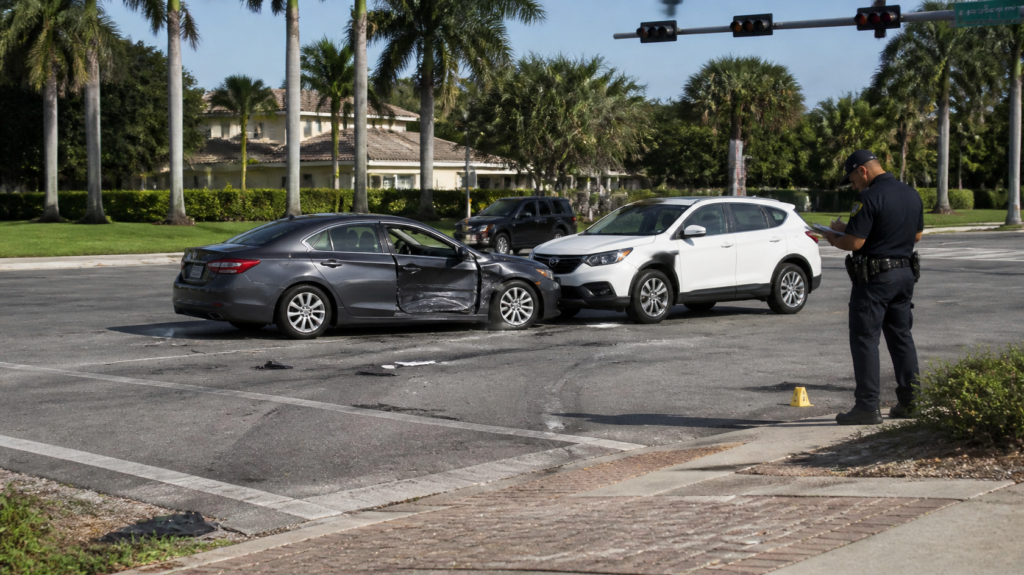
The driver whose car hit the side of yours is not automatically the one at fault. In a Florida T-bone accident, fault depends on who had the right-of-way, who broke a traffic rule, and whether either driver failed to use reasonable care. The point of impact is a clue, not a verdict. Plenty of side-impact crashes involve a driver who struck another car while lawfully crossing on a green light.
Who Is at Fault in a T-Bone Accident in Florida?
Fault usually falls on the driver who violated the right-of-way: by running a red light, ignoring a stop sign, or turning across oncoming traffic. But sometimes both drivers share responsibility, and that matters for any claim that follows.
Florida has no special statute for side-impact collisions. A T-bone, which police call an angle crash, is judged by ordinary negligence principles and the traffic rules for that intersection. Those rules tell you who was supposed to yield. The evidence tells you who actually did.
When a Driver Runs a Red Light
Under Florida Statute §316.075, a driver facing a red light must stop before entering the intersection and wait for a green signal. A driver who enters on red and strikes a car crossing on green is generally the one at fault.
The hard part is proof, because in many disputes both drivers insist the light was theirs. A green light also does not excuse a driver from watching for vehicles already in the intersection.
When a Driver Fails to Yield
Not every T-bone happens at a traffic light, and the rules change with the setup:
- Uncontrolled intersections (§316.121): A driver must yield to a vehicle that has already entered. If two arrive together, the driver on the left yields to the driver on the right.
- Stop signs and four-way stops (§316.123): The first to stop generally goes first. At a tie, the driver on the left yields.
- Left turns (§316.122): A turning driver must yield to oncoming vehicles within the intersection or close enough to be an immediate hazard.
- Driveways and private roads (§316.125): A driver pulling out of a shopping-center entrance, gas station, or apartment complex must yield to approaching traffic.
That last rule comes up often in Coral Springs, where many busy roads are lined with retail entrances. A crash at a plaza exit is a different legal question from one at a signalized corner, even though both leave the same kind of damage.
When Both Drivers Contribute
Having the right-of-way does not give a driver unlimited license. Florida’s careless driving statute, §316.1925, requires drivers to operate carefully given traffic and conditions. A driver speeding through a green light may share blame if a slower approach would have avoided the crash.
Searcy v. Zawackis, a 2011 decision from Florida’s Fourth District Court of Appeal, which covers Broward County, shows how this works. The case involved a fatal crash at a four-way stop after Hurricane Wilma knocked out the signals.
A truck driver stopped and began a left turn. A witness said she looked down for two to three seconds before entering, and a reconstruction expert testified that under that account she had not checked for approaching traffic. The court reversed summary judgment for the defendants because a jury could find her partly responsible, even though the other driver was accused of failing to stop and speeding.
The lesson is that right-of-way starts the analysis rather than ending it.
How Fault Is Proven After a Side-Impact Collision
Damage to a car’s door shows where it was hit, not who caused the crash. Investigators and attorneys rebuild the event from several kinds of evidence:
- Video. Traffic cameras, nearby business surveillance, and dashcams can show who entered first. An intersection camera does not guarantee usable footage, because some only monitor traffic without recording. Businesses often overwrite footage quickly, so ask early.
- Witnesses. Someone who saw both cars approach is more valuable than someone who only heard the impact. Independent witnesses carry real weight when both drivers claim the green.
- Signal records. Signal timing and controller data can help confirm the sequence of lights.
- Vehicle evidence. Reconstruction specialists study damage patterns, impact angles, skid marks, debris, and where the cars came to rest.
- Event data recorders. Many modern vehicles store data on the seconds around a crash, such as braking and speed, according to the National Highway Traffic Safety Administration. What is recorded varies by vehicle.
Does the Police Report Decide Who Is at Fault?
No. A crash report is a useful starting point that identifies the agency, vehicles, witnesses, and initial observations. It does not settle civil liability.
Under §316.066(4), statements people make to complete the required crash report generally cannot be used against them at trial, although they can still be explored in discovery, as the Second District Court of Appeal explained in Anderson v. Mitchell (2019). Courts also keep an officer’s opinion about who caused the crash away from juries. In Shaver v. Carpenter (2014), a jury blamed a turning driver 95% and a motorcyclist 5%, but the appeals court ordered a new trial because the trooper had been allowed to say who violated the right-of-way.
A missing citation or an inconclusive report does not close the door on a claim. The independent evidence does the heavy lifting.
Can Both Drivers Be Responsible for a T-Bone Accident?
Yes. Florida follows modified comparative negligence under §768.81. Your compensation is reduced by your percentage of fault. Suppose you suffer $100,000 in damages and a jury finds you 20% responsible. You could recover $80,000.
There is a hard cutoff, though. A person found more than 50% at fault for their own harm generally cannot recover damages in a negligence action. At 51%, the claim is typically barred. Because the percentage can decide the whole case, how fault gets argued matters. Insurers often try to shift some blame onto the other driver, even where the signal evidence points one way.
Common Injuries in Florida T-Bone Accidents
The side of a car has far less space between an occupant and the point of impact than the front or rear. That can mean significant force and intrusion into the passenger compartment, even with side-curtain airbags.
Injuries can include concussions and brain injuries, rib and chest injuries, shoulder and arm injuries, pelvic fractures, spinal injuries, and internal organ damage. Severity depends on vehicle size, speed, angle, restraint use, and seating position, so not every T-bone is catastrophic. Some symptoms also take hours or days to appear, which is why prompt medical evaluation is wise even if you feel fine at the scene.
T-Bone Accidents in Coral Springs and Broward County
Intersection crashes are a real part of the local picture. The Broward Metropolitan Planning Organization’s Regional Comprehensive Safety Action Plan reviewed fatal and serious-injury crashes on neighborhood streets from 2018 through 2022. It found Coral Springs had the highest share of such crashes happening at intersections among Broward municipalities: 50%.
That figure covers only severe neighborhood crashes, not all crashes in the city, and it does not single out any one intersection. Broward MPO’s county-wide review of crash records from 2017 to 2021 also found angle and left-turn crashes among the types linked to the most serious outcomes.
For local drivers, the takeaway is practical. Crashes on corridors like Sample Road and University Drive, or at plaza entrances, often turn on short-lived evidence such as a nearby store’s camera. Acting quickly to identify it can matter.
Contact Us
Coral Springs Office
9625 W. Sample Rd
Coral Springs, FL 33065
Tel: 954-866-HURT
(954-866-4878)
Fax: 954-334-1526
Frequently Asked Questions
Who is usually at fault in a T-bone accident in Florida?
The driver who violated the right-of-way, typically by running a red light, failing to yield at a sign, or turning across traffic. Fault can be shared.
Is the driver who hits the side of another car automatically at fault?
No. The striking driver may have been lawfully crossing on green when the other car entered against the signal.
What happens if both drivers claim they had a green light?
Fault comes down to evidence: video, independent witnesses, signal records, vehicle data, and reconstruction. A police report alone will not resolve it.
Can I recover compensation if I was partly at fault?
Yes, if you are 50% or less responsible. Your recovery is reduced by your share of fault. At more than 50%, recovery is generally barred. See the section on shared responsibility above.
Does a police report determine fault in a Florida car accident?
No. It is a starting point. Under §316.066 and case law such as Shaver, reports and officer opinions have limits at trial.
What evidence proves who caused a T-bone accident?
Video, witness accounts, signal timing records, vehicle damage patterns, event data recorder information, and expert reconstruction, often used together.
This article provides general information, not legal advice. Every collision is different; speak with a Florida attorney about your situation.