
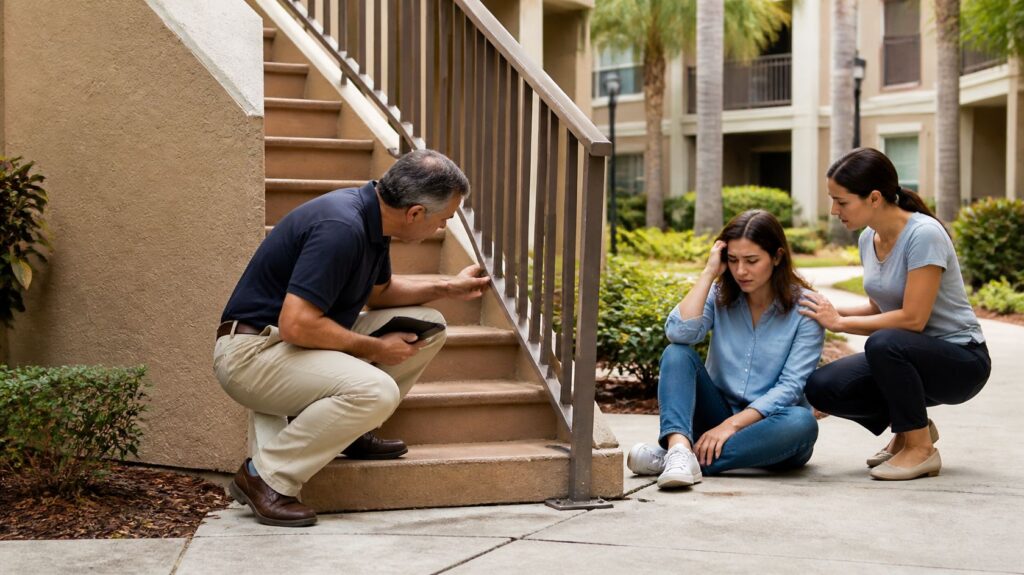
An apartment complex owner is not automatically liable for every injury on the property. Under Florida Statutes §83.51 and Florida premises liability law, responsibility depends on who controlled the area, whether management knew or should have known about the hazard, and whether that danger caused the injury. A resident who falls on a broken step and a guest who trips on a damaged sidewalk can face different legal questions even at the same complex.
Living in an apartment means sharing space with dozens or hundreds of neighbors. You rely on management to keep common areas safe and fix what breaks. When a loose handrail gives way or a walkway buckles, getting hurt is only half the headache. Figuring out who owes what is the other half.
Across Florida, Florida Health CHARTS recorded 659,876 emergency department visits for nonfatal unintentional falls in 2025 (an age-adjusted rate of 2,526.9 per 100,000 residents). In Broward County, that total reached 47,663 visits (2,210.3 per 100,000). Those numbers cover falls in all settings, not apartment complexes alone, and public records do not isolate apartment injuries in Coral Springs.
Common Injuries at Apartment Complexes
Apartment injuries happen both in shared spaces and inside individual units, and responsibility often turns on where the hazard sits.
- Stairways and entrances: Broken steps, loose handrails, dim lighting, worn stair treads, and damaged entryways create serious fall risks. A handrail that wobbles when you grab it is a clear sign of deferred upkeep.
- Walkways and hallways: Uneven pavement, loose tiles, raised concrete, debris, and standing water trip residents and visitors. See our personal injury types archive for more on falls and property hazards.
- Parking lots and garages: Potholes, cracked asphalt, poor lighting, damaged curbs, and worn pedestrian paths can cause falls. A crash involving a moving vehicle raises separate driving questions, though maintenance still matters.
- Other shared facilities: Elevators, laundry rooms, mail areas, and common rooms can all produce premises liability claims when poorly kept. Swimming pool injuries follow separate rules and belong in a dedicated pool guide.
- Inside an apartment: Faulty fixtures, structural defects, or ignored repair requests can hurt tenants right at home. If a broken fixture or product caused your harm, review our product malfunction law coverage.
When Is a Landlord Responsible for an Apartment Injury?
Under Florida Statutes §83.51(2), a landlord renting a dwelling other than a single-family home or duplex must make reasonable provisions for clean and safe common areas. That duty also covers rodent and pest control, garbage removal, and working plumbing, hot water, and heating, subject to statutory rules and lease terms.
The statute also addresses structural components and plumbing inside the rental dwelling. Even so, a maintenance flaw does not automatically prove liability. You still must connect the duty, the breach, and your injury.
Tenants have rules to follow too. Under Florida Statutes §83.52, tenants must keep their units clean, dispose of trash properly, care for plumbing fixtures they use, and operate appliances reasonably. A tenant’s own duties do not erase a landlord’s statutory duties for shared areas.
Can You Sue the Property Manager or Maintenance Company?
Yes, depending on what each party actually controlled and did. The name on the property deed rarely tells the full story at a multi-building complex.
- Property owner or landlord: May face liability for failing to maintain areas under its control or ignoring known hazards. Learn more about personal injury claims against property owners in Broward County.
- Property management company: May be liable when its contract and actions cover inspections, repairs, or maintenance and its own negligence causes harm.
- Maintenance contractor: May bear responsibility for shoddy repair work or careless upkeep within the scope of its job.
- Condominium or homeowners’ association: May control and maintain shared areas in associations or condo communities rather than a standard rental landlord.
Imagine a resident reports a wobbly handrail to the leasing office. Management logs the complaint but leaves the rail broken. Checking contracts, work orders, and control shows who owed what duty.
How Do You Prove the Apartment Complex Knew About the Hazard?
To prove a premises liability claim, you must show the complex had actual or constructive notice of the dangerous condition. Actual notice means management already knew about the hazard. Constructive notice means the hazard existed long enough that reasonable inspections should have caught it.
Helpful proof of notice includes:
- Maintenance requests submitted through a resident portal.
- Emails, text messages, or written complaints sent to management.
- Work orders, inspection logs, or past incident reports.
- Photos showing wear, age, or how long a condition lasted.
- Statements from neighbors or maintenance staff.
A cracked walkway ignored for months looks very different from a hazard that appeared moments before a fall. Lack of a written complaint does not automatically sink a claim if other proof shows the danger lasted long enough to be spotted through reasonable care.
What If You Slip and Fall at an Apartment Complex?
Slip and fall claims in Florida often turn on whether a hazard was a temporary spill or a lasting structural defect. Under Florida Statutes §768.0755, a claimant injured by a transitory foreign substance in a business establishment must prove actual or constructive knowledge of the substance. Constructive knowledge can be shown by how long the substance sat there or by regular recurrence.
Do not treat §768.0755 as a blanket rule for every fall at an apartment complex. Falling on a broken step, loose tile, or buckled walkway involves property maintenance rather than a temporary spill in a store.
Florida appellate decisions show how courts weigh these issues:
- Fierstos v. Cullum, 374 So. 2d 1057 (Fla. 4th DCA 1979): A tenant fell on a loose antenna wire on a dark shared staircase after reporting it to the landlord. The Fourth District reversed a judgment against the tenant and let the jury verdict stand.
- Godales v. Y.H. Investments, Inc., 630 So. 2d 675 (Fla. 3d DCA 1996): A child fell through a 17-inch guardrail gap where code required openings to reject a six-inch object. The Third District ruled the mother’s fault could not be imputed to reduce the child’s award.
- Mansur v. Eubanks, 401 So. 2d 1328 (Fla. 1981): The Florida Supreme Court addressed a landlord’s duty to inspect and repair before possession and a continuing duty to repair dangerous defects after notice.
- Perez v. Webb Realty Consultants, LLC (Fla. 2d DCA 2024): A tenant repeatedly reported loose entrance tiles. The Second District reversed summary judgment, holding that notice triggers a continuing repair duty that is not wiped out merely because the tenant knew about the tiles.
- Valdes v. Verona at Deering Bay, Inc. (Fla. 3d DCA 2024): A guest at a condo complex slipped on a dirty, partly dried puddle with footprints and smudges in a common storage room. The Third District reversed summary judgment because those details raised a fact issue on constructive notice.
Can a Building-Code Violation Support an Injury Claim?
Yes. Under Florida Statutes §553.84, a person harmed by a material violation of the Florida Building Code may have a statutory civil claim, subject to statutory rules and defenses. Code standards for stair rises, handrails, guardrails, and walkways can help show what safe construction looks like.
A code violation does not automatically prove every element of negligence on its own. Materiality, causation, and defenses still matter.
A Quick Note on Negligent Security
Criminal attacks like assaults or robberies raise separate negligent security questions. Under Florida Statutes §768.0706, qualifying multifamily properties can receive a presumption against liability for third-party crimes when they substantially implement listed security steps. That third-party crime rule does not defend against ordinary maintenance or fall claims.
What If the Apartment Complex Says You Were at Fault?
Under Florida Statutes §768.81, your damages in a covered negligence claim are reduced by your percentage of fault. If you are found more than 50% responsible for your own harm, you generally cannot recover damages.
Management may argue you ignored a warning sign or walked carelessly near a known hazard. Even if that lowers a recovery, it does not automatically wipe out a landlord’s duty to fix a reported danger, as Perez shows. Recoverable damages can include medical bills, future care, rehab, lost wages, lost earning capacity, pain and suffering, and permanent impairment. For questions on unpaid bills during a claim, see our personal injury medical expenses guide.
What Evidence Should You Preserve After an Apartment Injury?
Acting fast helps lock down facts before repairs or cleanups erase them.
- Photograph the exact hazard, lighting, and surrounding area.
- Report the injury to management in writing and keep a copy.
- Save past maintenance requests, emails, or portal messages.
- Get names and contact info for witnesses who saw the hazard earlier.
- Ask to preserve surveillance video right away, noting §768.0706 sets a 30-day retention rule for qualifying entry and exit cameras on covered properties.
- Keep medical bills and treatment notes.
- Write down the names of the owner, management firm, and any maintenance contractor.
Under Florida Statutes §95.11, Florida’s general deadline to file a negligence lawsuit is two years. Defective construction claims or government claims can involve different deadlines, statutes of repose, or notice rules.
Contact Us
Coral Springs Office
9625 W. Sample Rd
Coral Springs, FL 33065
Tel: 954-866-HURT
(954-866-4878)
Fax: 954-334-1526
Frequently Asked Questions
Can I sue my apartment complex if I fall in a common area?
Yes, if the owner or manager failed to maintain the common area with reasonable care and that failure caused your fall.
Is a landlord responsible for broken stairs?
A landlord can be responsible for broken common stairs or structural step defects under §83.51 and premises liability rules when notice and causation are shown.
Can I sue a property management company for an injury?
Yes, when the management company controlled or handled maintenance or repairs and its negligence contributed to the injury.
What if I reported the dangerous condition before the accident?
Prior reports help prove actual notice, and knowing a danger existed does not automatically erase a landlord’s repair duty.
Does Florida law make landlords responsible for all apartment injuries?
No. You still must prove duty, breach, causation, and damages based on the specific facts and location.
Speak With a Coral Springs Personal Injury Law Firm
Sorting out maintenance duties, notice records, and insurance pushback takes careful work after an apartment injury. When you work with a Coral Springs personal injury law firm, look for a team that digs into the facts early.
Reinfeld Cabrera Tison helps injured residents and visitors across Coral Springs and Broward County. Call (954) 866-4878 or reach out online to talk through what happened.