
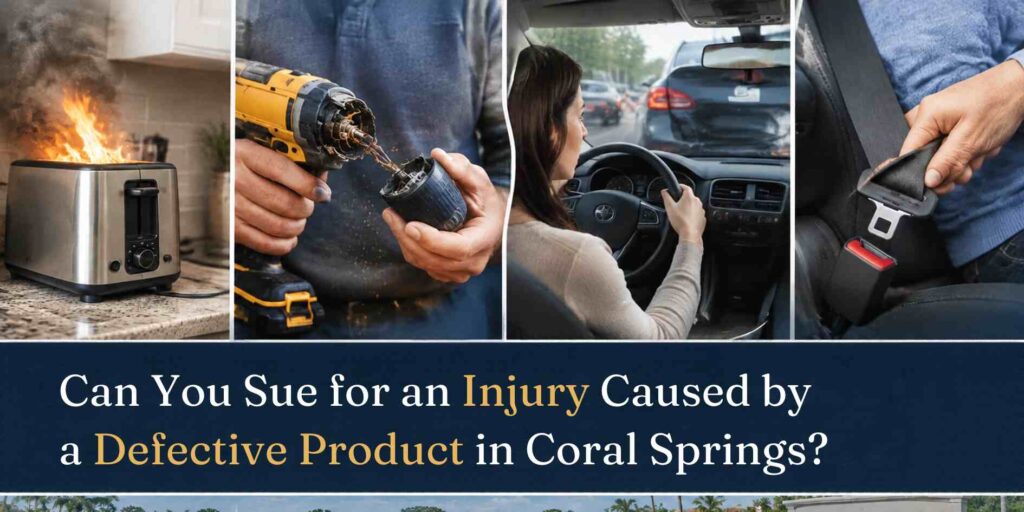
A household appliance catches fire while you’re using it normally. A power tool breaks apart in your hands. Your car’s brakes fail, or a seat belt comes loose during a collision. The injury may look like an accident, but the product itself could be part of the reason it happened.
Florida law allows injured consumers to pursue claims when a defective product causes harm. The difficult part is proving what went wrong. A manufacturer may argue that the product was damaged after purchase, that someone used it incorrectly, or that the injury would have happened anyway.
That is why product liability cases often begin with something surprisingly simple: the product itself. What remains of it may help explain the failure. Its model number may connect it to a recall. A seemingly insignificant component could reveal a manufacturing problem that affected thousands of units.
For someone injured in Coral Springs or elsewhere in Broward County, preserving that evidence can make a substantial difference.
Can you sue a manufacturer for an injury caused by a defective product in Florida?
Yes. Florida recognizes product liability claims against companies responsible for putting defective products into the stream of commerce. Depending on the circumstances, a claim may involve strict liability, negligence, breach of warranty, or another applicable legal theory.
In West v. Caterpillar Tractor Co., the Florida Supreme Court adopted strict product liability. The Court explained that the cost of injuries caused by defective products should generally fall on the makers who put those products into circulation, rather than on consumers who have little ability to protect themselves from hidden defects.
Strict liability matters because an injured person does not necessarily have to prove that a manufacturer was careless. The central issue is whether a defective and unreasonably dangerous product caused the injury. A separate negligence claim may focus on what the company knew or should have known, and whether it acted reasonably.
A claim still needs evidence. An injury occurring while someone uses a product does not automatically mean the product was defective. The product must have had a legally recognized defect, and that defect must have caused the harm.
What makes a product legally defective?
Florida product liability law generally recognizes three categories of defects. They can overlap, but each describes a different way a product can become dangerous.
1. Manufacturing defects
A manufacturing defect occurs when a particular unit differs from the manufacturer’s intended design. The design itself may be perfectly reasonable. Something went wrong while that particular product was being made or assembled.
Imagine buying a new pressure cooker. Its locking mechanism is supposed to hold the lid securely during operation. A faulty component slips through quality control, allowing the lid to release under pressure and cause burns.
The problem may affect only a small batch. Other pressure cookers from the same company may work exactly as intended. That does not make the defective unit any less dangerous.
Investigators may examine the failed component, production records, batch numbers, supplier information, and quality-control inspections. A manufacturing claim can become especially difficult when the damaged part has been discarded or replaced.
2. Design defects
A design defect is different. Here, the product was manufactured as intended, but the design itself creates an unreasonable danger.
Consider a power tool with a guard that does not adequately protect the operator from its cutting mechanism. Every unit may have the same design. The danger is built into the product rather than caused by an isolated assembly mistake.
Florida’s Supreme Court addressed design defects in Aubin v. Union Carbide Corp.. The Court reaffirmed the consumer-expectations approach to strict liability. A product may be defective if it fails to perform as safely as an ordinary consumer would expect when used as intended or in a reasonably foreseeable way.
The Court also recognized a risk-benefit approach. This examines whether the product’s risks outweigh the benefits of its design. A safer alternative design may help prove a case, but Florida law does not impose a universal requirement that every injured consumer produce one.
That distinction matters. A company cannot automatically escape a design-defect claim simply because the injured person cannot produce blueprints for a safer version of the product.
3. Failure to warn or provide adequate instructions
Some products carry risks that cannot be eliminated through design. That does not mean manufacturers can stay silent about them.
A product may be defective when its manufacturer fails to provide reasonable warnings or instructions about foreseeable dangers. The problem might involve an undisclosed chemical exposure risk, a medication interaction, an overheating battery, or a component that deteriorates during ordinary use.
A warning must do more than exist somewhere in the packaging. It must adequately communicate the relevant danger. A vague sentence buried in a manual may not tell consumers what they need to know.
A particularly useful Florida example comes from Suzuki Motor Corporation v. Winckler, decided by the Fifth District Court of Appeal in April 2026.
The case involved a 2007 Suzuki GSX-R1000 motorcycle. Its front brake system failed during a ride, and the resulting collision left the rider permanently paralyzed from the waist down. Suzuki had issued a safety recall concerning corrosion in the front brake master cylinder. The recall warned that the problem could reduce braking pressure and increase stopping distances.
After years of litigation and several trials, a jury found Suzuki negligent for failing to provide an adequate warning. The court upheld that result. Importantly, the jury had previously returned a defense verdict on the separate strict-liability design claim.
The case illustrates a point worth remembering: a product can raise a valid warning claim even when a separate design-defect claim fails. A manufacturer may have a continuing duty to warn about a foreseeable danger that develops during normal use.
The decision came from Florida’s Fifth District, so it is not a Fourth District ruling for Broward County. It is still a recent Florida appellate decision worth examining when a claim involves an allegedly inadequate warning.
Who can be held responsible for a defective product?
The manufacturer is an obvious place to start, but it may not be the only company involved. Depending on the product and the facts, potential defendants may include an importer, distributor, component manufacturer, or seller.
For example, a defective battery may have been manufactured by one company and installed in a device sold under another company’s brand. A dangerous component could have entered the product through a supplier. A seller may also face a claim under an applicable legal theory, depending on its role in the transaction and the circumstances of the defect.
This does not mean every store that sells a defective product automatically becomes liable. The legal basis for the claim matters, as does the company’s place in the product’s distribution chain.
Identifying the right parties can require tracing the product back through its model information, serial number, labels, packaging, and supply chain records.
What if a defective product made a car accident worse?
A product does not have to cause the original accident to create a product liability claim.
This distinction is especially important in vehicle cases. A driver may lose control because another vehicle runs a red light. The collision itself may be unavoidable, but a defective seat belt, airbag, roof, door latch, or other safety component could make the resulting injuries considerably worse.
These cases are often described as crashworthiness or enhanced-injury claims. The argument is that the vehicle or one of its components failed to protect its occupants as reasonably expected during the collision.
Florida law expressly recognizes this category. Under Florida Statute §768.81, a product liability action includes a claim that a defective product increased the injuries someone suffered in an accident.
This can create a more complicated investigation. The case may involve the driver who caused the collision as well as the manufacturer responsible for the defective safety component. The jury may have to consider how each party contributed to the injuries.
For example, a person in Broward County could suffer a collision caused by another driver’s negligence. If the vehicle’s roof collapses because of an alleged structural defect, the manufacturer may face a separate claim for the additional harm. The fact that another driver caused the crash does not automatically erase the product manufacturer’s potential responsibility.
What if the product simply malfunctioned during normal use?
You may not always know which internal component failed. Sometimes the product is destroyed in the incident. A fire can consume an appliance, a battery can rupture, or a machine can break apart before anyone has a chance to inspect it.
Florida law recognizes that circumstantial evidence may help establish a product defect.
In Cassisi v. Maytag Co., a clothes dryer caught fire during normal operation. The Florida appellate court recognized an evidentiary inference that may arise when a product malfunctions while being used normally. Under the right circumstances, the malfunction itself can support a finding that the product was defective.
That does not mean every broken appliance creates an automatic right to compensation. The circumstances still matter. Evidence that the product was used normally, had not been improperly repaired, and had not undergone a substantial change may be important.
The principle is useful because manufacturers often argue that an injured consumer cannot identify the precise component responsible for a failure. Cassisi recognizes that the absence of a perfect technical explanation does not necessarily end the case.
A 2026 Florida appellate record involving a Ford Mustang fire also discussed the Cassisi inference. The majority issued a per curiam affirmance without a written opinion, while a special concurrence discussed the existing doctrine. That concurrence should not be mistaken for a new binding rule. The established authority remains Cassisi.
Does a product have to be recalled before you can sue?
No. A recall is not a legal requirement for bringing a product liability claim.
A manufacturer may never issue a recall, even when a product has a dangerous defect. Some problems affect only a limited production run. Others emerge after years of use or become apparent only after investigators examine several similar incidents.
Still, recall information can be valuable. It may identify a known hazard, describe the affected models, explain the failure mechanism, or show that a manufacturer eventually took corrective action.
The Consumer Product Safety Commission’s recall database covers consumer products. For vehicles and vehicle equipment, the National Highway Traffic Safety Administration’s recall search is a useful starting point.
The scale of the problem is substantial. The CPSC estimated approximately 38.8 million medically treated consumer product-related injuries in 2024. That figure needs an important qualification: the injuries were associated with consumer products, but the agency does not claim that every injury was caused by a defective product.
Vehicle recalls offer another indication of how many safety problems can arise across the market. NHTSA reported 997 vehicle and equipment safety recalls in 2025, involving more than 29.2 million vehicles and related products. Those figures describe recalls, not proven product liability claims.
A recall can strengthen an investigation, but it does not settle the legal questions. The product involved in the injury must match the affected model or component, and the recalled condition must relate to the harm.
A recall can matter even when the injury happened years earlier
The Suzuki case is a good example. The motorcycle involved in the collision was manufactured in 2007. Suzuki issued its brake-related recall in 2013. The accident happened later that year.
The recall did not automatically establish liability. The evidence still had to connect the braking problem to the collision and support the warning claim. But it gave the litigation a significant piece of information about the danger.
A similar investigation may involve manufacturer service bulletins, warranty returns, consumer complaints, or reports of earlier failures. These records can help establish whether a company knew about a recurring problem.
Why should you keep the product after an injury?
Because the product may be the most important physical evidence in the entire case.
It is tempting to throw away a broken appliance or let a repair shop replace a damaged component. After an injury, most people want the mess gone. Understandably so. Unfortunately, disposing of the product can make it much harder to determine what happened.
Florida product liability litigation has dealt with this problem directly.
In Torres v. Matsushita Electric Corp., a homeowner claimed that a vacuum cleaner caught fire and caused injuries. The plaintiff’s expert examined the product, but it was destroyed before the manufacturer had an opportunity to inspect it. The court upheld dismissal based on the loss of critical evidence.
The missing vacuum prevented the manufacturer from examining possible modifications, misuse, maintenance issues, and the alleged cause of the fire. The case shows why preserving the product matters even when its destruction was accidental.
Florida courts do not impose the same sanction every time evidence disappears. The consequences depend on factors such as the circumstances of the loss and the prejudice caused to the other side. Dismissal is a serious outcome, not an automatic penalty.
The Florida Bar has published a detailed discussion of this issue in its article, “To the ‘Victim’ Go the Spoils: The Evolution and Operation of Spoliation of Evidence Law in Florida Product Liability Cases.”
The practical lesson is straightforward: do not discard, dismantle, repair, or return the product before considering whether it needs to be preserved as evidence.
What should you preserve?
If a product injures you, try to retain the actual item and any detached parts. Keep its packaging if available. Model numbers, serial numbers, lot codes, and manufacturing labels can help identify the exact product and determine whether it belongs to an affected production run.
Photographs and videos can also help document the product’s condition. Take pictures of the damaged area without attempting to recreate the failure. Keep receipts, manuals, warranty documents, and any messages exchanged with the seller or manufacturer.
If a repair is unavoidable, document the product’s condition before work begins. Ask that replaced components be retained. An inspection should be arranged with appropriate safeguards so the evidence is not altered or destroyed.
This is particularly important when the product is a vehicle, a machine, or an appliance with electrical or mechanical components. A qualified expert may need to examine the failed part and determine whether the damage resulted from a defect or another cause.
What evidence can reveal whether a manufacturer knew about a defect?
The product itself may show how the failure occurred. Other records can help explain whether the manufacturer had reason to anticipate the danger.
Some of the most useful evidence may be held by the company. It may not be publicly available before litigation, but it can become relevant during discovery.
For example, an investigation may examine:
- Earlier complaints and incidents: Reports from consumers who experienced the same failure may reveal a recurring problem.
- Warranty claims and returned products: Repeated repairs or returns involving the same component can point to a manufacturing or design issue.
- Engineering and safety tests: Stress tests, durability tests, electrical testing, and internal risk assessments may show what the company knew about the product’s weaknesses.
- Quality-control records: Production inspections and supplier records can help identify whether a defective batch or component entered the market.
- Internal safety discussions: Communications between engineers, quality teams, and management may reveal how the company evaluated a known risk.
- Recall assessments and service bulletins: These records can explain when a company identified a problem and what action it considered necessary.
A document showing that another consumer experienced a similar problem is not automatically proof that the same defect caused your injury. The product model must match, and the failure mechanism must be relevant. Still, a pattern of similar incidents can provide an important direction for the investigation.
There is also a difference between information that is publicly available and information that must be obtained through litigation. A company is unlikely to publish its internal failure analysis or engineering discussions on its website.
Where can you look for public safety reports?
Several government databases can help identify known product hazards.
The CPSC’s NEISS injury data provides information about injuries treated in a nationally representative sample of hospital emergency departments. Researchers can examine product categories and incident descriptions. The data can help identify patterns, but it does not establish that a particular product was defective.
For vehicles, NHTSA maintains recall information and other safety datasets. These include consumer complaints, investigations, manufacturer communications, and recall records.
Medical devices require a separate approach. The FDA’s MAUDE database contains reports of adverse events involving medical devices. It can help identify reported problems, but the FDA warns that these reports cannot reliably establish how often an event occurs or prove that a device caused a particular injury. Reports may be incomplete or unverified.
Medical-device cases can also involve federal preemption issues. Those claims may require a different legal analysis from an ordinary household product case.
What defenses might a manufacturer raise?
Manufacturers rarely accept that a product was defective without examining other possible explanations. Their defenses often focus on how the product was used and what happened to it after leaving the factory.
Misuse or improper maintenance
A company may argue that someone used the product in a way that was not intended or reasonably foreseeable. It may also claim that the product was improperly repaired or modified.
Those arguments need to be examined against the actual circumstances. A manufacturer cannot automatically avoid responsibility because a consumer used a product in a way that was reasonably foreseeable.
Maintenance records can be important here. So can photographs showing the product’s condition before the incident. Manuals and marketing materials may also help establish how the company expected people to use the product.
The product was altered after purchase
A manufacturer may argue that a later modification caused the failure. This can become relevant when someone replaces a component, changes an electrical connection, or modifies a safety mechanism.
Florida’s product liability jury instructions address whether a product underwent a substantial change that affected its condition. The details matter. A repair that had nothing to do with the failure does not necessarily defeat a claim.
The danger was obvious
Some products carry risks that are apparent to ordinary users. A manufacturer may argue that a warning was unnecessary because the danger was obvious.
In Rodriguez v. New Holland North America, a Florida appellate court considered a loader’s open and obvious danger. The facts supported a defense based on the user’s understanding of the risk.
That does not mean every visible danger excuses a manufacturer. A consumer may understand that a saw blade is sharp without expecting its protective guard to detach during normal operation. The question is whether the danger that caused the injury was actually apparent.
The product complied with government safety standards
Florida Statute §768.1256 creates a rebuttable presumption in certain product liability cases when the specific aspect of a product that allegedly caused the injury complied with relevant mandatory government codes or standards designed to prevent that type of harm.
The details are important. A voluntary certification or a general statement that a product meets industry standards does not automatically qualify. The statutory defense concerns applicable requirements that are mandatory and intended to prevent the harm involved.
The reverse can also matter. Failure to comply with a relevant mandatory safety requirement may create a rebuttable presumption that the product was defective or unreasonably dangerous.
The design reflected the knowledge available at the time
Under Florida Statute §768.1257, a design-defect case considers the scientific and technical knowledge available when the product was manufactured.
A company is not judged solely by what engineers discovered years later. The relevant question concerns the knowledge and circumstances that existed at the time of manufacture.
This makes historical evidence important. An investigation may need to examine older technical standards, engineering publications, testing records, and earlier versions of the product.
The injured person contributed to the harm
Florida’s comparative-fault law can affect the amount someone recovers. Under Florida Statute §768.81, a claimant found more than 50% responsible for their own harm is generally barred from recovering damages in a negligence action. Product liability actions are expressly included within the statute’s definition.
Enhanced-injury cases have an additional wrinkle. When a defective product allegedly made injuries worse during an accident, the jury must consider the fault of all persons who contributed to the accident when allocating responsibility.
This means a manufacturer may argue that the driver who caused a collision contributed to the injuries. The claimant may still have a separate argument that a defective vehicle component increased the harm.
How long do you have to file a defective product injury claim in Florida?
Florida generally allows four years to bring an action for injury based on the design, manufacture, distribution, or sale of personal property that is not permanently incorporated into an improvement to real property. The deadline appears in Florida Statute §95.11(3)(d).
For product liability claims, §95.031(2) provides that the limitations period runs from when the facts giving rise to the claim were discovered, or should have been discovered through reasonable diligence.
There is another deadline to consider: Florida’s statute of repose. For most products with an expected useful life of 10 years or less, a claim generally cannot be brought when the harm results from exposure to or use of the product more than 12 years after its first delivery to a qualifying purchaser.
The law contains exceptions. Certain aircraft, large vessels, railroad equipment, and improvements to real property receive different treatment. A manufacturer’s express warranty of a longer useful life can also affect the calculation.
The statute further addresses situations involving delayed injuries and active concealment of a defect. These exceptions have specific requirements. A concealment claim, for example, requires substantial factual and legal support showing actual knowledge by certain company officials and affirmative steps to hide the defect.
The important point is that the four-year period does not tell the whole story. A product’s age can create a separate legal problem, even when someone discovers the injury much later. Anyone considering a claim should have both deadlines examined promptly.
What should you do after a product causes an injury in Coral Springs?
If a product injures you, seek medical attention first. Once the immediate situation is under control, try to preserve the evidence before anyone repairs or disposes of the item.
Keep the product and any detached pieces. Photograph the model and serial number. Save the packaging and instruction manual if you still have them. Write down what happened while the details are fresh, including how the product was being used and whether it had been repaired before.
If the product is still under warranty, be cautious about sending it back without documenting its condition. A manufacturer may request the item for inspection or replacement. That request should be considered carefully when the product may be evidence in a legal claim.
For a serious injury in Coral Springs or elsewhere in Broward County, a product liability attorney can assess whether the facts support a claim. That investigation may involve reviewing the product’s history, identifying the companies responsible for its distribution, and arranging an expert inspection.
At Reinfeld, Cabrera & Tison, product liability matters fall within the firm’s personal injury practice. The central questions are what failed, why it failed, and whether that failure caused the injury.
A product should not be treated as defective simply because it broke. But when an item causes serious harm during normal or reasonably foreseeable use, the circumstances deserve a closer examination.
Contact Us
Coral Springs Office
9625 W. Sample Rd
Coral Springs, FL 33065
Tel: 954-866-HURT
(954-866-4878)
Fax: 954-334-1526
Frequently asked questions about defective product injuries in Florida
Can I sue if a product injured someone in my family rather than me?
Potentially, yes. Florida strict liability can extend beyond the person who purchased or used the product to foreseeable bystanders. The exact claim depends on the injured person’s relationship to the incident and the type of damages involved.
Can I sue if the product was secondhand?
Possibly. Buying a product used does not automatically eliminate a product liability claim. Its age, condition, repair history, and any substantial changes after manufacture may become important. Florida’s statute of repose can also create a deadline based on the product’s first delivery to a qualifying purchaser.
Do I need to prove that the manufacturer knew the product was dangerous?
Not necessarily. A strict liability claim does not require proof that the manufacturer knew about the defect. Evidence of prior complaints or internal safety discussions may still be important to a negligence or failure-to-warn theory.
What if the manufacturer has already recalled the product?
A recall may provide useful evidence, especially when it identifies the same model or component involved in the injury. It does not automatically establish that the recalled defect caused the incident. The product and the failure still need to be connected to the claim.
Can I bring a claim if the product was destroyed in a fire or explosion?
Potentially. Florida’s Cassisi doctrine recognizes that a malfunction during normal operation may support an inference of defect under appropriate circumstances. The remaining evidence becomes especially important, including photographs, witness accounts, maintenance history, and any surviving components. The loss of the product can also create serious evidence-preservation issues.
Can I sue if a defective car part made my injuries worse?
Yes, potentially. Florida recognizes product liability claims involving enhanced injuries. A defective seat belt, airbag, roof, or other safety component may create a separate claim when it increases the harm suffered in a collision.
Does a product liability claim require an expert witness?
Many cases require expert analysis, particularly when the alleged defect involves engineering, electronics, vehicle safety, or product materials. The expert may need to examine the product and explain how the failure occurred. Florida’s evidence rules require expert testimony to meet the reliability standards in §90.702.
Where can I check whether a product has been recalled?
The CPSC maintains a recall database for consumer products at CPSC.gov/Recalls. Vehicle owners can search for open recalls through NHTSA.gov/Recalls. A product that does not appear in either database may still be defective.